Gloucester 250th Anniversary Memorial Arch, 1892

For the celebration of its 250th anniversary in 1892, Gloucester erected this memorial arch adjacent to the former town hall, now the American Legion building, on Washington St. The original plan called for two such arches, one on Dale Avenue and another on Western Ave. just beyond the Cut bridge. This was the design originally planned for Western Ave. When the plan was eventually scaled back to just one arch, it was thought best to locate it on Washington St.

Front and rear views of the arch.

The arch was constructed of wood and covered with cloth that was painted to look as if it was made of granite. The lettering was painted to appear as if it was cut into granite. The two Thacher’s Island lighthouses on the top of the arch were illuminated with electric lights.

On the opposite side of the arch from what you see in this postcard, one column was dated 1642 (for the year the city was incorporated) and the other was dated 1892, the 250th anniversary. The 1642 column had this inscription: “Her rocky shores reveal the world’s deep laid foundations.” The 1892 column said: “The road to fortune is paved with her granite.”

The arch was taken down soon after the anniversary celebration.

This postcard is postmarked 1913. It was printed between 1908 and 1913 by the Curt Teich postcard company in Chicago, on behalf of publisher Edwin C. McIntire of Gloucester. It was printed using a process called C.T. Photochrom, which created color prints from black and white negatives. It is fair to assume that the card is based on an 1892 photograph adapted for this purpose.
Posted in Uncategorized | Tagged , | 2 Comments

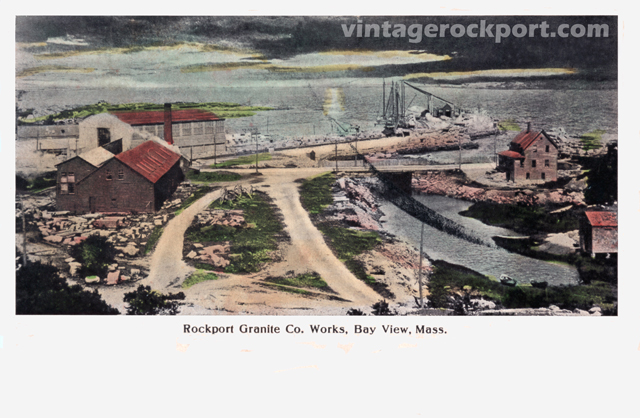
Rockport Granite Co. Works, Bay View, Mass., c. 1906

We are straying across the border from Rockport into Gloucester for this old view of the Rockport Granite Company’s wharves in Bay View. The site pictured here was in the news just this week, with the Gloucester Times reporting that it is about to become the new home of the Large Pelagics Research Laboratory, a facility dedicated to the study of bluefin tuna and other long-distance marine travelers.

I previously posted a view of Rockport Granite’s wharf in Rockport, at what is now called Granite Pier. The Bay View operation served the company’s quarries in Lanesville.

This postcard is postmarked 1906. There is a small logo that may identify its publisher, but I do not recognize it.

Posted in Uncategorized | Tagged | 11 Comments

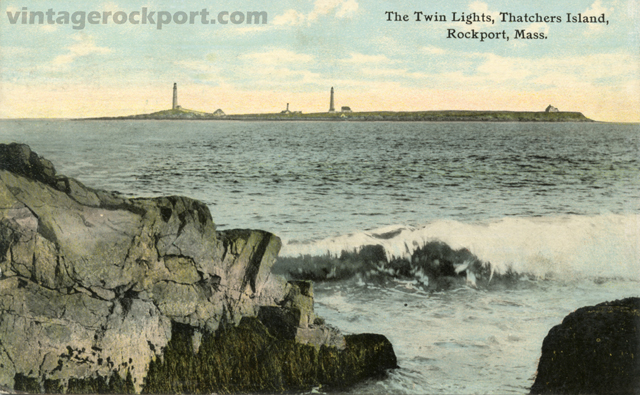
The Twin Lights, Thatchers Island, Rockport, Mass., c. 1910

Here is a view of the Twin Lights on Thacher Island, taken from the Rockport shoreline. The postcard is postmarked 1911, so the picture is likely to be at least a year older, if not even more. The postcard was published by Edwin C. McIntire, Gloucester, Mass.

For more about the history of Thacher Island and how it got its name, see my earlier post. Many postcards from the early 1900s spell the name with a “t”, as does this one. But the man for whom the island was named was Anthony Thacher — no “t” — and that is how the island’s name is referenced by the organization that helps maintain it, the Thacher Island Association.

Posted in Uncategorized | Tagged , , | 1 Comment

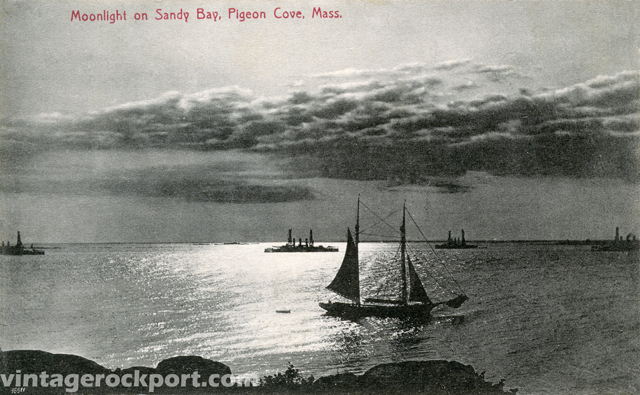
Moonlight on Sandy Bay, Pigeon Cove, Mass., circa 1910

In honor of this week’s “supermoon,” here is a postcard of the moon over Sandy Bay from around 1910. The image is quite dramatic, with the fishing schooner in the foreground set off by the U.S. Navy warships in the background, all framed by an ominous dark cloud.

Compare this image with this other one showing the sunrise over the warships in Sandy Bay.

Although this card is postmarked, the stamp has been removed and, with it, the date. It is from the 1907 to 1914 era, so I am estimating it to be about 1910. The card was published by Rockport Photo Bureau and printed in Germany.

Posted in Uncategorized | Tagged , | 2 Comments

Steel Derrick Quarry, as an Active Quarry Circa 1910

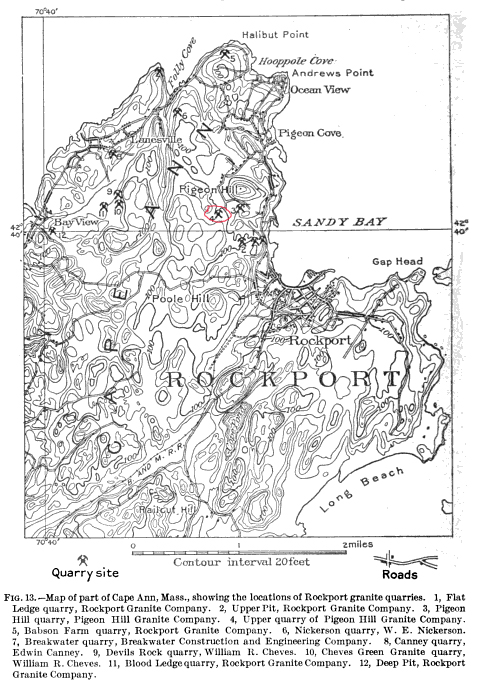
Today, Steel Derrick Quarry is a popular swimming spot for locals. At the time this picture was taken, it was an active granite quarry, one of two owned by the Pigeon Hill Granite Co. Founded in 1870, Pigeon Hill was Rockport’s second-largest granite company, second to Rockport Granite Company. (Earlier posts here have shown Rockport Granite’s Old Stone Bridge, its wharf and its quarry.) Stone from this particular quarry, known at the time as Pigeon Hill’s “upper pit,” was used in construction of the Longfellow Bridge between Boston and Cambridge.

I will confess, I am not 100% positive this is Steel Derrick. If there are any quarry experts out there reading this, your help would be appreciated. Everything I’ve read about the upper pit quarry seems to place it right about at the location of Steel Derrick. Added to that, I came across this 1907 map of Rockport’s quarries drawn by the U.S. Geological Survey. I’ve drawn a red circle around the upper pit quarry. Comparing this to a Google map view of Steel Derrick, it appears to be an exact match.

I am also guessing at the date of this postcard. I can say with certainty that it was from somewhere between 1907 to 1913. No publisher is identified but the backside indicates that the card was printed in Germany.

Posted in Uncategorized | Tagged , , | 13 Comments

Main Street, East from Post Office, Rockport, Mass., c. 1915

Compare this view of Main Street — which I estimate to be 1915 — with this one from 1911 and this one from 1920, all from more or less the same angle. Also compare it with this one from 1906 looking in the opposite direction and this one from 1911 of Memorial Hall near where these were taken.

In the one above, the brick building to the left has a sign that identifies it as Rockport National Bank — pretty much across the street from where it is now. In the 1920 card, the same building is the third down on the left.

Neither this card nor the 1920 card was dated (the other two were). I estimated the date of the 1920 card based on the appearance of the cars. The more I look at cars from that era, the more I realize that the car in that picture could have been made anywhere from 1910 to 1920.

The picture above provides an additional clue. I can just make out the license plate. It is white lettering on a dark background. It appears that “Mass.” is imprinted vertically to the left side of the plate, followed by the numbers “8677.”

Much to my surprise, the Registry of Motor Vehicles has a web page devoted to the history of Massachusetts license plates. Unfortunately, none of the plates pictured or described there matches this one. Further searching on Google, led me to eBay, where — who knew? — there is an ample market in antique license plates. Even there, I could not find an exact match. But putting information from the RMV site together with clues from the eBay images, it seems safe to date this license plate at around 1914 or 1915.

This card was published by Thomson & Thomson, Boston, Mass. It was printed in France.

Posted in Uncategorized | Tagged | Leave a comment

The Rocky Shores in 1910, When it Was a Private Estate

If this grand estate looks familiar to you, it is because it still stands on Eden Road, where it is now known as the Rocky Shores Manor. At the time of this photo, which was around 1910, the estate was called Widcombe-by-the-Sea and was the summer home of Francis Smith of San Antonio, Texas. Note the view of the Twin Lights in the background.

Smith bought the property — some 80,000 square feet of land — in 1909 from Arthur Lyman. The sale was reported in the Boston Evening Transcript on Oct. 2, 1909, where the item noted, “It is believed that Mr. Smith will erect a dwelling house on the property.” Some dwelling house!

Four years later, on June 30, 1913, the Boston Evening Transcript had this item:

Mrs. Francis Smith Routledge of San Antonio, Tex., is spending the summer at Rockport, Cape Ann, where Mr. and Mrs. Francis Smith, also of San Antonio, are at their summer cottage, “Widcombe-by-the-Sea,” for the season.

As for where Francis Smith got the money to build such a grand home, it appears he had been the head of a San Antonio investment firm. I found this reference which says that, in 1883, Smith and a partner founded the investment firm Francis Smith, Caldwell and Company. The firm acted “as a financial liaison between Texas farmers and ranchers seeking money to expand their land and agriculture operations, and British and Scottish financiers who had money to lend and were looking for greater returns on their investments than European markets could.”  Later, Smith and his lawyer, Henry Patrick Drought, bought out his first partner’s interest in the firm and renamed it Francis Smith and Co. In 1900, Smith retired and the company was renamed H.P. Drought and Company.

This appears to be a real-photo postcard, suggesting Smith himself had it made.

Posted in Uncategorized | Tagged , , | 5 Comments

Pigeon Hill: A View ‘Excelled Nowhere’ on the New England Coast, circa 1915

Unfortunately, the view that an author once described as “excelled nowhere on the New England coast” can no longer be seen. The summit of Pigeon Hill, the highest point in Rockport, is overgrown with vegetation that obstructs what was once a panoramic view in virtually every direction.

That description of the view came from Henry C. Leonard in his 1873 book, Pigeon Cove and Vicinity. Here is what he said:

[T]he prospect from Pigeon Hill is excelled nowhere on the New England coast. On this height, the eye takes in a portion of Massachusetts Bay; Sandy Bay, between the horns of the Cape; the broad offing of the ocean; Ipswich Bay, and the long coast of hills, headlands, and beaches from the Chebacco River to Agamenticus; and the Buttercups, dark blue hills near the ancient town of York, in Maine. Other objects belong to this prospect: on the right hand, the village of Rockport; farther toward Gap Head, Norwood’s Head; Gap Head and Straitsmouth Island; and southward from these points, Thatcher’s Island and Milk Island; in front, three miles from the base of the hill, the Salvages, bare, savage rocks, with heads just lifted above the water, wearing a fitting name, albeit as it was anciently spelled and written; around the foot of the hill, the beginning of the village of Pigeon Cove as it is approached from Rockport; on the left hand, close to the foot of the hill, Pigeon Cove Harbor, with its breakwater, wharves and shipping, and its collection of buildings; the post-office, several stores, a few stone-workers’ sheds, groups of fish-houses, and a score of dwellings; farther northward, on ascending ground, the continuation of the village, comprising the comely church and the spacious and pleasant summer hotels and boarding-houses; farther still, northward, Andrews’ Point, the northern termination of the Cape, partly clad with hardy oaks, walnuts and pines, and laid out with winding avenues and gravelled walks, like a park; besides, more than a score of miles from Andrews’ Point, the Isles of Shoals; then far away on the main land, the villages of Essex and Ipswich; Indian Hill, in Newbury; Powow Hill, in Amesbury; and Newburyport, on the Merrimack. Thus are pointed out some of the grander general outlines, and some of the finer marks and dots of the prospect from Pigeon Hill, as seen by the observer on this height in the present day.

According to a 2005 state government report, the Sandy Bay Historical Society, which owns part of Pigeon Hill, “is interested in re-establishing the historic views from the hill.” I do not know whether anything more has come of that idea.

This postcard was published by the Rockport Photo Bureau. I am not sure of the date, but I read somewhere that the Hotel Edward did not get that name until 1913, so I am estimating this to be around 1915.

Posted in Uncategorized | Tagged , , | 4 Comments

George J. Tarr School, Rockport, Mass., circa 1910

In 1882, fire swept through the Annisquam Cotton Mill, which had operated since 1847 on a site bordered by Main Street and Broadway in Rockport. Remarkably, although the fire destroyed the mill, the ruins remained standing there for another 22 years, until, in 1904, they were finally removed.

Ruins of the Annisquam Cotton Mill.

The fire spared one mill building, the machine shop, built in 1864. In 1904, the then-owner of the former machine shop, George J. Tarr, deeded the property to the town of Rockport. As the Boston Daily Globe reported on Nov. 28, 1904:

[The building]is to be converted into a modern school building, with tasteful exterior and interior arrangements, so planned as to yield the best results both as to convenience and sanitation. It will be called the George J. Farr (sic) school, in honor of the public-spirited citizen whose generosity has made it possible.

Architect's rendering of the new school.

Along with the building, Tarr also donated to the town the remainder of the land on which the mill stood, which consisted of “several acres, bounded by three streets, and facing down the harbor, … to be used for park or other purposes at the discretion of and for the benefit of the town.”

Today, this former machine shop and former school building has a new use, as the town’s library. In this postcard, to the right of the building, you can see how the property reached down to the harbor, clear from the school to Main St.

Two buildings from the former mill housing also still stand on Broadway, just up the street from T-Wharf, where they are now condominiums.

This card has no date and lists no publisher. I am guess-timating that it is from around 1910.

Posted in Uncategorized | Tagged | 4 Comments

Long Beach, Cape Ann, Mass., 1905

Here is a beautiful, colorized 1905 view of Long Beach, looking much the same as it does today, except for the Victorian-era attire on the people strolling along the beach. One other difference is that the concrete retaining wall that now separates the cottages from the beach had not yet been built at the time of this photo. Instead, it appears that a slight dune is all that stands between the cottages and the shore.

Just two years after this photo was taken, a fire swept through the cottages at Long Beach, destroying 13 of the 56 cottages. According to the Boston Daily Globe, the Nov. 18, 1907, fire was suspected to have started by a stray spark left in a cottage that had been closed up for the season.

The Globe story illustrates the antiquated state of fire fighting at the turn of the century:

It was impossible to fight the fire other than by a bucket brigade, with water from the wells near there. A telephone message was also sent to Chief Crowe of Gloucester, and he sent down a carload of men on the Long Beach line with axes and hand extinguishers.

By this time, the fire had leisurely eaten up 12 cottages, and had reached Sea Breeze cottage, on the eastern end, … when the force of men with buckets and wet blankets, axes, etc, were sufficient to stay it.

In case you missed that, let me restate it: Firefighters from Gloucester came to the scene by taking a trolley. Imagine if firefighters today responded to alarms via public transportation.

This postcard shows a 1905 copyright on the front and bears a Oct. 19, 1905, postmark on the reverse. It was published by The Rotograph Co. of New York City.

Posted in Uncategorized | Tagged , | 1 Comment