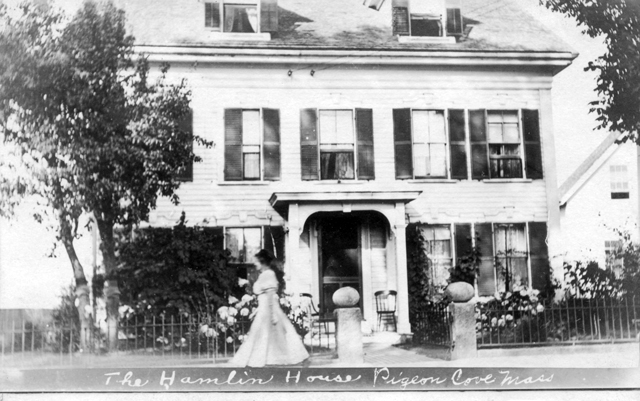
The Hamlin House, Pigeon Cove, Mass., circa 1910

[Note: I have new information about this house in a later post.]

Here is a real-photo postcard identified as The Hamlin House in Pigeon Cove. This house still stands, as you can see from the picture below. The  address is 163 Granite St. It is two houses away from the Pigeon Cove Post Office.
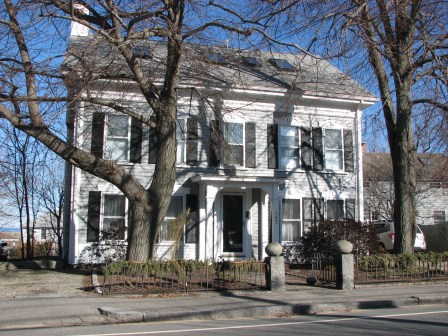
The Hamlin House today.

My research has turned up nothing about the Hamlin House or about anyone named Hamlin who lived in Pigeon Cove. If any readers have any information, please share it.

The house today has a historical plaque that identifies it as the Samuel Wheeler House, built in 1792. I did find a reference to a Samuel Wheeler of Rockport who died in 1849 at age 90. There were Wheelers among the earliest settlers of Pigeon Cove. As a matter of fact, prior to 1750, there were only nine houses in Pigeon Cove, two of them occupied by Wheelers.
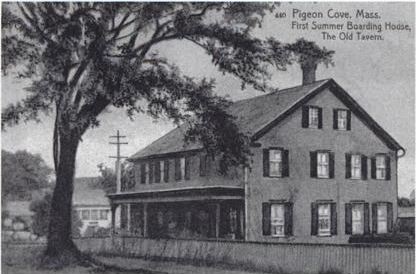
The Wheeler Tavern, a few doors down from the house.

There was a popular tavern close to this location known as the Wheeler Tavern. I believe the building immediately to the left of the Pigeon Cove Post Office is the old Wheeler Tavern. It was started by Capt. Daniel Wheeler (the man who first built a wharf in Pigeon Cove harbor in 1825) and then run by William Norwood Jr., who later relocated the tavern to a location approximately where the Emerson Inn now stands.

Note the woman walking by in her ground-length dress. I have little to go on in dating this photo, but judging by her dress and the markings on the reverse side, I estimate it to be from around 1910.

Posted in Uncategorized | Tagged | 4 Comments

Front Beach, Rockport, Mass., 1905

Here is a beautiful view of Front Beach in Rockport published by the Rotograph Co. in 1905. Except for the absence of the gazebo that now stands on the rocks in the upper left of the picture, this scene is virtually unchanged today.

On close examination of the actual postcard, you can see a few details not readily visible on the scan above. It looks as if you can see the wooden masts of a derrick at Knowlton’s Point (now known as Rowe Point), just above the tip of the rock jetty in the upper left. The derrick would have been used to load granite onto schooners from the pier there.

Also visible in the approximate location of Granite Pier (about center in the picture) are the masts of schooners, no doubt docked to take loads from the Rockport Granite Co.

Posted in Uncategorized | Tagged , | Leave a comment

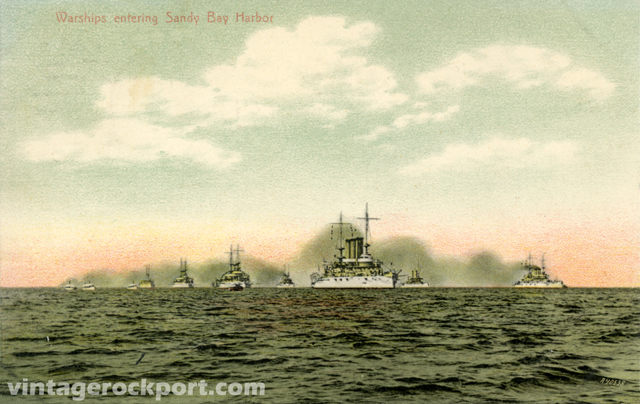
Warships Entering Sandy Bay Harbor, Rockport, Mass., c. 1907

I’ve written several times here about the regular summer visits to Rockport of the North Atlantic squadron and of the to-do its arrival caused among the townspeople. While I’ve seen various photos of the fleet anchored off Rockport, I’ve never seen one that so dramatically conveys the excitement its arrival must have caused. The sight of these warships powering into Sandy Bay must have been something to see.

A July 14, 1906, Boston Daily Globe article gives a taste of this. Headlined, “Rockporters Agog Over Coming of Admiral Evans’ Fleet,” the article began:

All is in readiness for the event to which the townspeople have looked eagerly forward for the past eight weeks, the coming of the North Atlantic squadron to Rockport for its summer headquarters and evolutions. The fleet will remain here during July and August for practice and evolutions, making an occasional visit to other places along the New England coast, then returning to its base.

Sixteen of Uncle Sam’s mightiest floating machines of war, the largest number ever assembled on this coast, it is expected, will be at anchor within this magnificent roadstead, under command of that doughty sea fighter, Rear Admiral Robley D. Evans.

The name of the publisher is obscured on this postcard. It bears a Gloucester postmark of Aug. 27, 1907. Since it is unlikely that the picture was taken during the fleet’s 1907 visit, it could well show the very 1906 arrival discussed in the above news article.

Posted in Uncategorized | Tagged | 1 Comment

The Witch House in Winter, Pigeon Cove, Mass., circa 1920

In honor of today’s snow, here is a nice winter view of the building known as the Witch House. The house has long been a source of fascination and was the subject of many early 20th Century postcards. (I have previously posted two others, here and here.)

The name of the house derives from the Salem witchcraft trials. In 1692, John and Elizabeth Procter were convicted of witchcraft and sentenced to die. John was hanged but Elizabeth, who was pregnant, was let go on the condition that she leave Salem. Her two sons brought her to this house, giving it the name.

No one knows for certain whether that is true. Some say the house was built much earlier, as a garrison to protect woodcutters and fishermen against Indian raids. Historical documents from 1676 describe two such houses in Pigeon Cove. The other side of this house, not visible in this picture, has a garrison-style overhang on the second floor. Reportedly, the overhang originally existed on all four sides. In further support of this theory, the house was long referred to not as the Witch House, but as the Garrison House.

Starting around 1704, Joshua Norwood and his family lived in this house. This is the same man who also owned the property occupied by The Old Castle and who may have constructed the original structure there. Norwood lived here until somewhere between 1732 and 1740, when he resettled at Gap Cove near Straitsmouth Point. I have read that the house Norwood built when he moved to Gap Cove is the one that now stands at the corner of Atlantic Ave. and Mt. Pleasant St., where it was later moved. Norwood was the man who first cut mooring stones out of granite, starting around 1710. You can see an example of one in the front yard of The Mooring Stone inn on Norwood Ave.

Another resident of the Witch House was Joseph Babson, the man who later operated the Babson Farm quarry at Halibut Point.

This European plant was found growing on the property.

Here is an interesting footnote about this house. This house was mentioned in an 1876 issue of The American Naturalist magazine because of an unusual plant found there. The plant, the sedum reflexum or Blue Stonecrop, was native to Europe but rarely seen in the U.S. The article said that the plant appeared to have been cultivated on the property before going wild. Someone remembered having seen the plant there 60 years earlier, the article said. Someone had also planted some of it at the cemetery at Folly Cove, it said.

This postcard was published by the Rockport Photo Bureau. There is a blurred postmark on it that appears to say 1920.

Posted in Uncategorized | Tagged , , , | 12 Comments

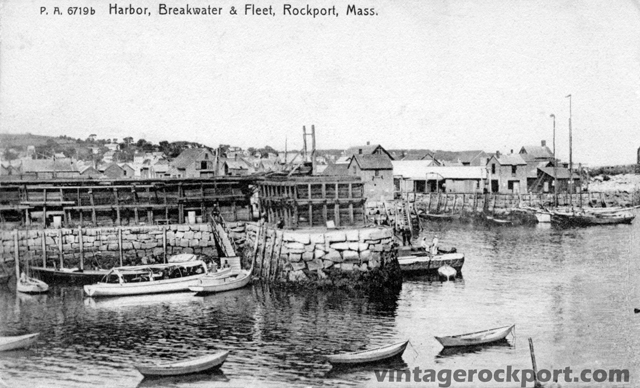
Harbor, Breakwater & Fleet, Rockport, Mass., circa 1906


Here is a circa 1906 view of T-Wharf and Motif No. 1 beyond it. The wooden structure on T-Wharf is the coal pocket where coal was stored. It was later replaced by a cold storage building.

T-Wharf was built in 1869 and was long known as Central Wharf. It seems the name changed gradually, not all at once. I found an 1885 Rockport business directory that listed a business located on “T Wharf.” But I’ve also seen maps from that same year that showed it as Central Wharf. 

In this picture, on the dock at the end of T-Wharf, there appear to be two sailors in white uniforms, possibly waiting for a shuttle to take them back to the warships that regularly anchored off Rockport in late summer.

This postcard was published by The Rotograph Co., New York City, and printed in Germany. It bears a 1907 postmark but has an undivided back, which suggests it was printed prior to 1907, the year postal laws changed to allow divided backs.

Posted in Uncategorized | Tagged , , , | 1 Comment

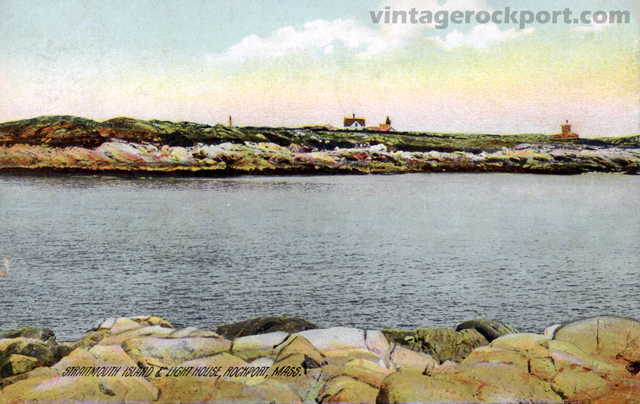
Straitsmouth Island & Lighthouse, Rockport, Mass., circa 1909

This view of Straitsmouth Island and the Straitsmouth Lighthouse bears a postmark of Jan. 6, 1910. The postcard was published by The Rotograph Co., New York City.

Compare this view of Straitsmouth Island with this one and this one.

Posted in Uncategorized | Tagged , | 1 Comment

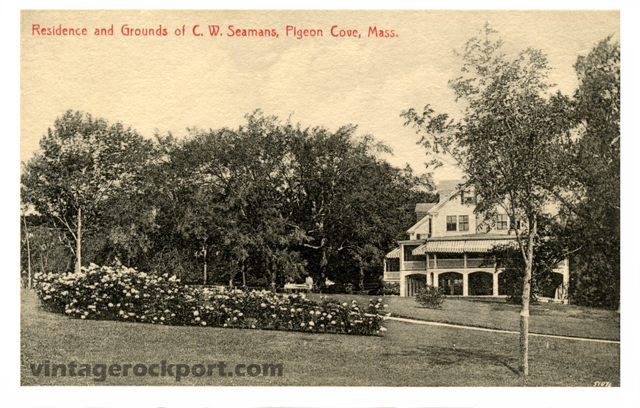
Residence of C.W. Seamans, Pigeon Cove, Mass., c. 1912

When C.W. Seamans died in his Pigeon Cove summer home on May 30, 1915, his obituary in the Boston Daily Globe described him as “one of the men chiefly responsible for the universal use of the typewriter.”

Seamans started his career as a clerk for E. Remington & Sons in Ilion, N.Y., a company known at the time for firearms and sewing machines. Around 1870, the company acquired the right to manufacture the first patented typewriter (and the device that introduced the QWERTY keyboard). Remington began manufacturing the “Type-Writer” in 1873 and then, in 1878, introduced the first typewriter with a shift key for upper- and lower-case letters.
That same year, 1878, Seamans became Remington’s manager of typewriter sales. In 1882, with Remington’s encouragement, he organized a separate company to manage sales of the Remington typewriter. In 1893, that company became the Remington Typewriter Company, with Seamans as its general manager. In 1893, it became the Union Typewriter Company, with Seamans as its president until 1910 and then the chairman of its board.

Seamans built his home where the Pigeon Cove House once stood.

For at least 15 years before he built this house, Seamans was a regular summer visitor to Pigeon Cove, staying each summer at the Pigeon Cove House. After a January 1903 fire destroyed the Pigeon Cove House, Seamans bought the property where it had stood and built this house, which he called “The Elms.” His obituary described the house as “one of the finest summer homes on the North Shore and a showplace of the town.”

The Pigeon Cove House was located between Phillips Ave. and what is now called Granite St., at approximately the point where Phillips today intersects Lacrosse Ave. I do not know precisely where the house was. I do not see anything there today that resembles the building in this picture.

Seamans was generous to the town of Rockport, according to his obituary. He paid out of his own pocket to have about a mile of the main road through town macadamized — an early form of paving using crushed stone, and he donated an automobile to the town, which the town used as an “auto chemical” — a vehicle used in fire fighting.

Seamans died in this home, just eight days after arriving in Pigeon Cove for the summer.

The postcard was published by Rockport Photo Bureau and printed in Germany. It is not dated. Given the caption describing it as the residence of Seamans, it seems fair to assume it was published before his death. Other markings on the reverse side of the card are consistent with cards produced by Rockport Photo Bureau between 1910 and 1915.

Posted in Uncategorized | Tagged , , | 6 Comments

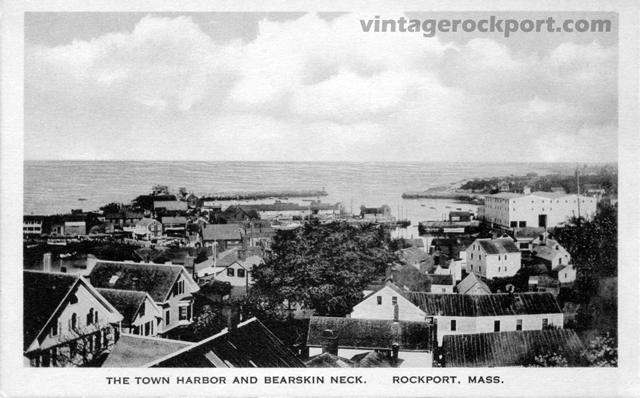
Elevated View of the Town, Harbor and Bearskin Neck, c. 1920

In this view of Rockport, you can see the cold storage building that stood on T-Wharf from 1919 to 1923. (See this post for more information on that building and another view of it.) You can also see Motif No. 1. The picture appears to have been taken from the steeple of the Congregational Church. Main Street runs diagonally from the lower left corner of the image.

The postcard was published by The Rockport Photo Bureau and printed by The Albertype Co., Brooklyn, N.Y. There is no date or postmark. Given that it shows the ice house, it was taken sometime between 1919 and 1923.

Posted in Uncategorized | Tagged , , , | 1 Comment

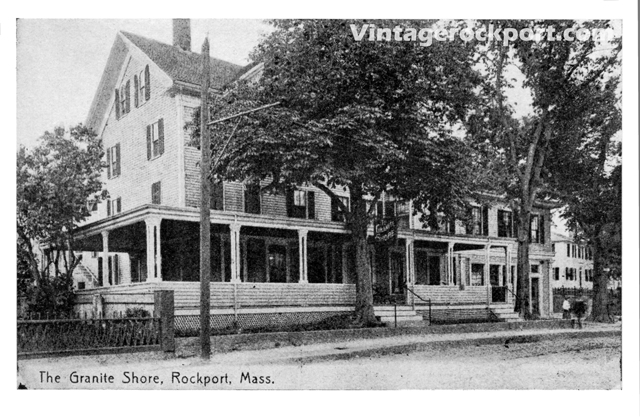
The Granite Shore Hotel, Rockport, Mass., circa 1907

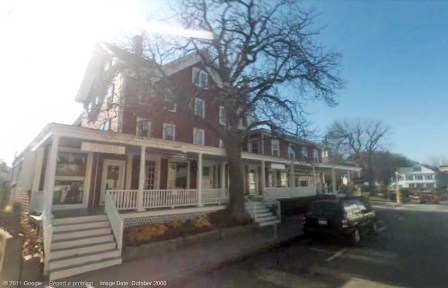
Google Street View of the building as it looks today.

The building that once housed the Granite Shore Hotel still stands at the corner of Main and School Streets in downtown Rockport. I read that part of this building was originally the home of the Rev. Ebenezer Cleaveland, who arrived here in 1752 as Sandy Bay’s first permanent minister. I’m not exactly sure when the building became a hotel. An 1872 map shows the house as belonging to J.R. Gott, who I believe was Jabez R. Gott, a deacon of the Congregational Church and the original cashier of the Rockport National Bank from its founding in 1851 until close to the time of his death in 1876.

By the time of an 1889 map, the building had become the Granite Shore. (I see it variously referred to as the “Granite Shore Hotel” and the “Granite Shore Inn.”) An 1898 building inspection report said that the hotel was ordered to install portable fire escapes, with which it complied. 

1904 article in the Boston Evening Transcript said this about the hotel:

A feature about the Granite Shore Hotel at Rockport, Mass., is the fact that all its guests are so pleased with the place at the close of each season that they never hesitate to recommend the hotel in the most enthusiastic terms, which goes to prove that it is conducted on a very high plane of excellence. The hotel is described as one of the best and most comfortable “Village Inns” on Cape Ann, and is located conveniently to one of the best beaches on the coast. For particulars address F.H. Pratt at that place.

Various people served as the hotel’s proprietors over the years. A 1903 listing showed William Adams as the hotel’s proprietor. That 1904 article above listed F.H. Pratt, who also managed The Linwood hotel in Pigeon Cove. A 1906 advertisement listed Herbert A. Dunklee as the proprietor. In 1909, it was run by Mrs. Helen G. Turner.

A 1905 book showed rooms available at the Granite Shore for $2 a night. By 1919, the rates were $3 a day or between $15 and $18 a week.

I don’t know when the hotel closed. The last reference I could find to it was a 1942 listing in a business directory.

Another view of the hotel can be seen in this postcard from 1920. The part of the building directly on the corner of Main and School housed the Post Office.

This postcard is undated. The same image appears on other postcards, one of which I’ve seen with a 1907 postmark. This card was published by Frank W. Swallow of Exeter, N.H. I have seen the same photograph on postcards published by The Rotograph Co. of New York City.

Posted in Uncategorized | Tagged , , | 4 Comments

Main Street Rockport in Living Color, circa 1911

I’ve previously posted the black-and-white version of this postcard, but this colorized version is much nicer. Besides adding color, this version removed the utility poles and wires that lined both sides of the street and you can only barely make out the trolley tracks on the street’s right side.

The same scene in black and white.

As I noted previously, the building in the center is now the site of the Shalin Liu Performance Center.

Like the previous card, this one was published by The Rotograph Company of New York City and printed in Germany. This card has no date or postmark. The black-and-white one had a 1911 postmark, so the scene is then or earlier.

Posted in Uncategorized | Tagged | Leave a comment