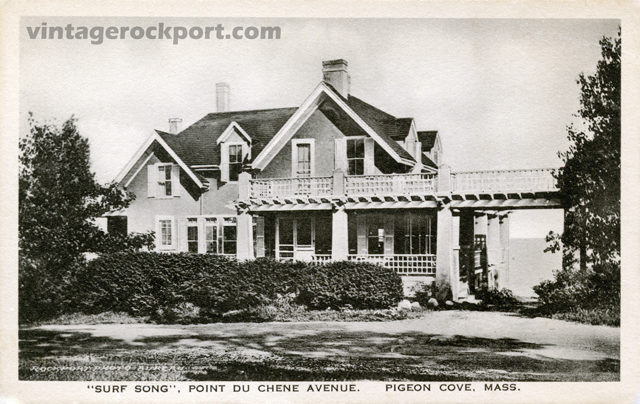
‘Surf Song,’ Point du Chene Avenue, Pigeon Cove, Mass., c. 1918

At the time of this picture, Surf Song, located on Point de Chene Avenue in Pigeon Cove, was the summer home of Mr. and Mrs. Frederic H. Ripley and their daughter Grace. Mr. Ripley was the principal of the Prince School at the corner of Newbury and Exeter Streets in Boston. Reportedly, he was a direct descendant of Mary Chilton, who was said to be the first European woman to step ashore from the Mayflower at Plymouth Rock.
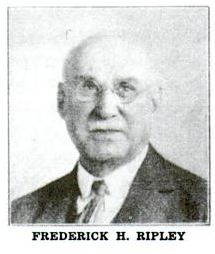
Ripley was nationally known, at least in education circles, for having co-edited the Natural Course in Music in 1895, a book that was seen as a major advance in the method of teaching music in schools. In December 1917, he gave a paper to the Music Teachers’ National Association annual meeting in New Orleans in which he explained the theory behind his book and his approach to teaching music.
Ripley retired from the Boston schools in 1923 and died in 1941 at the age of 86. His obituary in the Boston Daily Globe said that his music books “are now in schools throughout the world,” and that, in his later years, Mr. Ripley regularly visited Munich, Germany, to take part in Mozart and Wagner festivals there.

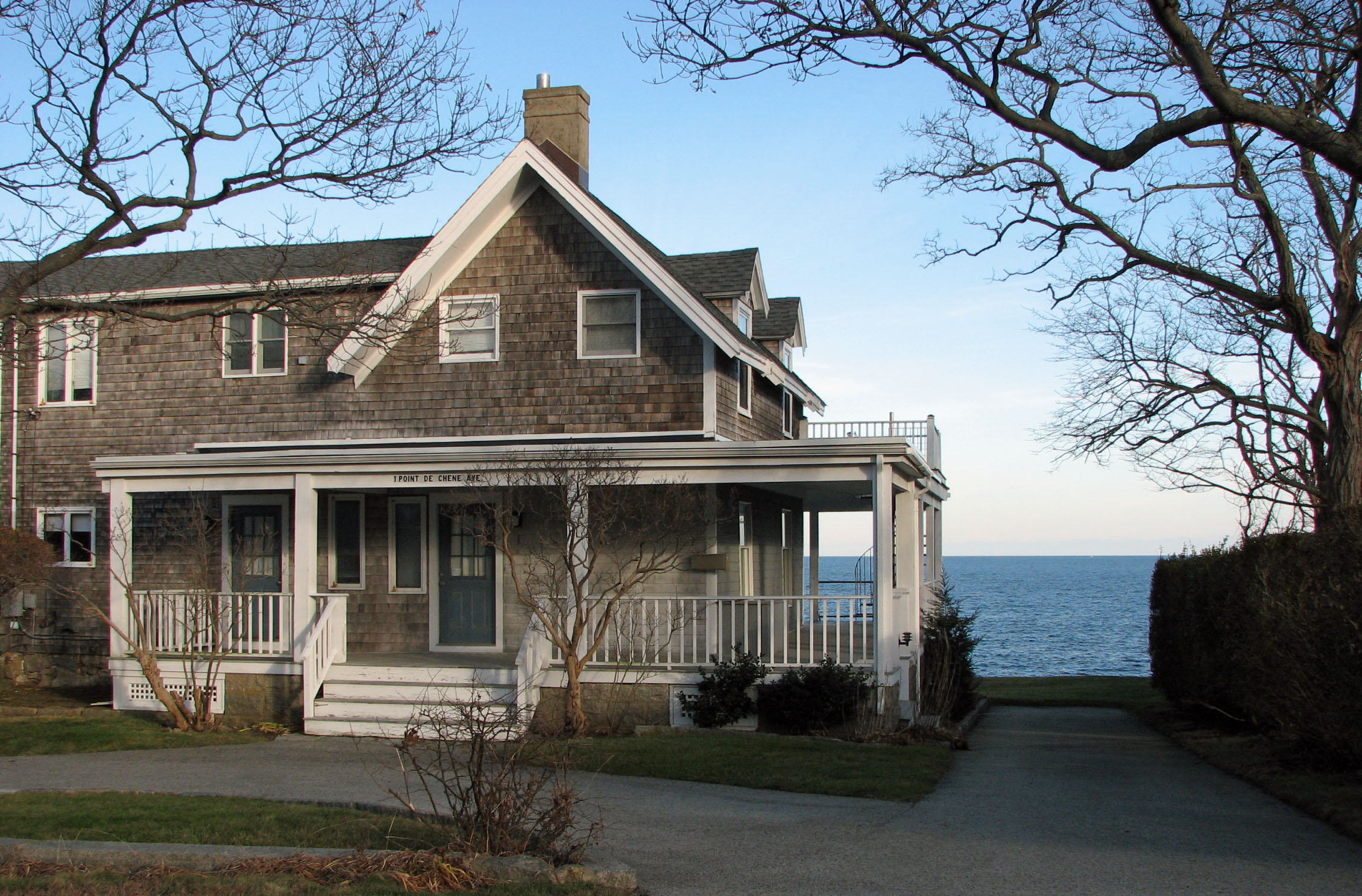
The house pictured at right is, I believe, the same house today, although with some modifications. Located at 1 Point de Chene Avenue, it has the same, distinctive A-shaped roof, chimney and dormers on the right side. As you can see, the left side has been modified, as has the porch. Zillow lists this house as having been constructed in 1880.

This postcard was published by the Rockport Photo Bureau. It is undated but appears to be from approximately 1918.

Posted in Uncategorized | 7 Comments

Kids Winter Clothing Drive this Weekend in Rockport

This weekend, donate your gently used children’s winter clothing at either the Rockport Transfer Station or Ace Hardware in Rockport. Donations will be accepted at the Transfer Station on Saturday, Nov. 24, 8 a.m. to 2 p.m., and at Ace on Friday and Saturday, Nov. 23 and 24, throughout both days.

Posted in Uncategorized | Leave a comment

Thacher’s Island, Loblolly and Haskell’s Camp, Rockport, Mass., circa 1920

This view of Thacher Island and Loblolly Cove was probably looking out from somewhere in the vicinity of the old Turk’s Head Inn. As the caption says, it also shows Haskell’s Camp, although it is hard to make out here. As described in an earlier post, Haskell’s Camp was a famous seafood restaurant — a true “in the rough” establishment with wooden tables and chairs covered by a canopy of sail cloth. Rough though it was, it attracted many famous visitors, including President William Howard Taft. In the view above, Haskell’s is at the lower right corner of Loblolly Cove. If you look carefully, you can make out cars parked there and a flagpole.

This postcard was published by the Rockport Photo Bureau. I have posted two other postcards showing Haskell’s (the one noted above and this one), both also from the Rockport Photo Bureau. All have the same printing on the reverse, indicating they were all produced around the same time, which I estimate to be around 1920.

Posted in Uncategorized | Tagged , , , , | 1 Comment

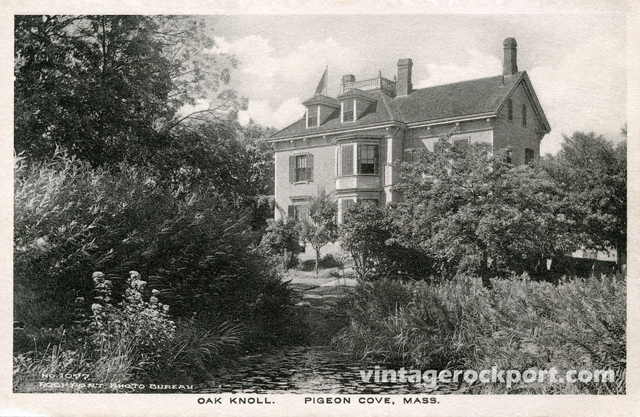
Oak Knoll, Pigeon Cove, Mass., circa 1918

[Update 1/2/13: Thanks to a comment below, I’ve identified the present-day location of the former Oak Knoll. See my updated post with photos of the home as it appears today.]

Oak Knoll was a boarding house for summer guests in Pigeon Cove. As best as I can determine, it was located on the east side of Granite Street, between Phillips Avenue and Haven Avenue. I cannot find when it opened or closed, but I found one newspaper reference to it dated Aug. 30, 1914.

Oak Knoll was operated by Mrs. Edwin Canney. I have been unable to find any details about Mrs. Canney, but a Mr. Edward Canney of Pigeon Cove ran quarries in Lanesville and Pigeon Cove and also operated a marine-salvage business. He bought his first quarries in the 1880s. His main pit was near the office of the Cape Ann Tool Company and he also owned pits on the Babson Farm property near Halibut Point.

In 1895, Canney sold all of his Pigeon Cove quarries, totaling some 75 acres, to the Rockport Granite Company. Four years later, in 1899, he bought a quarry in Lanesville. That pit remains on Washington St. in Lanesville, adjacent to Butman’s quarry, on the property more recently owned by famed sculptor Paul Manship, and is still sometimes called the Canney quarry. It produced mostly paving stones and its stones were used in Boston, New York and Philadelphia, as well as in Gloucester.

After buying the Lanesville quarry, Canney constructed an inclined railway that ran from the pit, across Washington and Langsford Streets, down to a granite pier he built. A steam engine carried the granite down the railway, where the stone was loaded on schooners for transport. A flagman stood watch on Langsford Street to stop traffic as the engine approached.

In addition to owning quarries, Canney had a business salvaging shipwrecks from local harbors. For example, in 1905, the Army Corps of Engineers contracted with him to remove the wreck of the schooner Albert H. Harding from the entrance to Pigeon Cove harbor, where it had sunk mid-channel just outside the harbor’s entrance. He was paid $300 for the job.

This postcard was published Rockport Photo Bureau. It has no date or postmark. In the early days of the Rockport Photo Bureau, its cards were numbered. This one, you can see on the image, was number 1072. Based on how that compares to other numbered cards I have, I estimate this to have been published around 1918.

Posted in Uncategorized | Tagged , , , | 4 Comments

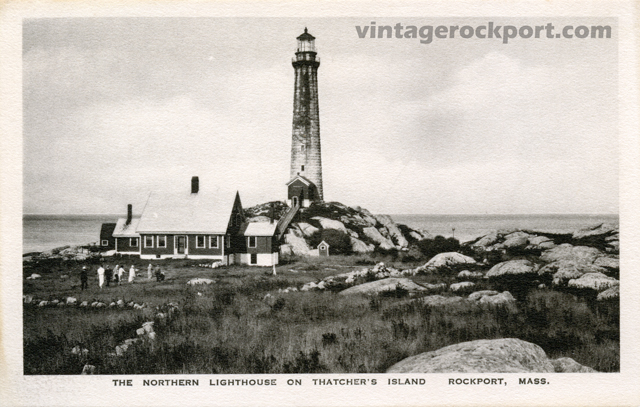
The Northern Lighthouse on Thatcher’s Island, Rockport, Mass., circa 1920

Built in 1861, this is one of the twin lighthouses that stand on Thacher Island off the Rockport coast. Today, the north tower shown here is owned by the U.S. Fish and Wildlife Service and maintained by the town of Rockport as part of a National Wildlife Refuge. The south tower is owned by the town. Compare this view of the north tower with this stylized view showing it at night. For the account of the shipwreck that gave the island its name, go here.

This postcard was published by the Rockport Photo Bureau. There is no date or postmark. Based on the similarity of the markings on the reverse to other postcards, I estimate its date to be around 1920.

Posted in Uncategorized | Tagged , , | Leave a comment

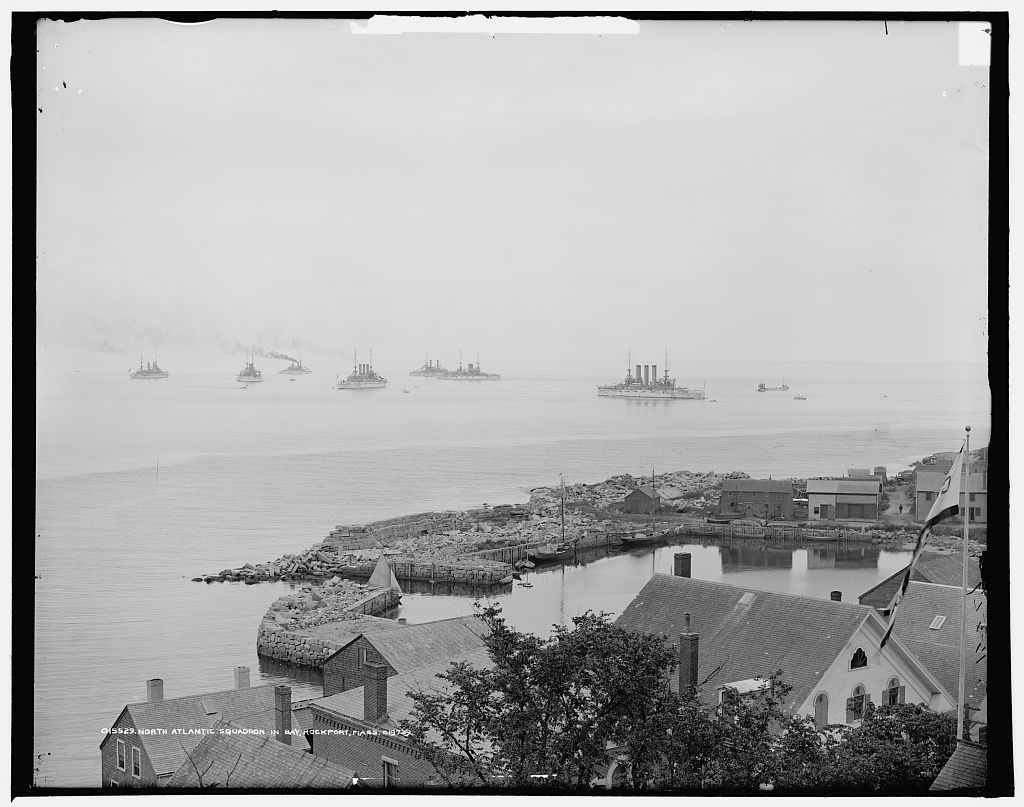
North Atlantic Squadron in Bay, Rockport, Mass., 1906

Above you see both the postcard and the original photograph on which it was based. The view looks out over White Wharf at the U.S. Navy’s North Atlantic Squadron, which was a regular summer visitor to Rockport for many years. I believe that it was taken from the steeple of the Congregational Church.

These images are from the Detroit Publishing Co. As I’ve noted in other posts, it was once one of the largest U.S. postcard publishers and was considered to have some of the finest images. It began producing postcards in 1897 and continued to do so until 1924.

The postcard is copyrighted 1906. If that was the year the photograph was taken, then it was the same year as a newspaper article I quoted in another post, “Rockporters Agog Over Coming of Admiral Evans’ Fleet,” which described some of the festivities planned for the fleet’s arrival.

As you can see in the pictures, White Wharf, which is now used for parking, was covered then with granite stones, presumably being used to build up the seawall that appears to be only partially complete in this picture. More recently, White Wharf gained a measure of fame as the locale of the Quikee Burger restaurant in the 2003 Farrelly brothers movie Stuck on You (although the movie pretended it was Martha’s Vineyard).

Posted in Uncategorized | Tagged , | Leave a comment

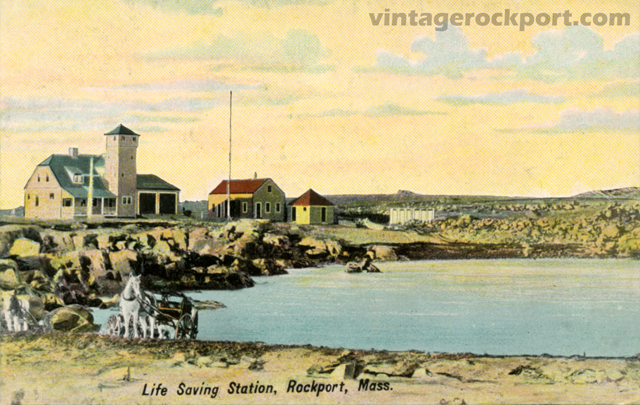
Live Saving Station, Rockport, Mass., circa 1905

The U.S. Live Saving Station on Gap Cove in Rockport was built in 1889 and remains there today, now a private residence. Originally named the Gap Cove Station, the name was changed to Straitsmouth Station on July 1, 1902. It was active as a life saving station until July 1964.

According to the U.S. Coast Guard, the first keeper of the station was Jabez Marchant Jr., who was appointed in 1874, at the age of 35, and who resigned Jan. 4, 1896. Next was Charles A. Bearse, appointed Feb. 3, 1896. Next came Frank E.Aublin, who was acting keeper for a time until his appointment on Nov. 12, 1915; Robert F. Pierce, who was reassigned from the Orleans station on July 6, 1921, and who retired on Dec. 11, 1923; and
John J. Glynn, who was keeper from Oct. 15, 1927, until June 20, 1932. Glynn was followed by Chief Boatswains Mate S. H. Cobbett, but he returned on July 20, 1934 and remained until July 18, 1935. He was followed by Everett M. Mills, who arrived on July 12, 1935, and remained until Nov. 4, 1937.

There appear to be two horses and wagons by the shore. I presume they belonged to farmers gathering seaweed to use as fertilizer. Alternatively, they could have been collecting popplestones to use as ballast, but generally sturdier carts would have been used for that.

The postcard is unused and undated. It was published by The Metropolitan News Co., of Boston, which was in business from 1905 to 1916. This is a divided-back postcard, meaning it was produced no earlier than 1907. However, the picture appears to be from even earlier. Note that you can see Straitsmouth Island to the far right of this picture, but you do not see the Straitsmouth Inn, which was built at the tip of Gap Head in 1906. That leads me to believe that the picture is from before the inn was built.

Posted in Uncategorized | Tagged , , | 4 Comments

Two Views of The Glen Acre, Pigeon Cove, c. 1915 and 1925

Once a popular Pigeon Cove hotel, The Glen Acre is now a private residence located at 231 Granite Street. It was operated by Mr. and Mrs. John F. Swett and later by Mrs. Swett alone. A 1906 newspaper article describes it as “quiet, restful and in every way desirable.” One reference I found said that the house was originally built in 1802.

The house today, via Google Street View.

An old, undated brochure for The Glen Acre says, “On the grounds is the famous ‘Glen Acre Spring’ a pure, cold and sparkling water, equal in every respect to the Poland Spring Waters of Maine.”

In the view on the top, the sign over the front door says, “The Glen Acre,” then under it says, “The Babson Homestead.” I do not know which Babson this might have been or even whether any Babson ever lived there. Farther down Granite Street, where Halibut Point State Park is now, is the former Babson Farm, which was purchased in 1820 by David Babson from the Norwood family.

The cover of an undated brochure.

Note the differences between the two pictures above. In the lower view, dormers have been added to the house, there is a new sign, and there is now a curbstone running along the road. In the top picture, two children stand by the gate.

The top picture has a postmark of 1921. However, the printing on the reverse side is identical to several other postcards I have that are all from 1910-1914. Thus, I would estimate this picture to be no later than 1915, probably even earlier. The lower card was published by the Rockport Photo Bureau and is postmarked 1925. Most likely, the actual picture was taken at least a year or two earlier.

Posted in Uncategorized | Tagged , | Leave a comment

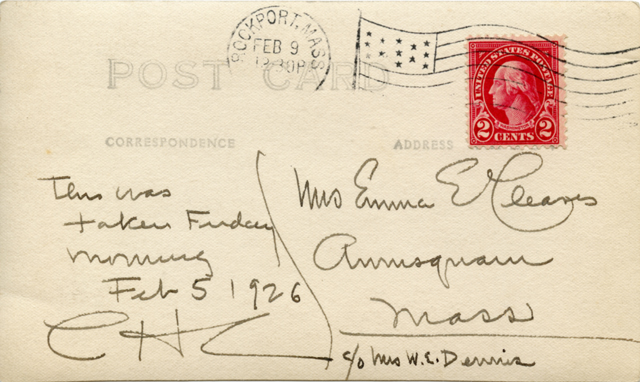
Granite St. in Winter: Real Photo Card Signed by Cleaves, 1926

[Editor’s update: Note the comment below that corrects me on the identity of the Emma Cleaves to whom this card was addressed. It was Charles Cleaves’ mother Emma, not his sister Emma.]

In this real-photo postcard (printed directly from a negative), we see Granite Street in winter. A person walks past the building at 111 Granite Street that was formerly the Swedish Evangelical Church and is now a private residence. As I previously noted, this was one of three Swedish churches built in Pigeon Cove by Swedes who came here to work in the quarries.

As you can see from the reverse, this postcard bears the note, “This was taken Friday morning Feb 5 1926.” It is signed with the initials “CHC” and addressed to Emma E. Cleaves in Annisquam. “CHC” is Charles H. Cleaves, the Rockport photographer who founded the Rockport Photo Bureau and published many of the postcards you see here at Vintage Rockport. Emma Cleaves was his sister. We’ve seen her before in a picture from 1898 of people standing in the Old First Parish Cemetery, when she was 19.

This is another postcard loaned to me by Merry Seppala of Pigeon Cove, from her personal collection of old postcards and photographs. Could it be the same winter day pictured in another postcard from Merry that I posted yesterday?

Posted in Uncategorized | Tagged , , | 2 Comments

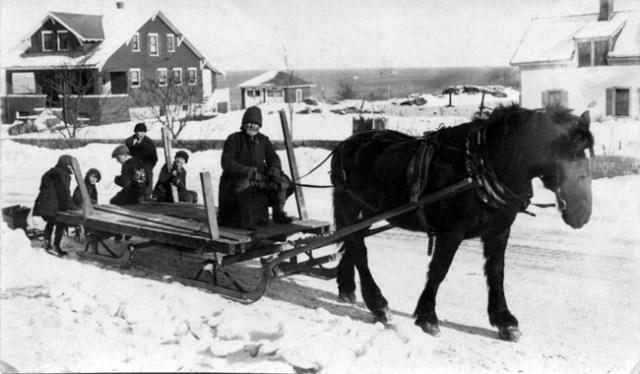
Real Photo Postcard of Sleigh on Granite Street, circa 1920

This image is another of the old photographs and postcards provided to me by Merry Seppala of Pigeon Cove. As you can see, it shows a horse-drawn sleigh, the driver, and five children, on a snow-covered street. The picture was taken in front of 84 Granite Street. The stone wall and columns are still there, as is the house that you see on the left.

In the distance, anchored offshore, is what looks to be a four-masted schooner, no doubt waiting to take on a load of granite from the Rockport Granite Company.

I previously posted another image taken from almost exactly the same location. It shows Charles Cleaves, the photographer and lawyer, and his cousin Millie. In that photo, from 1910, you can see the same stone wall and columns and the same rock outcroppings in the background. Merry Seppala is related to Cleaves and the photograph above could possibly be his, although it not identified as such.

The reverse of this real-photo postcard has the inscription, “Your old friend John Hooper.” Hooper may be the sleigh driver, but that is just conjecture.

As for dating this picture, the particular brand of postcard backing used to create this real photo postcard was manufactured from 1910 to 1930.  The Rockport Granite Company (assuming that is why the schooner is there) operated until 1933. I cannot date this precisely but it was most likely somewhere between 1915 to 1925, so I’ll call it 1920.

Posted in Uncategorized | Tagged , | 3 Comments