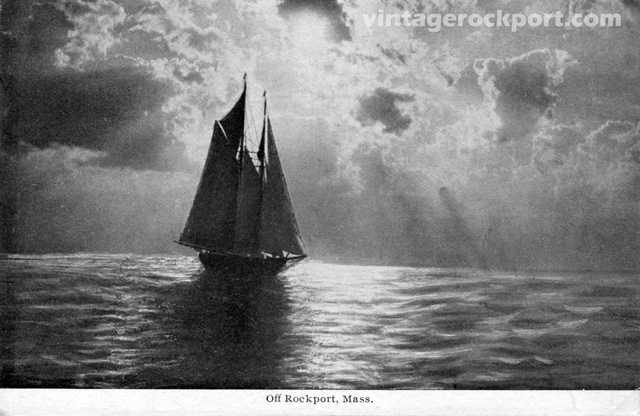
Schooner off Rockport, Mass., circa 1920

This lovely postcard of a schooner off Rockport has no date or postmark. It was published by Frank W. Swallow of Exeter, N.H. As I’ve previously noted, Swallow produced postcards starting in 1904 and continuing until his death in 1927. After his death, his wife kept the company going into the early 1930s. I have no way of knowing for certain when this card is from, but I’ll guesstimate it to be around 1920.

Posted in Uncategorized | Leave a comment

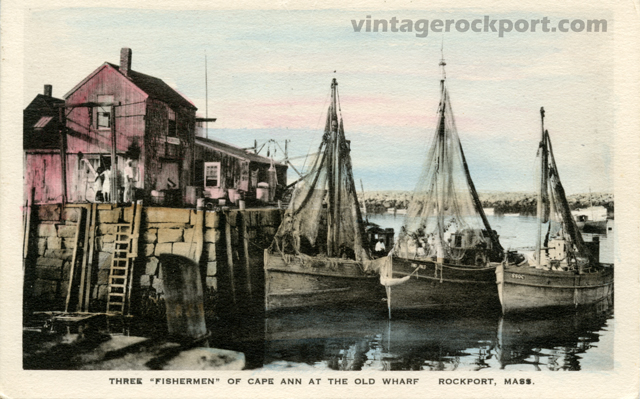
Three ‘Fishermen’ of Cape Ann at the Old Wharf, Rockport, Mass., c. 1942

Note that the fishing shack you see here is not the famed Motif No. 1. Rather, it is the very similar shack that stood on the wharf now known as Tuna Wharf. You can see the two wharves with the two sheds in this postcard.

This card was published by the Rockport Photo Bureau. Although she is not named on the card, I believe the photographer was Virginia Cleaves Little. As I’ve noted before, she took over running the Photo Bureau from her father, Charles Cleaves. This photo resembles several others taken by her, including the one I linked above and also this one.

I have a black-and-white version of this same postcard. This colorized version is nicely done.

The card has no date or postmark. Most of her pictures are from between 1940 and 1945 and other similar ones I have are from 1942.

Posted in Uncategorized | Tagged , , , , | 1 Comment

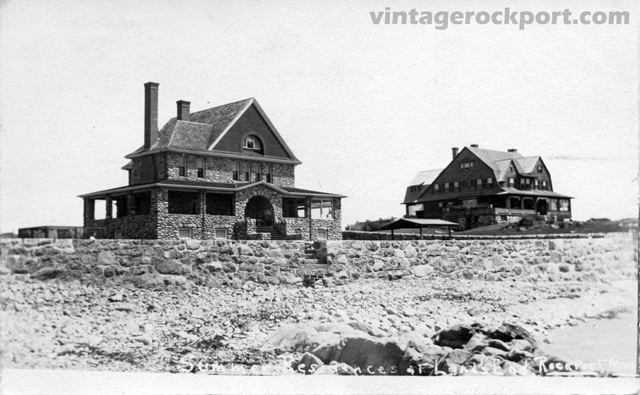
Summer Residences at Land’s End, Rockport, Mass., 1910

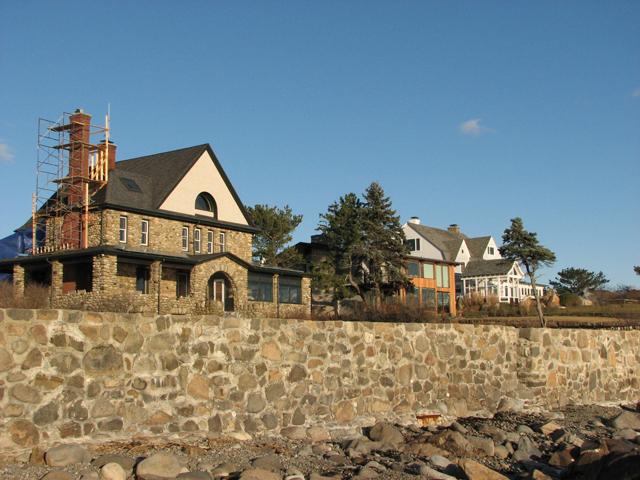
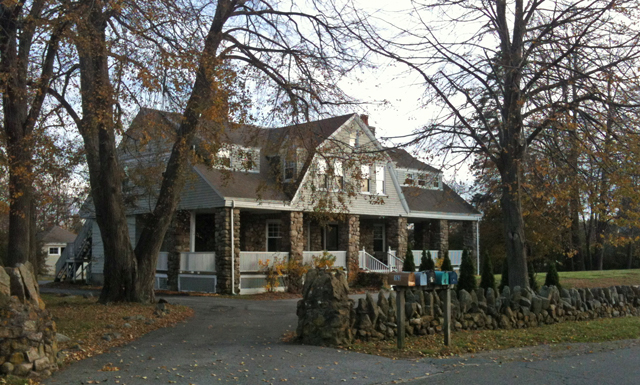
As you can see from the photo below, these two houses still stand (with a third house now dividing them) on Penzance Road at the eastern end of Pebble Beach in Rockport. This is a real photo postcard bearing a postmark of Aug. 17, 1910. According to the note written on the back, the house on the left was built of stones collected from the beach.

In this map of Land’s End published in 1885, these houses are not shown. Thus, they were built sometime between 1885 and 1910.

Anyone have more information about either of these houses? If so, please share in the comments below.

Posted in Uncategorized | 9 Comments

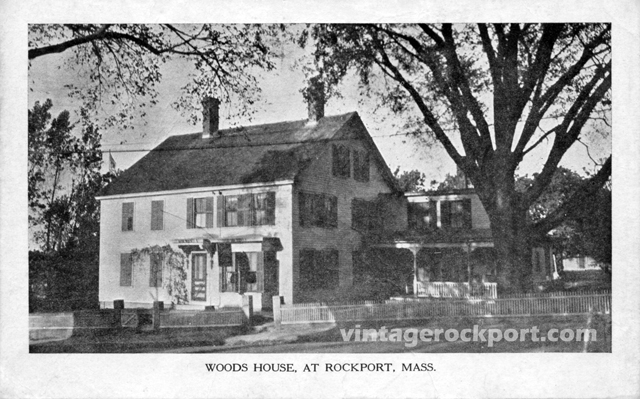
Woods House, Rockport, Mass., circa 1920

The Woods House still stands at the corner of Mt. Pleasant St. and Norwood Ave. (see picture below). At the time this picture was taken, the house was a summer boarding house. A 1912 classified ad in the Boston Evening Transcript described it this way:

Centrally located, well furnished, all modern conveniences; handy to beach, boating, fishing and electrics. Home cuisine.

The greater historical significance of the house is that it was once the home of Henri N. Woods, a prominent lawyer and civic leader in Rockport in the latter half of the 19th century.
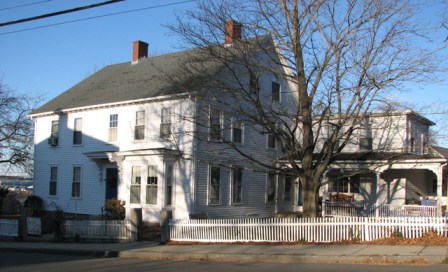
The Woods House as it looks today.

Woods was the defense lawyer in a notorious 1877 Rockport murder case involving two traveling salesmen. The two men, Albert Joy and Charles H. Gilman, arrived in Rockport on April 11, 1877, on the 9 a.m. train from Beverly. While Gilman called on several houses, selling an attachment to sewing machines, Joy hung around the railroad station. Around noon, the two men were seen passing through the station and out its western end, heading toward a nearby reservoir. A half hour later, Joy was seen returning, alone. He walked up Pooles Lane to Main Street, then to Broadway and into town, where he stopped at a restaurant and ordered oyster stew and tea. He then returned to the station and boarded the train that was set to leave at 1:30. As he waited for it to depart, voices suddenly started screaming, “A dead man has been found in the reservoir.” Upon hearing that news, Joy exclaimed, “My God! It is my chum.”

Police quickly arrested Joy, who professed his innocence, saying he left Gilman at the reservoir while he went to get food. With Henri Woods as his defense attorney, Joy was put on trial in Salem on July 9, 1877, for the murder of Gilman. After a four-day trial, the jury returned a verdict a guilty. He was sentenced to be hanged, but four days before the scheduled hanging, the governor issued a reprieve. A few weeks later, the governor commuted his sentence to life in prison.

Woods was also instrumental in helping to establish the first public library in Rockport in 1871 and served on the first library committee. Also in 1871, he served as Town Meeting moderator. In 1875, he was an incorporator of the Rockport Water Company, formed “for the purpose of supplying the town of Rockport with pure water for the extinguishment of fires, domestic and other purposes.” The company was granted a license by the state legislature to take water from Cape Pond.

He was involved in various railroad businesses. He was an officer and member of the board of directors of the Long Beach Railroad Company in 1888. In 1896, he was on the board of directors of the Cape Ann Granite Railroad Company. f

In 1894, Woods was appointed to serve as a special justice of the Gloucester District Court.

Woods was born on March 15, 1846, and died on Oct. 9, 1901. He wife, Bella Sears Woods, was born on Aug. 21, 1846, and died on Jan. 6, 1918. Both are buried at Beech Grove Cemetery.

There was a fishing schooner by the name of Henri N. Woods that was built in 1882 in Boothbay, Maine. I cannot find whether it was named for this same Henri Woods, but it was registered as part of the Gloucester fleet and was owned by George Norwood & Son, which owned several Gloucester-based schooners.

As for this postcard, it may have come from the proprietor of the guest house, as it informs someone in Somerville, “I have been unable to locate a room for you. Trusting that we will have better luck another year.” The sender’s name appears to be Annie C. Parr. The card was mailed on July 5, 1927. This same photograph is included in the 1924 book, Rockport: A Town of the Sea. So I would estimate the picture to be from between 1920 and 1923.
Posted in Uncategorized | Tagged | 1 Comment

The Common, Rockport, Mass., circa 1910

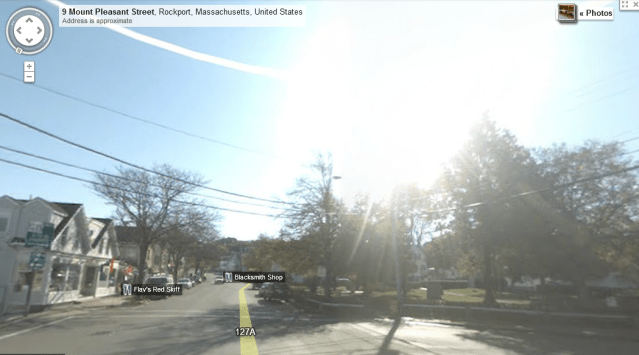
This view shows the Rockport Common, looking up Mt. Pleasant St. from where it intersects with Broadway. The houses to the right are on High St., where they remain today. To the right of the common, outside the view of this picture, would be the First Baptist Church. To the left in the foreground would be T-Wharf.

The building to the left, where the men are standing, has a sign on the side that says “Gasolene.” I cannot make out the sign on the building’s front. It looks as if it is the same building that now houses a gift shop at the corner of T-Wharf and Mt. Pleasant, although it has been modified. Just past the men is a wagon. The white pole in the lower center looks like it might have been a water pump.

Here is the same view today, captured from Google Streetview.

This postcard was postmarked May 30, 1910. The note written by the sender on the back says, “I’m having a great time. I ate 6 lobsters yesterday.” Apparently, they were cheaper back then.

Posted in Uncategorized | Leave a comment

The Horseless Carriage Comes to Turk’s Head, circa 1906

In my research one day, I tripped across an article from the July 4, 1906, issue of The Horseless Age, a magazine devoted to the growing popularity of the motor vehicle. In a section of the magazine devoted to “commercial applications” of the motor vehicle, just after an article about an enterprising undertaker who had recently started using a motor car to carry caskets, was a piece entitled, “Automobiles at Summer Resorts.” Therein was a contribution from C.B. Martin, proprietor of Turk’s Head Inn in Rockport, describing how he had recently started using motor cars.

Coincidentally, a week or so after reading that, I found this postcard. I believe it may show the very motor cars Martin described in that article.

Here’s what Martin told The Horseless Age in 1906:

During the season of 1905 we used light touring cars between the house and the railroad station, a distance of 1 1/2 miles, in which is one quite steep hill. With these cars we are able to carry 12 passengers between the house and the depot. On account of having fourteen trains daily we find the touring car an advantage over a barge because the average number of passengers carried from each train is only four. We allow six minutes between the house and depot, while with horses we have to allow at least twenty-five minutes. In all last summer’s work we failed to make only one train on time, caused from defect in the auto.

We also used cars for short pleasure trips, taking the place of horses and carriages. We consider the venture has been a success so far, the income having been more than sufficient to meet the expense of operation and depreciation. This year we will put on more cars, and use still fewer horses.”

The postcard shown here has an undivided back, which generally means that it was printed before 1907, the year postal regulations changed to allow divided backs. That means it is probably from 1905 or 1906. The two cars pictured in the card both resemble 1905- and 1906-model touring cars. (Several companies made them but they looked very much alike, especially given the low level of detail in this picture.)

Given the year of the card and the type of cars — not to mention the absence of any other cars — these could well be the cars Martin described in his contribution to the magazine.

As another clue, look at this 1905 postcard of the inn. In it, you see a wagon but no cars. Perhaps this was the wagon — or “barge” as Martin called it — he used to pick up passengers before buying his cars.

Posted in Uncategorized | Tagged , | 2 Comments

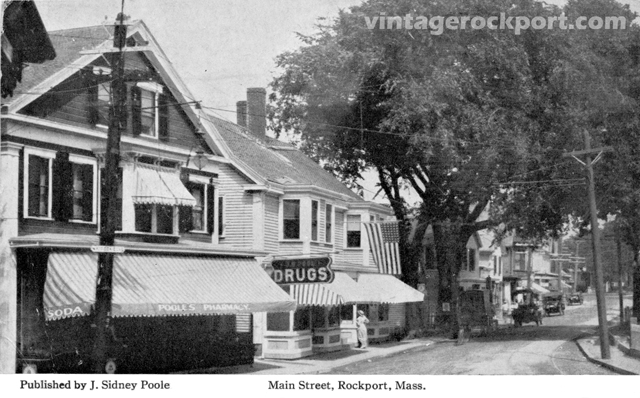
Main St., Showing Poole’s Drugs, Rockport, Mass., c. 1914

This postcard was published by J. Sidney Poole and shows Poole’s Pharmacy, the drugstore he operated at the corner of Main and Beach streets. I believe he lived upstairs from the pharmacy.

Poole was a descendant of John Pool, who was said to be the second settler of Sandy Bay, as it was then known. Poole died on Aug. 1, 1927, at the age of 77. An obituary said he started working at age 13 as a fisherman before learning the drug business. His drugstore, it said, was a community centre for years.” It said that he was a great lover of flowers and that his garden “was one of the show places of the town.”

Poole published other postcards, such as another that appears on this site, Launching the Lifeboat. Both of these cards were published by Frank W. Swallow of Exeter, N.H.

Swallow was an interesting person himself. Born in 1864, he was a traveling salesman and car dealer before launching his postcard business around 1904. Like many postcard publishers then, he started out having the cards printed in Germany. But he soon launched his own printing business. He went on to produce hundreds of postcards, mostly of New England and mostly using photos he took himself. After Swallow died in 1927, his wife and nephew kept the business running into the early 1930s. (My “Lifeboat” post said that Swallow’s business continued to the 1940, but several sources say 1930s.)

Posted in Uncategorized | Tagged , | 1 Comment

Rising Sun Behind the Twin Lights, Rockport, Mass., c. 1906

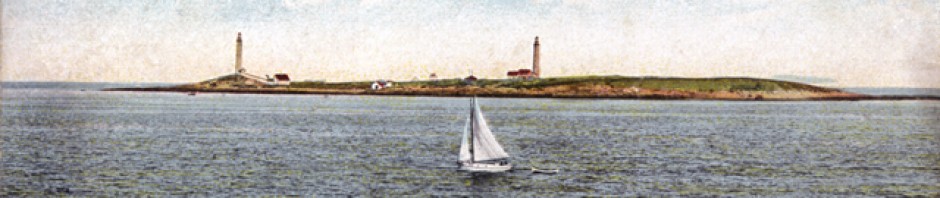
This view of the Twin Lights on Thacher Island appears on several postcards from the early 1900s. This particular one is unique for the publisher’s addition of the rays of the rising sun emanating from behind the island.

Something else unique about this care is the printing. Instead of black and white, the printer used a green-and-white process.

The publisher of this card was the Souvenir Post Card Co. of New York. It was in business from 1905-1914. The undivided back on this postcard suggests that it was printed before 1907.

Posted in Uncategorized | Tagged , | 1 Comment

The Billingsgate, Rockport, Mass., circa 1912

The home shown in this postcard still stands, as you can see in the picture below, which I took just this week. It is located at the southern end of South Street, just past Penzance Road. Note how much the trees grew in the century that separates these two pictures.

I assume this was, at the time, a summer cottage and that the name, “The Billingsgate,” was given to it by its owner. It was common for well-to-do owners to give their summer homes a name. I have not been able to find any reference to it using that name.

This postcard was mailed in 1913. It does not identify a publisher or a publication date. The style of the front and the markings on the reverse suggest it was from the same publisher as this 1911 postcard of the railroad station.

Posted in Uncategorized | 1 Comment

Driftwood Farm, Rockport, Mass., c. 1937-1940

Driftwood Farm was the home of J. Raymond Smith, a man well known in Rockport for the lumber yard and hardware store he operated, and his wife, Edna L. Smith. Driftwood Farm was also operated as a guest house, managed by Mrs. Smith. It was located off of South Street, overlooking Whale Cove, between Whale Cove Lane and Driftwood Road.

Mr. Smith died in 1947, just two days after Christmas, at the too-young age of 59. According to his obituary, which described him as “one of Cape Ann’s leading businessmen,” he died suddenly at his Driftwood Farm home.

Mrs. Smith lived to be 86. According to her 1983 obituary, she operated Driftwood Farm as a guest house from 1937 until her husband’s death in 1947. After Mr. Smith’s death, Mrs. Smith took over operation of the lumber and hardware business. Before marrying Mr. Smith in 1933, she owned the Driftwood Tea Room, which she opened in 1929.

The Smith family continues to operate Smith Hardware & Lumber, adjacent to the railroad station.

This postcard is what is a called a “real photo postcard,” meaning it was a photograph someone took and had developed onto special photographic paper with a postcard backing. The markings on the reverse side of this card reveal that it was processed by a company named Azo sometime during the period 1924-1949. My estimate of the card as from around 1937-1940 is a pure guess, based on that time period and on the years the house was operated as a guest house.

As always, if anyone has any additional information to share about this picture, please add it in the comments below or send me an email.

Posted in Uncategorized | 3 Comments