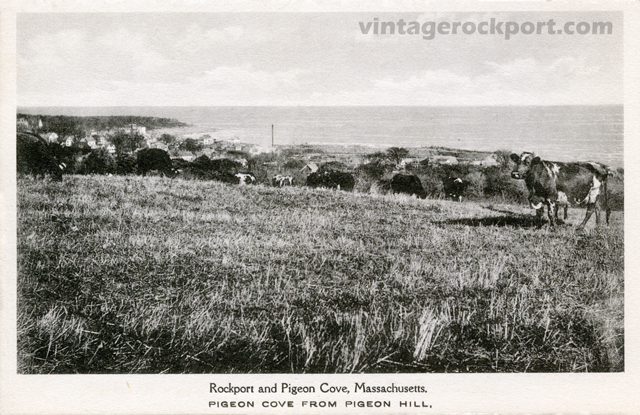
Pigeon Cove and Tool Company from Pigeon Hill, c. 1912

View-from-Pigeon-Hill-post

This summer has brought the demolition of the iconic tool company smokestack in Pigeon Cove. In this view of Pigeon Cove taken from atop Pigeon Hill, the smokestack is clearly visible. Of course, the dozen or so cows you see grazing here could care less about the smokestack or even about the panoramic ocean view behind them. So much of what you see in this image is now gone — a barren Pigeon Hill, grazing cows, and now the smokestack.

As for Pigeon Hill, early in the town’s history, settlers recognized it as an important landmark for mariners. At a town meeting in 1713, the voters decided that the top of Pigeon Hill should “lie common, still, perpetually, to be for a sea mark.” Despite this vote, in 1819, the town sold the land to David Babson, William Fears and John Fears for $525. (This is the same Babson who later purchased the Babson Farm property near the entrance to Halibut Point.)

Eventually, Ezra Eames came to own the five-acre property. In 1929, his heirs agreed to sell it back to the town, to be used as a park for the benefit of all the people of the town. It remains public property today, situated at the top of Landmark Lane.

This postcard was published by Rockport Photo Bureau and printed by The Albertype Co., Brooklyn, N.Y. No printing date is indicated and there is no postmark. Based on the similarity of the reverse side to other postcards that I have dated, I estimate this to be from around 1912.

Posted in Uncategorized | Tagged , , | 1 Comment

Moonlight Over Sandy Bay, circa 1910

Sandy-Bay-Moonlight-post

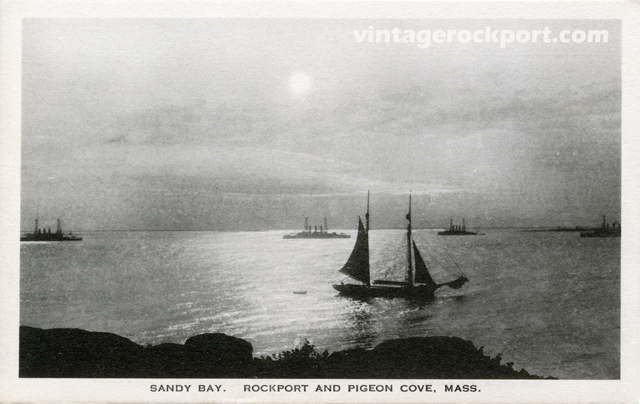
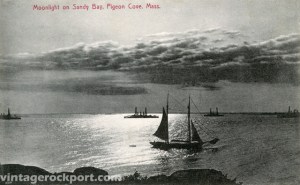
Seeing the nearly full moon last night over the ocean inspired me to want to post this view of a moonlit Sandy Bay. It was only as I was preparing to publish it that I realized that I had previously published this exact same view, only in a different postcard (see image right). As a matter of img411_postfact, the earlier version benefits from a better printing job, with more vivid contrast and dramatic clouds covering the barely visible moon.

Both postcards come from the Rockport Photo Bureau. I suspect that this one was printed later than the other. The other was printed in Germany, which was common for postcards before World War I, but this one was printed in New York.

Posted in Uncategorized | Leave a comment

Episcopal Church, Rockport, Mass., circa 1915

Episcopal-Church_post

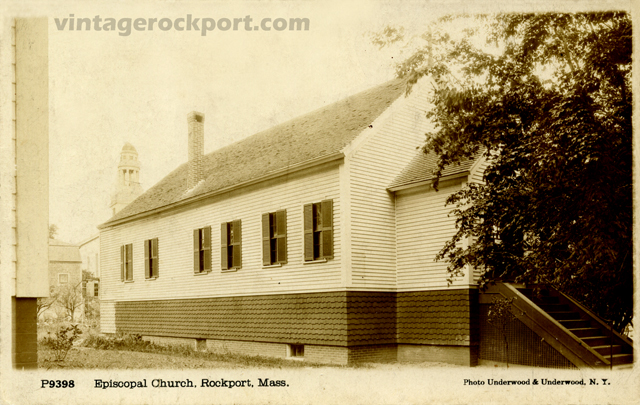
Although it looks nothing like the present-day St. Mary’s Episcopal Church on Broadway in Rockport, I believe this is the original structure, before the church was expanded out and up. In addition to the fact that the postcard identifies it as the Episcopal Church, there is a clue in the background — the steeple of the Congregational Church in the very location where you can still see it behind the Episcopal Church.

2013-06-30 14.44.10

St. Mary’s church today.

Episcopalians first began holding services in Rockport in 1872, meeting in the Y.M.C.A. on Broadway (more recently known as the Odd Fellows Hall). Because these services were conducted by the rector of St. John’s Episcopal Church in Gloucester, they discontinued once winter arrived. They did not start again until July 1878, only to again be discontinued in October 1878 until they resumed in 1885, with meetings in various halls around town.

On May 7, 1886, the town’s 19 Episcopalians formed a formal organization by the name of St. Mary’s Mission. A room in town hall served as their chapel until, on Aug. 6, 1892, St. Mary’s church on Broadway was opened for its first service.

The steeple of the Congregational Church can be seen through the trees, approximately where it appears in the postcard view.

The steeple of the Congregational Church can be seen through the trees, approximately where it appears in the postcard view.

This real-photo postcard was published by Underwood & Underwood of New York City. The company was founded in 1881 by two brothers, Elmer and Burt Underwood, to sell stereoscopic images. In 1891, the brothers started making their own stereoscopic photographs. By the turn of the century, the company became the largest producer of stereoviews in the world.

In 1910, the company began sending photographers all over the world and supplying news photos to newspapers and postcard publishers. From around 1914 to 1919, the company also began publishing its own postcards. As you can see from the image above, all the postcards were numbered. From what I can gather, the number on this card would place its date as approximately 1915.

Posted in Uncategorized | Tagged | 1 Comment

The Stone Fireplace, Straitsmouth Inn, circa 1925

Straitsmouth-Fireplace_post

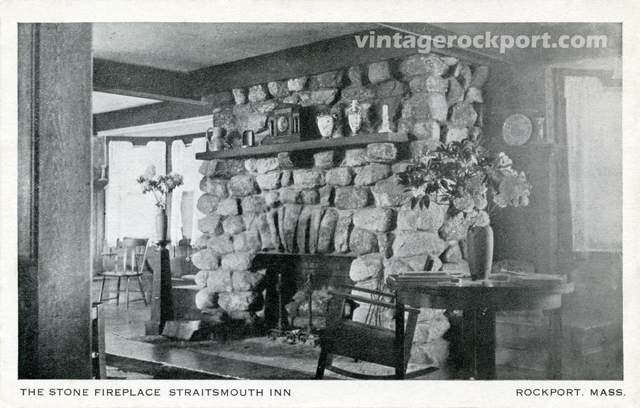
The Straitsmouth Inn stood on the tip of Gap Head, also known as Straitsmouth Point, from 1906 to 1958, when it burned to the ground on New Year’s Eve. I’ve posted other views of the exterior of the inn, but this is the first postcard I’ve found that shows the inn’s interior.

The postcard shows the inn’s granite fireplace, made of popplestones in a style I’ve seen in other Rockport houses. A clock and several vases decorate the mantel. The vases on the table to the right and the pedestal to the left hold rhododendron, no doubt fresh picked.

This postcard has no information on the reverse that would identify its publisher or its date. The style of it printing and the markings on its backside suggest a date of around 1925.

Posted in Uncategorized | Tagged , , | 5 Comments

High-Res View of Rockport Granite Fountains in D.C., 1917

Union Station Detail

Coincidentally, just a week after I posted an image of one of the two Rockport Granite fountains at Union Station in Washington, D.C., the blog Shorpy posted an amazingly detailed, high-resolution image showing both fountains and their placement in front of Union Station. What you see above is only a portion of the entire image posted on Shorpy. In it, you can clearly see the two fountains on opposite sides of the plaza. (Click the above image to enlarge.)

If you are not familiar with Shorpy, it is devoted to posting extremely high-resolution images. Go to the Shorpy page I’ve linked to above, then click on the image to load the high-resolution version. The detail you can see is simply amazing.

To read more about the fountains, see my post from last week.

Posted in Uncategorized | Leave a comment

Rockport Granite Fountain at Union Station, Washington, D.C., circa 1911

Rockport-Granite-Fountain_p

Rockport-Granite-Fountain_b

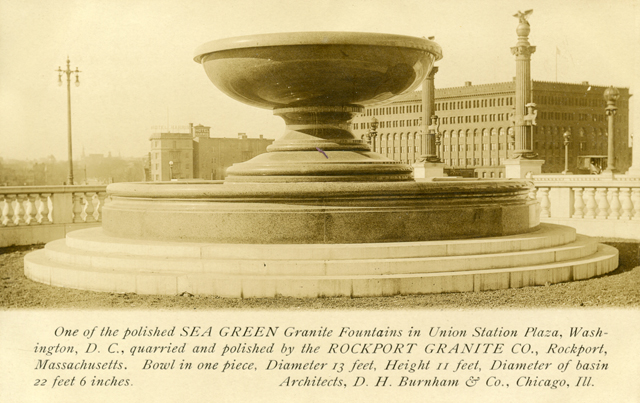
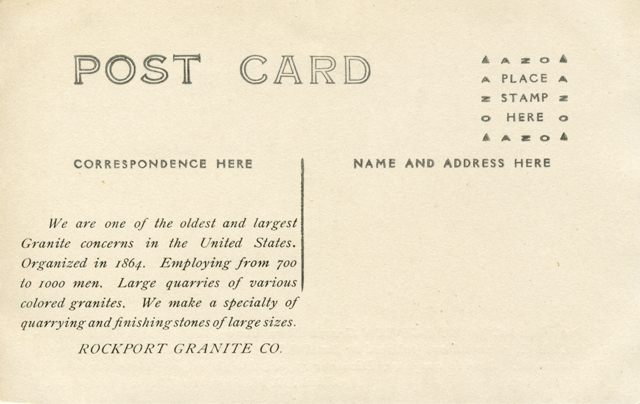
For the Rockport Granite Company, perhaps its proudest achievement was the installation of two massive granite fountains in the plaza at Union Station in Washington, D.C., where they can still be seen today. As you can see from the real-photo postcard above, the company used the image of one of these fountains for this commercial postcard touting itself as making “a specialty of quarrying and finishing stones of large sizes.” Below you can see an ad from a 1913 magazine that uses the same image.
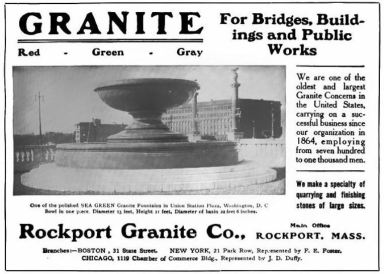
Granite Fountain AdSeveral achievements made the fountains notable. The first was that each 13-foot wide by 11-foot tall bowl was sculpted from a single piece of granite. The sea green granite came from the Blood Ledge quarry in Bay View, part of Gloucester. (See here for a circa 1906 view of the Bay View works.) For each bowl, a single, 65-ton block of granite was cut from the quarry — an achievement noted in one magazine of the time as possibly a first — at least since the monumental engineering achievements of the ancient Egyptians.

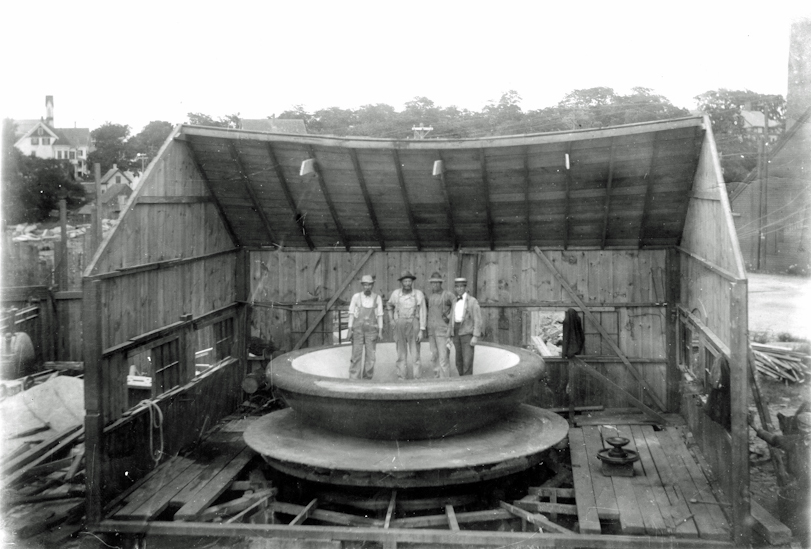
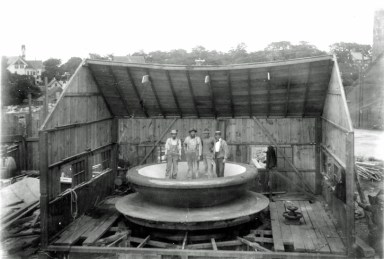
Equally impressive was the work of the stonecutters in shaping the bowls — each big enough for five men to stand within it. Each granite block was mounted on a revolving platform in a shelter near Washington St. in Bay View. Despite the scale of the job, it required delicate and careful work, with much of the cutting and shaping done by hand. The work was conducted during the spring and summer of 1910, with the first bowl finished in July 1910.
Bowl-Stonecutters

Stonecutters pose in the massive bowl in the shed at Bay View. Note the track under the bowl that allowed it to rotate.

One of the stonecutters later said it had been the most “ticklish” job he had ever done. Another said that the bowl’s surface was so highly polished that he could have used it as a mirror to shave.

The final notable achievement was the transportation of the bowls from Cape Ann to Washington. Because standard rail cars could not safely carry the bowls, a special flatcar with reinforced cross pieces was brought from a marble quarry in Vermont. Even then, the man in charge of transporting the bowl, C. Harry Rogers, was so worried about its safety that he ordered one of the company’s engineers, Bucky Moore, to accompany it. As Barbara Erkkila relates in her book, Hammers on Stone:

A southbound freight pulled out of Boston for Washington several days later and the flatcar carrying the bowl was attached to the tail end just behind the caboose. And Bucky rode in that bowl all the way to Union Station.

There were checkpoints along the way where Bucky was to call Rogers and tell him of the progress, but the waiting was too much for Rogers, who hopped a fast train and was at Washington to meet the somewhat lamed and sleepless Bucky when he arrived, bowl and all.

Although this postcard has no date, we know that the bowls were installed in 1910 and that the same image was used in the 1913 magazine ad above. It is safe to assume the photograph was taken sometime soon after the installation was completed, either in 1910 or 1911.

Also, this was a real-photo postcard that used photo-processing paper produced between 1904 and 1918.
Posted in Uncategorized | Tagged | 2 Comments

Memorial Day Parade, Pigeon Cove, circa 1912

Memorial-Day-Pigeon-Cove_po

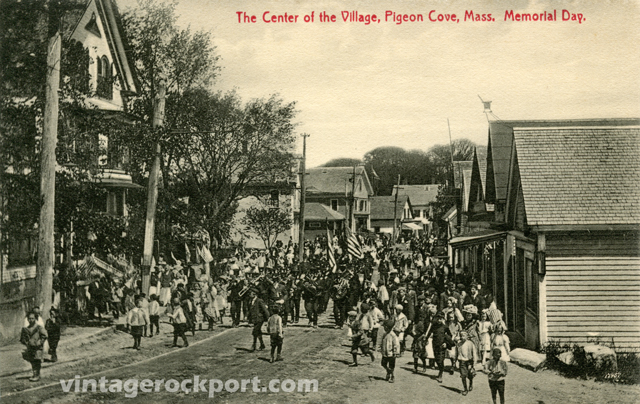
I meant to post this on Memorial Day, but better late than never. This is a postcard from the Rockport Photo Bureau showing the Memorial Day parade through the center of Pigeon Cove. Children are running ahead of uniformed men playing brass instruments, followed by the color guard. The old trolley tracks run along the left side of the unpaved street.

This postcard was never mailed but it has a note on the back dated March 1915. I have another copy of this card that was postmarked in 1913. The card has a Rockport Photo Bureau identification number, 1015. Other cards I have with numbers in that range came from roughly 1910-1912.

Posted in Uncategorized | Tagged , | Leave a comment

The Shore Path to Marmion Way, Rockport, circa 1925

The-Shore-Path-to-Marmion_p

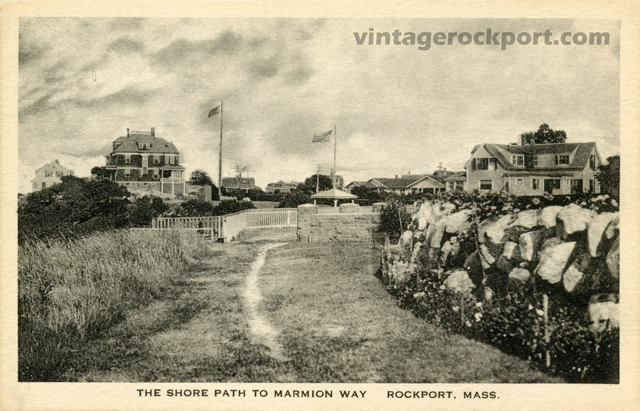
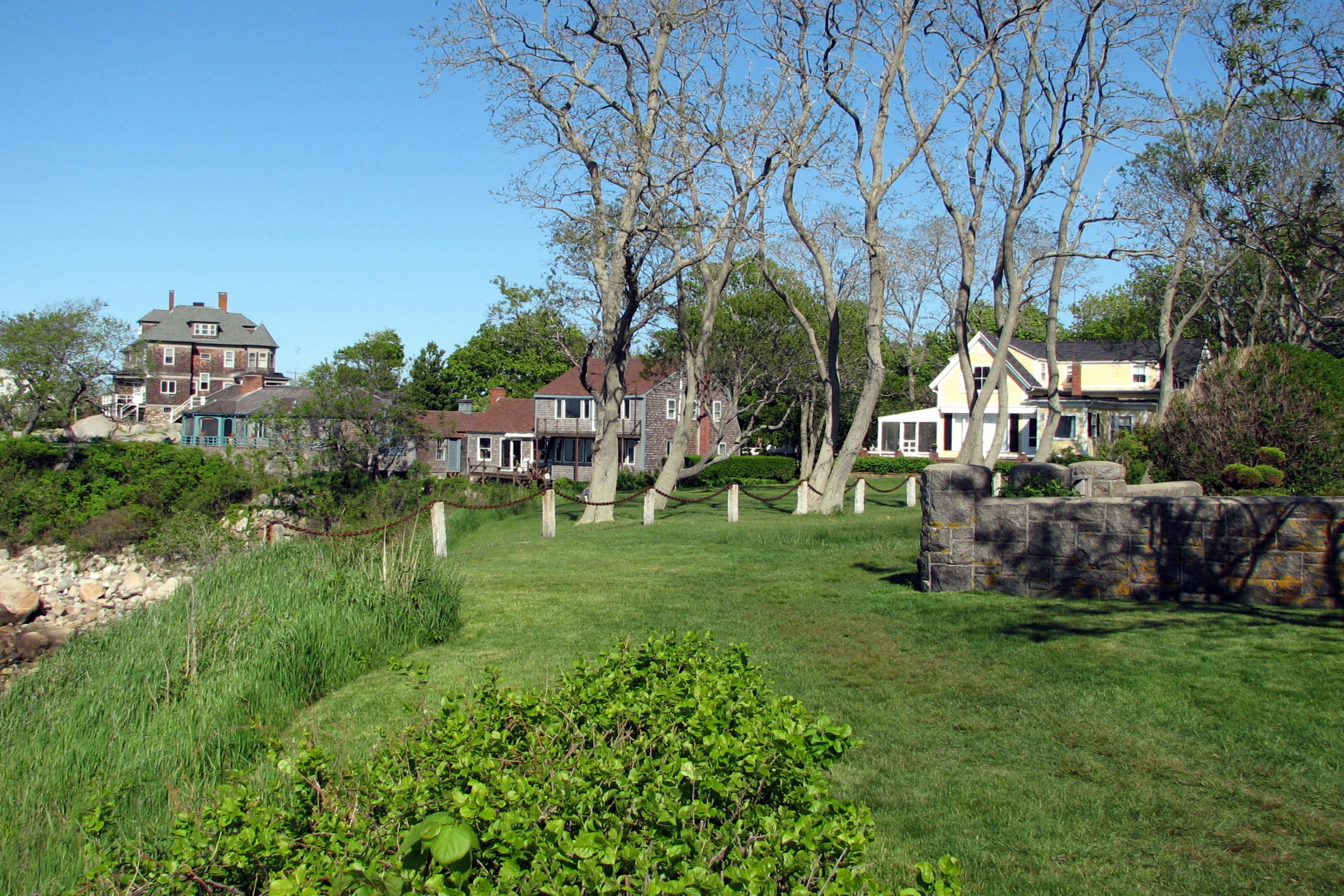
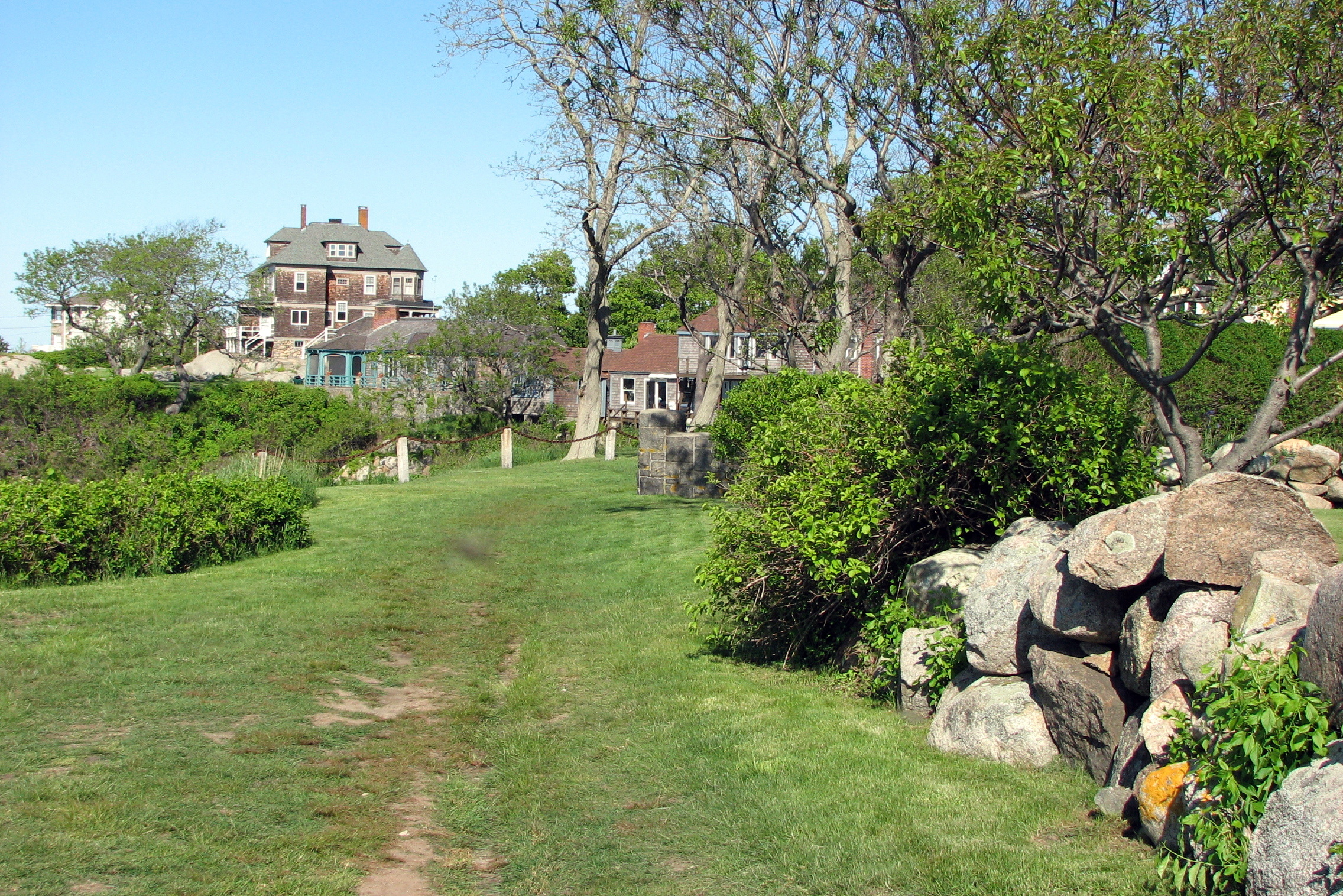
This is a view of the shore path that runs from Old Garden Beach to Marmion Way. The sign there now calls is Old Garden Path. As you can see from the two photos below, both of the houses that frame this image are still there today, as is the rough stone wall you see to the right and the stone wall and pillar at the center.

IMG_2403_edit

In the years since, two new houses have been built that now also fill this scene. And large trees have now grown where there were none before.

The house to the right in the postcard, which is yellow in the color photos, was known in the 1960s and 1970s as the Hammock HouseIMG_2405_2. Its owner, Paul Dow, began making hammocks in his retirement for family and friends. As demand grew for his hammocks, he started selling them from his Marmion Way home.

This postcard was published by the Rockport Photo Bureau. It is unused and undated. Although the company published postcards for more than three decades, the markings on the reverse changed over time and help approximate the date. Based on this card’s markings, I estimate it to be around 1925.

Posted in Uncategorized | Tagged , , | 1 Comment

Front Beach, Rockport, Mass., circa 1910

The-Beach_post

Here is another postcard published by J. Sidney Poole. As I’ve noted before, Poole was a pharmacist in Rockport at the turn of the century. His pharmacy was located at the corner of Main and Beach streets. For other postcards published by Poole, see the items tagged with his name.

In this view of Front Beach, you can see the old firehouse — the yellow building with the hose-drying tower. The building was moved to front beach from Dock Square in 1855 and remained in service as a firehouse until 1939. It then served for many years as a facility for tourists, until it was demolished less than a decade ago and replaced with new tourist restrooms.

This postcard has a postmark of July 29, 1912. It was printed by the N. E. Paper & Stationery Co. of Ayer, Mass., which was in business only from 1907 to 1910. Thus, the postcard was produced sometime during those years.

Posted in Uncategorized | Tagged , | Leave a comment

Granite Pier, Rockport, Mass., circa 1907

Granite-Pier_post

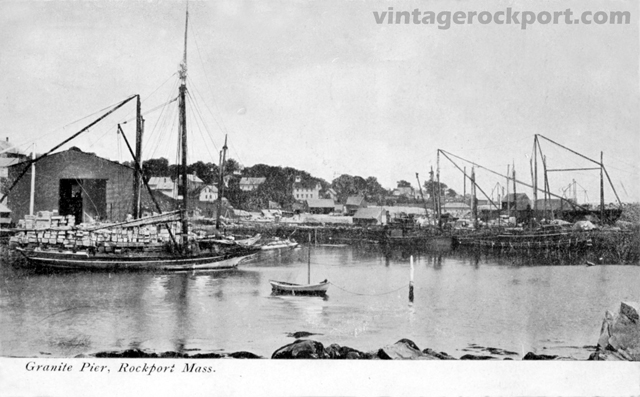
This is the first early-1900s postcard I’ve seen that refers to the Rockport Granite Company pier by the name Granite Pier. Although that is what we call it today, I had not previously found any references from that era that use the name.

This postcard was postmarked on June 18, 1908, and mailed to an address in Roxbury, Mass. The note on the back, dated June 17, urges the recipient to “begin to think about coming on the steamer.” The writer adds, “It has not begun to run yet but thought it was time for you to think it over and come before the fog.”

Posted in Uncategorized | Tagged , | 1 Comment