2012 Vintage Rockport Year in Review

The WordPress.com stats helper monkeys prepared a 2012 annual report for this blog.

Here’s an excerpt:

4,329 films were submitted to the 2012 Cannes Film Festival. This blog had 39,000 views in 2012. If each view were a film, this blog would power 9 Film Festivals

Click here to see the complete report.

Posted in Uncategorized | Leave a comment

Andrews Point Artists’ Camp, Rockport, Mass., circa 1909

Cape-Ann-Camp_post

[Note added 1/1/13: Turns out this was not at Andrews Point but was the summer camp of artist John I. Coggeshall in Lanesville. See my updated post here.]

The description that accompanied this postcard when I purchased it said that this was an artists’ camp on Andrews Point in Rockport. The card itself bears no title that identifies the location. The card was postmarked from Springfield, Mass., on Oct. 4, 1909. The sender describes the scene as “the camp on the Cape Ann shore where we spent our vacation.”

George A SwallowThe card was mailed by someone identified only as “Geo.” and was addressed to George A. Swallow in Brownsville, Vt. The website Find A Grave has a listing for a George A. Swallow of Brownsville. It includes the photo you see to the right, which is of Mr. Swallow. The note on the card refers to “mother,” leading me to wonder whether the two Georges were related.

As it turns out, Mr. Swallow was quite the amateur photographer. His primary occupation was running a general store and serving as postmaster in Brownsville. But he took many glass-plate negatives. Last year, the unattributed negatives were donated to the Vermont Historical Society. It took some sleuthing on the society’s part to track them back to Swallow. Now, they’ve posted his photographs to Flickr.

As I said, Mr. Swallow was the recipient of this card, not the sender. Thus, although he was an avid photographer, I have to assume he was not the photographer here.

This was a real-photo postcard, printed from an actual photo negative. The photo was badly faded and in poor condition. I attempted to restore it to a viewable level, but it is still in rough shape.

If anyone knows anything about this camp, I would love to hear from you.

Posted in Uncategorized | 2 Comments

Winter Scene on Granite St., Pigeon Cove, circa 1905

Pasture-Road-Winter_post

This is a real-photo postcard showing Granite Street in Pigeon Cove. At the center of the photograph are the two granite pillars that mark the beginning of Pasture Road. The two pillars, which remain there today, are each inscribed with the letter “C” to denote the entrance to what was once the Cleaves’ farm.

It is possible that this photograph is by Charles Cleaves, the photographer who founded the Rockport Photo Bureau.  This photograph comes from the collection of Rockport native Merry Seppala. It is not dated. The back of the postcard is undivided, which suggests it was printed prior to 1907, the year divided-back postcards came into use.

Note the trolley tracks running along Granite Street. As I’ve noted before, the trolley began service through Rockport on July 4, 1896, and operated until June 19, 1920.

Posted in Uncategorized | Tagged , , | Leave a comment

Found on the Web: Steel Derrick Quarry, 1906

Upper Pit Quarry

This is the Upper Pit quarry of the Pigeon Hill Granite Company, which is known today as Steel Derrick quarry. This picture was taken in 1906 for the U.S. Geological Survey. The view looks out over the quarry towards the southwest.

For a circa 1910 postcard view of this quarry, see this post. For a postcard view of the Pigeon Hill Granite Company docks, see here.

Posted in Uncategorized | Tagged , , | Leave a comment

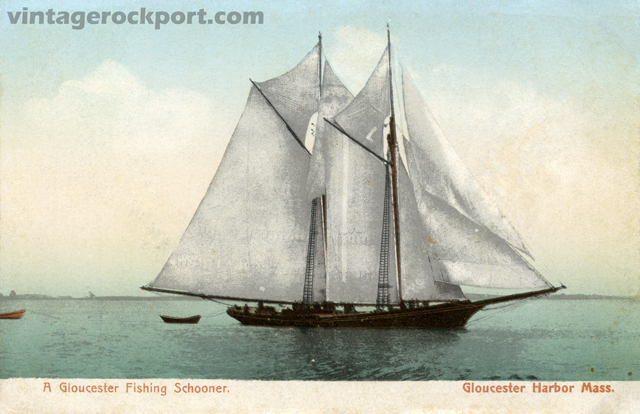
A Gloucester Fishing Schooner, Gloucester, Mass., c. 1905

This postcard shows a two-masted fishing schooner in Gloucester Harbor. Note the schooner’s clipper bow, curving upward from the waterline, and its long bowsprit.

The postcard was published by the New England News Company, which was in business from 1904 to 1924. It is an undivided back postcard, which indicates that it was published prior to 1907. It was printed in Germany.

Posted in Uncategorized | Leave a comment

Thatcher Island Lights from Turk’s Head Inn Piazza, c. 1918

Thatcher-Island-Lights_post

As I’ve previously noted, the Turk’s Head Inn was long considered Rockport’s grandest hotel. No doubt, this view was part of its appeal. According to the caption, this picture is form the inn’s piazza, looking out over Loblolly Cove towards Thacher Island and its twin lighthouses.

The view is similar to that of another postcard I’ve posted here, which I guessed was from somewhere in the vicinity of the Turk’s Head Inn.

This card does not name a publisher. It was postmarked in Rockport on Aug. 9, 1918.

Posted in Uncategorized | Tagged , , , , | 2 Comments

Docks of Pigeon Hill Granite Co., Rockport, Mass., circa 1910

Docks-of-Pigeon-Hill-Granit

The Pigeon Hill Granite Co.’s wharf was just north of the present-day Granite Pier (which was the Rockport Granite Co.’s wharf). The location was known as Colburn’s point and is now the location of private homes. The building in the center was the powerhouse and the sheds to the left were probably cutting sheds to shelter the stone carvers. In the right foreground is a pile of stone dust.

This same picture, although not as a postcard, is included in Barbara H. Erkkila’s book about the history of Cape Ann granite, Hammers on Stone. She estimates the date of the photo to be 1890.

The railroad tracks you see to the left were for an inclined railway that ran down from the company’s two quarry pits, the quarries known today as Steel Derrick and Parker’s. At the time, Parker’s was called the Pigeon Hill quarry and Steel Derrick was called the Upper Pit. For a view of Steel Derrick as it looked then, see my earlier post.  According to Erkkila’s book, a rail car broke loose at least once.

It was in February 1875 that a stonecar high up near Upper Pigeon Hill Pit, not far from the cutting shed, rammed into an empty car ahead of it, sending the second car forward with a terrific spurt. It broke its brake and hurtled down the hill, shot across Granite Street, and zoomed clear to the end of the wharf. There it leaped thirty feet into the air and fell with a tremendous splash beneath the surface of the water.

The Pigeon Hill Granite Co. was formed in 1870 by George R. Bradford, Anson Stimson, Amos Rowe and Levi Sewall. In 1871, the Massachusetts legislature authorized the company “to construct and maintain a wharf from the land of said company in Rockport, extending in a north-easterly direction towards, or to Colburn’s point, and to construct a breakwater from said Colburn’s point, in a south-easterly direction, to Bartlett’s, Dodge’s or Half tide rock, so called.” In 1914, the company was sold to the Rockport Granite Co. for $100,000.

This postcard identifies no publisher or date. It appears to be from the same publisher that produced the postcard of Steel Derrick that I mentioned above.

Posted in Uncategorized | Tagged , | 3 Comments

Found on the Web: Geologists at Whale’s Jaw, circa 1901

13661651

I have no idea who these men are, but given that the photograph comes from the collection of the Harvard University geology department, and is grouped with other photos of Cape Ann geology, I assume these men were visiting Whale’s Jaw in Dogtown to study it, not to picnic there.

The photograph is dated “190?” Given the attire of the men and the dates of other similar photographs, I believe this is from just after the turn of the century.

Click on the photo for a larger view. For another view of Whale’s Jaw, see this post.

Posted in Uncategorized | Tagged , | Leave a comment

View from Straitsmouth Inn, Rockport, Mass., circa 1920

View-from-Straitsmouth-Inn_

Last August, I put up a postcard showing a tennis court looking out towards Straitsmouth Island. I speculated that the tennis court was part of the old Straitsmouth Inn, on Gap Head Road off Marmion Way.  Now, here is another view of that tennis court. This time, the postcard’s caption leaves no doubt about the court’s location as being at the Straitsmouth Inn.

Note the Twin Lights of Thacher Island in the background and Straitsmouth Island in the upper right. The white building on Straitsmouth Island is, I believe, the boat house that once stood there, adjacent to the landing.

This card has no publication date or postmark. It was published by Arthur N. Burke of Waltham, Mass. This is the first postcard I have ever come across published by Burke. In Waltham, he was a teacher and then, for many years, the principal of Waltham High School. He was at Waltham High at least from the years 1905 to 1931, because I found references to him during those dates — possibly longer.

I also found a reference indicating that when he retired from the school, he moved permanently to Rockport.

Posted in Uncategorized | Tagged , | 1 Comment

Residence of J. F. Reynolds, Paradise Cliff, Rockport, Mass., c. 1908

Earlier this year, I posted a series of three views of Eden Road near Loblolly Cove that referred to Reynolds Rocks. Having never heard the name, I asked readers for information. A reader named Margot explained that Reynolds was the man who developed that area around the turn of the century. He was responsible for a development of shingle cottages on Athena Way called Paradise Cliff, she said.

Now, here is a postcard showing the home of J.F. Reynolds at Paradise Cliff. This house no longer stands; it was replaced by another house in the 1950s, and that new house has been further renovated in recent years. The location is 34 Eden Road, right where the road turns sharply, just above the bit of coastline known as Flat Rock. The new house was built to blend into the rocks, but if you look at it carefully, you can see that its foundation stands on the same rock seen in the lower-left of the postcard above.

From what I can find out about Reynolds, he was an artist who lived for a time in the South End of Boston. He lived in a building at 110 Tremont St. called the Studio Building, which housed artists’ studios, theater companies and other businesses. In December 1906, a fire heavily damaged the Studio Building and, in its wake, many of the artists who lived and worked there had their works stolen or vandalized. A 1918 directory of Boston businesses lists him as an artist and still at 110 Tremont.

I found a 1903 magazine advertisement in which Reynolds advertised the rental of what may have been this cottage. It said:

Cottage of 7 rooms and bath; town water, electric lights. high ground, fronting Thacher’s Island and ocean; wide piazzas; rent $350. J.F. REYNOLDS, 110 Tremont St., Boston, Mass.
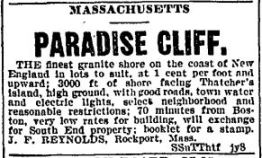
By 1905, Reynolds started advertising lots at Paradise Cliff for sale at 1 cent per foot or “exchange for South End property.” A Sept. 7, 1905, ad read:

Paradise Cliff. The finest granite shore on the coast of New England in lots to suit, at 1 cent per foot and upward; 3000 ft of shore facing Thatcher’s Island, high ground, with good roads, town water and electric lights, select neighborhood and reasonable restrictions; 70 minutes from Boston, very low rates for building, will exchange for South End property; booklet for a stamp. J.F. REYNOLDS, Rockport, Mass.
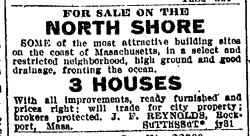
By 1910, Reynolds was advertising for sale three houses. An Aug. 4, 1910, described them as having “all improvements, ready furnished and prices right.” Again, he offered to trade “for city property.”

That was the last I could find about Reynolds or his real estate. If anyone knows more, please feel free to add it in the comments below.

This postcard does not identify its publisher. It is postmarked, but the date of the postmark is not legible. The stamp is Benjamin Franklin 1 cent stamp issued in 1908, so I estimate this postcard to have been published around that year.
Posted in Uncategorized | 1 Comment