Front Beach, Rockport, Mass., circa 1935

Apart from the styles of the bathing suits, this Front Beach scene from around 1935 looks pretty much the same today. What changes there have been are mostly architectural. The mansard-roofed building in the center background has been replaced by the Shalin Liu Performance Center. The building to the right, atop the granite wall, is (I believe) the old firehouse that would still have been in service then. (Here is a 1905 view of Front Beach with the firehouse.) And just beyond that would have been The Manning House, where the Captain’s Bounty Motor Inn is today.

This card was published by the Rockport Photo Bureau. It is postmarked in 1936 from Santa Barbara, Calif. Given that the picture was probably taken at least a year earlier (if not more), I estimate its date to be 1935. Charles Cleaves, the photographer who ran Rockport Photo Bureau, died in 1937. His daughter, Virginia Cleaves Little, continued to publish postcards into the 1940s.

Posted in Uncategorized | Tagged , , | 3 Comments

Town Hall, Rockport, Mass., circa 1909

Compare this postcard of Rockport’s former town hall with this black and white one. Also, read the text I posted along with that earlier card for some of the history of this building.

Neither of these two cards has a date. I guesstimated the date of the earlier card as 1910. This card appears to be even earlier. Note that there is no light pole in front of it, as there is in the other picture. Note also the horse and wagon parked in front. This card is no older than 1907, and I am going to guesstimate the date here as 1909.

I would love to hear from anyone who knows more about the history of this building. In particular, I would appreciate knowing when and why it came down.

The reverse side of this card has no postmark and identifies no publisher.

Posted in Uncategorized | Tagged | 1 Comment

Round House Studio of Harrison Cady, circa 1930

This distinctive round building, which still stands on Atlantic Ave. overlooking Rockport harbor, was for many years the studio of artist and illustrator Harrison Cady. Cady is best known for his collaboration with writer Thornton W. Burgess, producing dozens of books and hundreds of comics. In 1910, they published their first book, Old Mother West Wind, in which Cady illustrated characters such as Peter Rabbit, Jimmy Skunk, Chippy Chipmunk, Reddy Fox and many others. Besides producing numerous children’s books with Burgess, Cady drew comic strips, was an illustrator for Life and other magazines and newspapers, and created a variety of other illustrations and paintings, including many of Rockport.

A 1923 sketch of the studio from the Boston Daily Globe.

Cady was born in Gardner, Mass., in 1877, and died in 1970 in his home in New York City. At age 18, he moved from Gardner to New York and it was around then that he first visited Rockport. Regular summer visits soon turned into permanent summer residence here. In 1921, Cady was one of the founders of the Rockport Art Association.

I do not know when Cady first built this studio. It is described in a 1923 Boston Daily Globe article about the unusual buildings some Rockport artists used for their studios. According to that article, Cady constructed the studio from a former silo. Another source I read conjectured that the building was a former gas house from the old Annisquam Cotton Mill in Rockport. The Globe seemed to have gotten the silo story straight from Cady, so that may be the more credible report.

As far as I can tell, the house — also round — that is now attached to the studio was added after Cady’s death. Cady lived in a different house on Atlantic Ave. In a 1960 interview with the Boston Daily Globe, he said the house he lived in had been built in 1781, “with pirates’ money.”

To spend your career drawing rabbits and other animals for comics and children’s books no doubt requires a sense of humor. Cady had a good one, it seems. In that 1960 interview, he told the reporter that he and his wife were once on the other side of Rockport when they noticed smoke billowing out of their house. “We hurried home quickly and found 40 little rabbits sitting on our fence all smoking cigars,” he told the reporter.

In a 1945 newspaper interview, Cady talked about his long love of summering in Rockport. Alluding to the large summer colony of artists that helped cement Rockport’s fame, Cady quipped, “The only way to be inconspicuous in this town, I’ve discovered, is NOT to be an artist.”

This postcard was published by the Rockport Photo Bureau. It is undated. I am estimating the date of the card as 1930, but it could be earlier. Note the fishing schooner on the horizon.

Posted in Uncategorized | Tagged | 1 Comment

Pigeon Hill, Back When it was ‘Bald,’ circa 1915

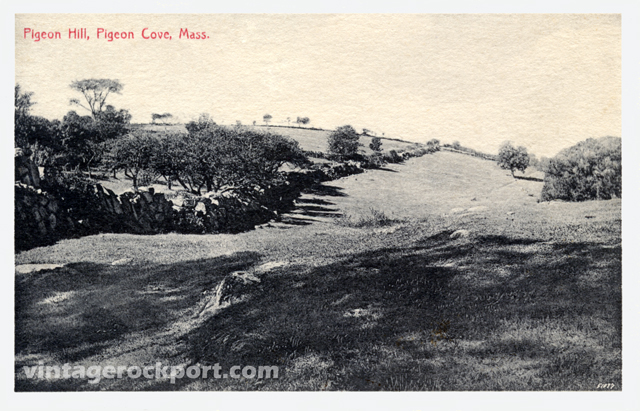
Pigeon Hill is the highest point in Rockport. As I wrote here before, its summit once provided a panoramic view that a writer in 1873 said “is excelled nowhere on the New England coast.” Now, the hill is overgrown with vegetation and the view is no more.

This postcard provides a clear view of just how “bald” the hill once was. The postcard bears a Pigeon Cove station postmark dated July 7, 1915. The card was published by Rockport Photo Bureau and printed in Germany.

Posted in Uncategorized | Tagged , | Leave a comment

Sandy Bay Club House, Rockport, Mass., circa 1913

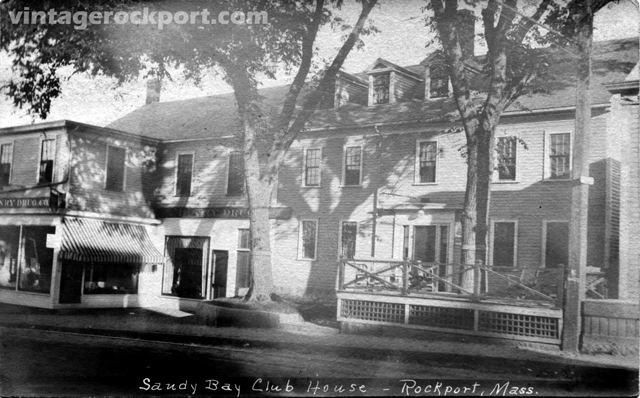
What you see in the picture is the building that currently houses the Rockport Art Association at 12 Main St. Built in 1787 and known as the Old Tavern, the building was originally a sea captain’s house. Over the years, it served as a tavern, an inn and a stage coach stop. The RAA moved in in 1929.

This card describes the building as the Sandy Bay Club House. The only reference I can find to a Sandy Bay Club around that time is to what is now known as the Sandy Bay Yacht Club. The yacht club was formed in 1885 and did not move to its present location until 1930. Was this the former location of the yacht club? If anyone knows, please help me out.

To the left of the photo, in the location now occupied by the Strisik Gallery, was a pharmacy, the McHenry Drug Co. It appears this pharmacy was short-lived. Based on state documents, it appears that this pharmacy opened for business in 1903, was organized as a corporation in 1907 and then dissolved in 1916.

This is what is called a Real Photo postcard, meaning it was an actual photograph developed onto postcard-sized photographic paper with a postcard back for mailing. The card is postmarked, but the last digit of the postmark date is blurred so that it could be either 1913 or 1918. According to one resource I found, this type of Real Photo card — bearing the Velox brand with diamonds in the corners — was produced only from 1907 to 1914. Thus, the year of the postmark must be 1913.

Posted in Uncategorized | Tagged | Leave a comment

Old Garden Beach, Rockport, Mass., circa 1912

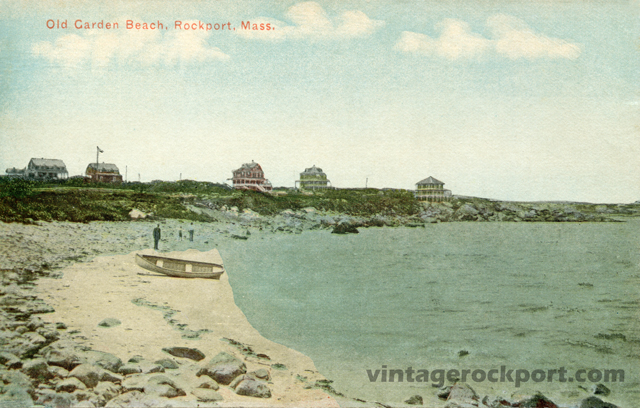
The image quality of this postcard is poor and no publisher or publication date are identified. Although no publisher is identified, the reverse side has a distinctive format that matches other cards I have with postmarks from 1910 to 1914.

Compare this picture of Old Garden Beach with this one from 1908.

Posted in Uncategorized | Tagged | Leave a comment

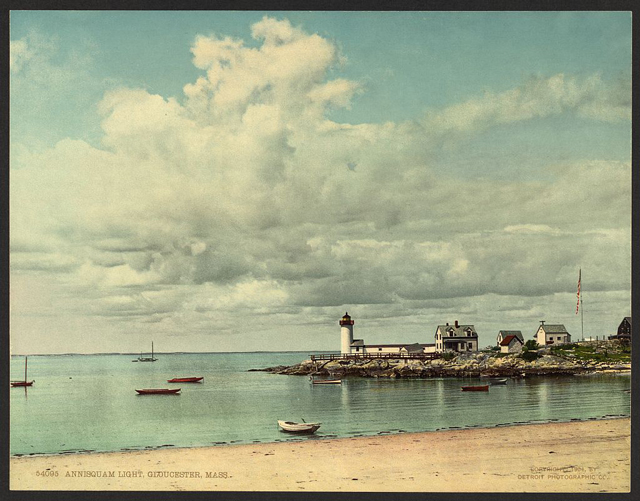
Annisquam Light, Gloucester, Mass., 1904

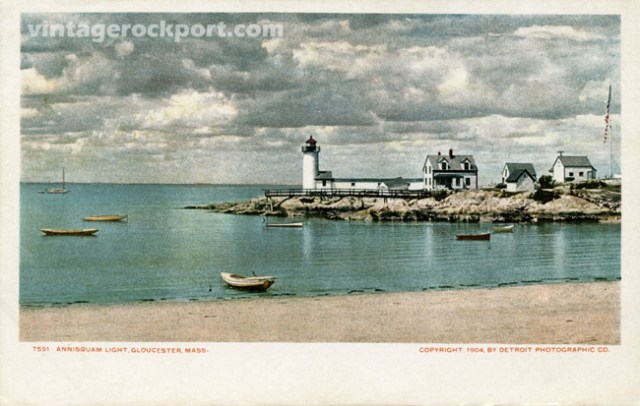
Forgive me this trespass into Gloucester and out of Rockport, but this photograph of the Annisquam Light is so beautiful I could not resist the temptation. Here you see both the postcard and the original image on which it was based.

This 1904 postcard was published by the Detroit Photographic Co. A year later, as the company concentrated its business on postcards, it changed its name to Detroit Publishing Co.

Posted in Uncategorized | Tagged | 2 Comments

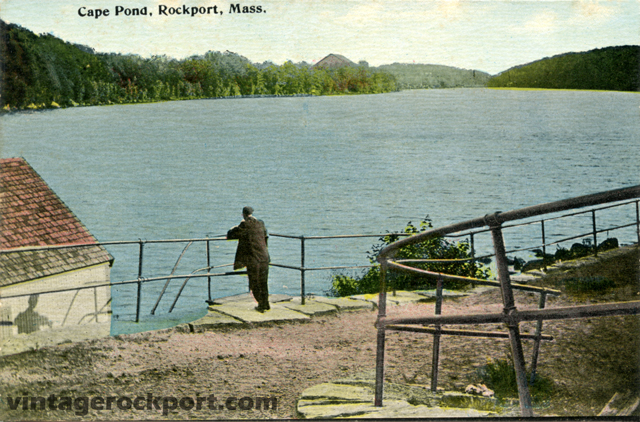
Cape Pond, Rockport, Mass., circa 1914

Nowadays, everyone on Cape Ann knows who holds bragging rights as the coolest guys around. But Cape Pond Ice became known well beyond Cape Ann when it was featured in both the book and the movie, The Perfect Storm. Cape Pond Ice is named for Rockport’s Cape Pond, where for many years the company harvested ice to supply Gloucester’s fleet of fishing schooners.

The company now known as Cape Pond Ice was started in 1848 by Nathaniel R. Webster, a blacksmith. He started by damming a brook in Gloucester and creating Webster’s Pond. (The pond was on Webster St., where Veteran’s Memorial School is now. Here is an 1889 map that shows its location.) Five years later, he expanded to Upper and Lower Day’s Ponds in Gloucester and to Cape Pond in Rockport. Much of this history is recounted on the Cape Pond Ice website.

John J. Babson’s 1860 book, History of the Town of Gloucester, provides a description of Cape Pond around the time Webster started taking ice from it:

[Cape Pond] is situated near the easterly end of the Cape; and is a beautiful sheet of water, covering about seventy acres. It is nearly environed by high and rocky hills, which on one side recede with abruptness from the shore. Perch and pickerel are occasionally caught there; but it is seldom visited for the purpose of fishing. The brook by which it has its outlet takes a westerly direction; and after flowing about two miles, in part through a swamp filled with the high blueberry and other shrubs, mingles its waters with those of the sea, at Mill River. Trout have been taken from this stream; but it is not so plentifully supplied with them as to make it a resort for anglers.

In 1858, Webster’s son, also named Nathaniel, took over the company. The company continued to thrive over the years, holding a monopoly on the ice business on Cape Ann. In 1870, the Massachusetts legislature authorized Webster to build a railroad running from Beaver Dam Farm (the site of the Babson cooperage museum on Eastern Ave.) to Cape Pond.

In 1898, the town of Rockport tried to put a stop to Webster’s ice business on Cape Pond. Four years earlier, in 1894, the state legislature authorized the town to take control of Cape Pond as a public water supply. In 1898, the town filed a lawsuit against Webster asking the court to issue a permanent injunction to stop him from cutting ice from the pond. The town won its case in the Superior Court, but Webster appealed to the state Supreme Judicial Court. In 1899, the SJC ruled that Webster could continue to harvest ice from Cape Pond, concluding that the activity had no effect on the town’s use of the water or on the purity of the water.

The two ice houses on Cape Pond, which you can see here, burned in the 1940s.

Another challenge to Webster’s business came from a competitor. In 1876, Francis W. Homans went into the ice business to compete with Webster. Homans constructed Fernwood Lake in West Gloucester and built ice houses there. He soon set off a price war, undercutting Webster’s price by selling his ice at $2.50 a ton and winning a great deal of the fishing industry’s business. Even when Webster cut his price to $2 a ton, fish dealers continued to patronize Homans, according to an account in the 1908 Cold Storage and Ice Trade Journal. In the late 1890s, Homans further secured the good will of Gloucester’s fishing community when he made a will that bequethed his business to the widows and orphans of fishermen and the Addison Gilbert Hospital.

Apparently, that all changed around 1908, when Homans, then aged 70, married a much younger woman. That year, Homans sold his business, the Fernwood Lake Ice Company, to the  company that then owned Cape Pond Ice, F.H. Abbott & Company. With that, Cape Pond once again became the sole provider of ice to fishing boats on Cape Ann, with the capacity to store some 120,000 tons of ice.

This postcard does not identify a publisher or a date of publication. It is postally unused, so there is no postmark. I have seen another copy of this same postcard that had a postmark of 1914. So I am estimating that it is from about that year.
Posted in Uncategorized | Tagged | Leave a comment

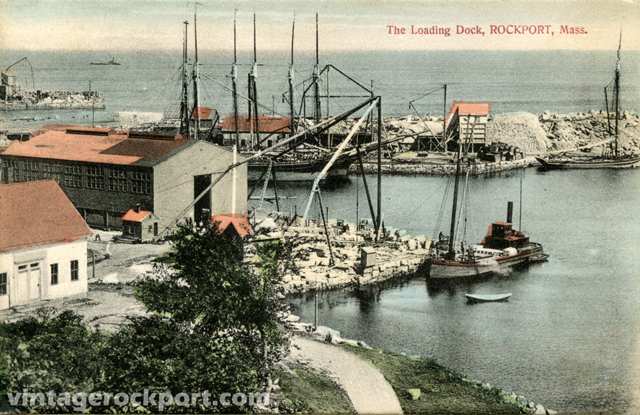
The Loading Dock (Granite Pier), Rockport, Mass., 1908

This postcard provides a view of the level of industry that once dominated Granite Pier in Rockport. Now primarily used to launch and moor recreational boats and some lobster boats, Granite Pier was once the primary point of transit for the Rockport Granite Company. (My last post showed a view looking out towards this pier from Flat Ledge Quarry, under the stone bridge.) The large buildings and three-masted schooners have long since disappeared from this view.

This postcard was published by the Souther-Mears Co., Boston, Mass., and was printed in Germany. According to the information I’ve been able to find, this company published postcards only for two years, 1908-1910. This postcard bears a Pigeon Cove postmark dated July 17, 1908 — almost exactly 103 years ago.

Posted in Uncategorized | Tagged , , | 4 Comments

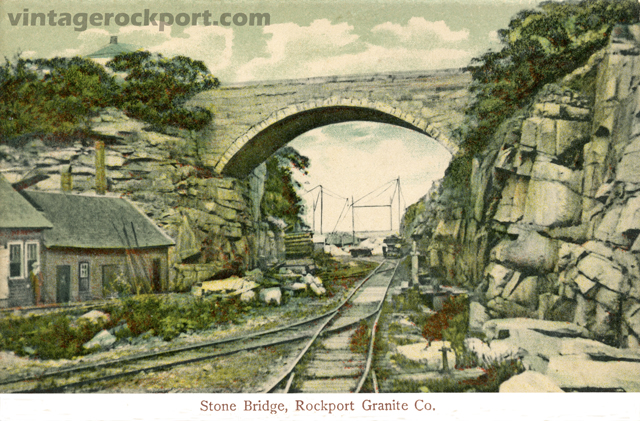
Stone Bridge, Rockport Granite Co., c. 1906

As I noted in an earlier post, the Rockport Granite Company built this 65-f00t arched bridge in 1872. It took just 11 weeks to build and, at the time, was one of the largest bridges in the state. The view here is from the Flat Ledge Quarry side, looking through the bridge towards the derricks on Granite Pier used to lift the quarried blocks of granite onto the schooners that would transport them to destinations far and wide.

The bridge not only still stands, but also is still the only direct route by car from Rockport to Pigeon Cove. Gone is the building you see here to the left and gone are the derricks on Granite Pier. And you can still stand under the bridge and hear your voice echo as you let out an expression of amazement at the durability of its stone arch construction.

The reverse of this postcard identifies no publisher or date of publication. It bears a postmark of Oct. 17, 1906.

Posted in Uncategorized | Tagged , , , | 4 Comments