Thatcher’s Island By Night, Rockport, Mass., 1924

Thatcher's Island By Night, Rockport, Mass.

This nighttime view of the northern lighthouse on Thacher Island is the product of the 1920s version of Photoshop. The image was colored to make it appear to be night, but the exact same image appears as a daytime view in other postcards from the same era.

The postcard was published by C.T. American Art, an imprint of Curt Teich & Company of Chicago, a company that was in business from 1898 to 1978. Teich numbered most of its postcards and there is a guide available that tells you the postcard’s year by its number. The number on this card is A-97021. According to the guide, that means it was printed in 1924.

Posted in Uncategorized | Tagged , | 1 Comment

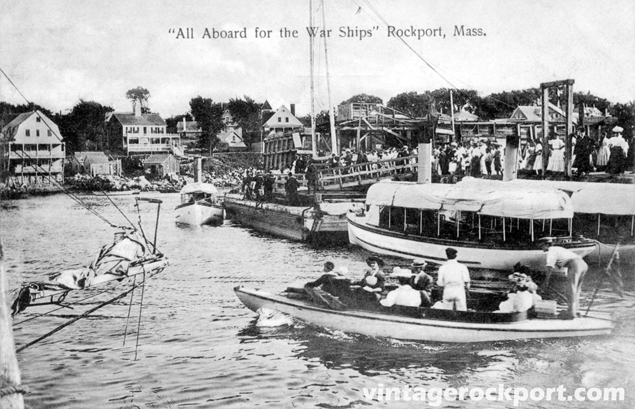
All Aboard for the War Ships, Rockport, Mass., circa 1907

As I’ve noted in several earlier posts, the annual summer visits to Rockport of the U.S. Navy’s North Atlantic Fleet were always a major event, with officers and sailors coming ashore for celebrations of every sort. But the visits were not all one way. Many townspeople and local dignitaries went out and visited the warships as well.

This postcard shows a shuttle heading out of the harbor and others in the background that could have been both dropping off sailors and picking up visitors. For another view of the same scene, see this postcard. I can’t say for sure, but it appears that these two photos could have been taken at the same time.

In the background, you can see the coal pocket where coal was stored on the end of T-Wharf. (Here’s another view of that.) To the left, you can see a bowsprit, probably of a fishing vessel.

This postcard does not identify a publisher. The card was printed in Germany and bears a Rockport postmark dated Aug. 14, 1911.

Posted in Uncategorized | Tagged , | Leave a comment

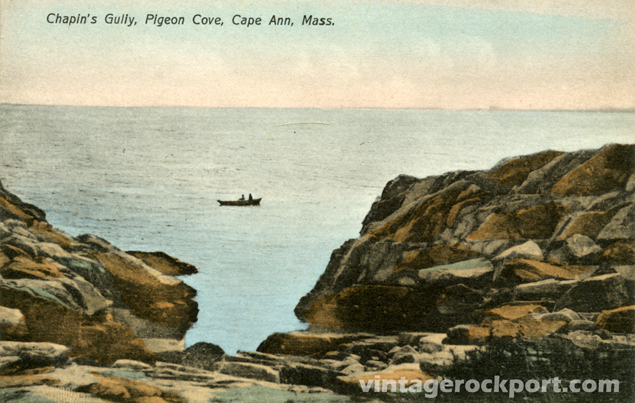
Chapin’s Gully, Pigeon Cove, Cape Ann, Mass., circa 1910

Chapin’s Gully was named for Edwin Hubbell Chapin, an internationally prominent 19th Century preacher, author and editor of the influential newspaper, the Christian Leader. Chapin spent some 30 summers in Pigeon Cove. He died at his cottage there in 1880, a few days before his 66th birthday.

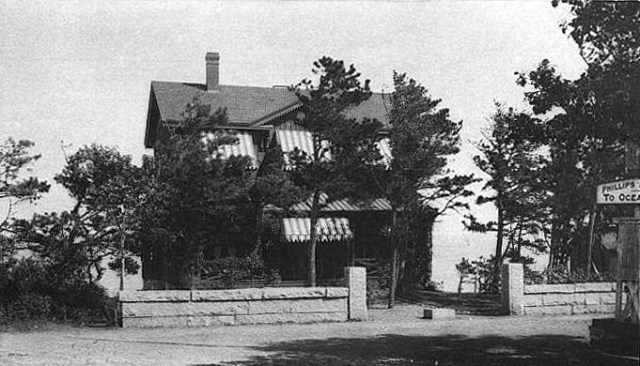
Chapin's cottage circa 1880.

Chapin’s cottage was just south of the gully, at 57 Phillips Ave., almost exactly at the intersection of Phillips Ave. and Point De Chene Ave. From there, he loved to swim in the gully. A biography, Life of Edwin H. Chapin, published in 1883, described it this way:

Outside of the Cove, stretching along the rugged bluffs which rise from the sea to the west, is a rambling street of spacious summer homes, and among these stands the picturesque cottage built by Dr. Chapin, and occupied, for a decade of summers at least, by the Chapin family. It is located on a site which was a great favorite with its builder, commanding an unobstructed sea view, and having a gradually sloping ledge, six or eight rods deep, from its waterside to the ocean, serving as a pleasant promenade. A few rods to the west is “Chapin’s Gully, a great notch cut into the shore of solid granite where it is highest and boldest.” The notch may be forty or more feet wide, and at its entrance from the land side is a broad rock, “at low tide half in the water,” known as Chapin’s Rock. This rocky enclosure seems made for a private bath, and here for nearly thirty summers was Dr. Chapin accustomed to go, with a chosen friend or two, to take his sport with the salt sea-water.

An 1876 issue of The Nation includes a classified advertisement for the Pigeon Cove and Ocean View hotels. The ad features this quote from Rev. Chapin:

I have spent my vacations for nearly thirty years at Pigeon Cove. I consider it one of the most healthy and delightful places for a summer residence on the New England Coast. There are ample facilities for bathing, boating, sailing, and fishing. The drives in the vicinity are very pleasant, and the ocean view is one of the grandest I have ever seen.

This postcard was published by E.C. McIntire of Gloucester and printed in Germany. Although it is undated, its reverse side is similar to other McIntire postcards I have from around 1910.

Posted in Uncategorized | Tagged , | Leave a comment

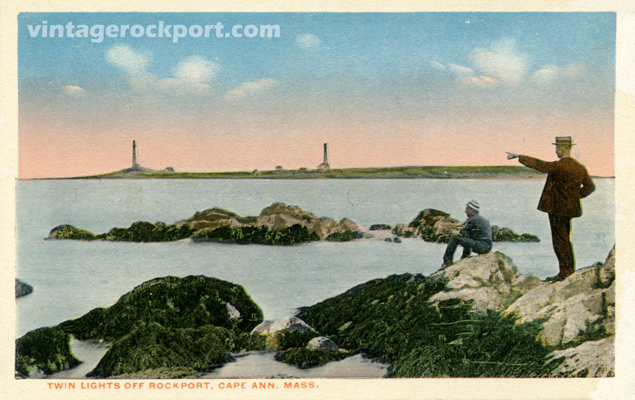
Twin Lights off Rockport, Cape Ann, Mass., circa 1902

The coloring is beautiful in this view of the Twin Lights on Thacher Island. The two men on the rocks appear to be looking not at the island, but at something to the left of it. We can only imagine what the man in the straw boater hat was pointing at.

The postcard provides few clues to help me date the image. No publisher is named and the card is unused and undated. The card itself was published sometime after 1906, because it has a divided back, which postal regulations did not allow until early 1907.

I looked at the image for clues. Straw boater hats were most popular from the late 1890s to around 1920. But they remained fairly common into the 1930s and, of course, can still be found today. So that doesn’t tell us much.

The best clue I can find as to the date of the image is in something missing from Thacher Island. I do not see the chimney of the whistle house. Look at this postcard from around 1922 and you can see the whistle house and its chimney to the left. Here is another view, from the shore looking out at the island, where you can clearly see the chimney between the two lighthouses.

The whistle house was built from 1886-1887. The chimney, however, was not constructed until 1903, according to the document filed to nominate the Twin Lights as a national historic landmark.

That would suggest that this image is from before 1903, even if the postcard was printed some years later. That’s the best evidence I have to go on. If anyone has any other ideas about this card, please let me know.

Posted in Uncategorized | Tagged , | 2 Comments

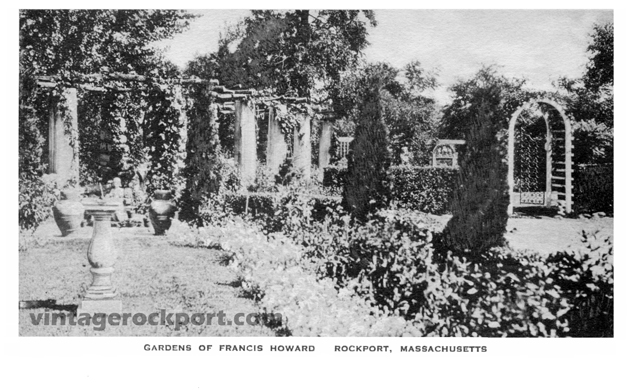
Gardens of Francis Howard, Rockport, Mass., circa 1928

Francis G. Howard was a nationally prominent landscape architect widely known for his designs of gardens and garden furniture and ornaments. Born in Maine in 1869, he lived in New York City and summered in Rockport, where he had a studio. He died in 1937. I do not know where his home was here and would appreciate hearing from anyone who does know. I assume the gardens shown here were at his home, but I do not know that.

Howard was popular as a landscape designer in New York social circles. Several news articles from the 1930s describe his work designing both permanent gardens and landscaping for special social events. Earlier in his career, he toured Spain and became an expert in Spanish gardens. In 1922, he delivered an address to the American Institute of Architects on the subject of Spanish gardens. The address was published in the April 12, 1922, issue of The American Architect. An even-earlier article, from 1919, describes Howard’s use of granite and wrought iron he collected from Italy to design wells for a garden in Connecticut.

Happy Shooting

'Young Diana' at the MFA.

Locally, Howard was known for designing the garden for the Hammond Castle in Gloucester, built by inventor John Hays Hammond Jr. as his home and to house his art collection. The garden, which featured a panoramic view of Gloucester harbor, was filled with many statues, but the focal point was said to be a statue called Young Diana.

Legend has it that the model for the statue was the actress Bette Davis, who is said to have posed nude for it in 1924, when she was 18 years old. The sculptor was Anna Hyatt Huntington, a prominent sculptor who also created the Joan of Arc statue in Gloucester. The Young Diana sculpture remained at the Castle until the 1970s, when it was donated to the Museum of Fine Arts in Boston. The museum lost track of it for several years until it was discovered tucked away in a storeroom. It is currently on display there.

A collection of Howard’s papers are held by the New York Public Library. The collection includes a letter from Howard’s father sent from the battlefield at Gettysburg after the Rebel retreat. There is also a reference on the Sandy Bay Historical Society website to a Francis Howard, architect, with regard to a record titled “General Plan of Old Commons and Baptist Church Land.”

This postcard was published by Rockport Photo Bureau. It has no date. Based on the similarity of the backside to other cards, it appears to be from sometime around 1928.

Posted in Uncategorized | Tagged | Leave a comment

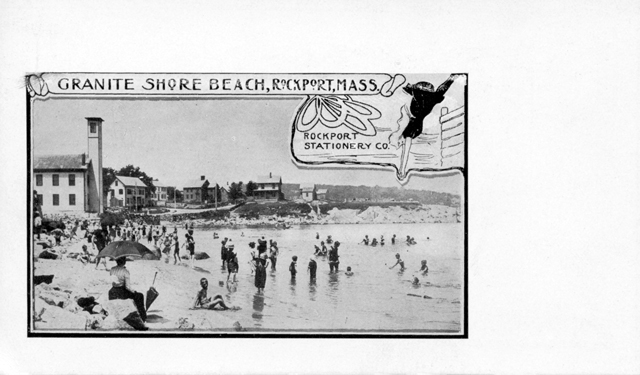
Granite Shore Beach, Rockport, Mass., circa 1900

Until 1898 in the U.S., only the U.S. government could produce what we think of today as postcards. Private companies could buy these government-issued “Postal Cards” with one side blank, print their own advertising on them, and mail them for one cent postage. In the 1890s, private publishers began to produce their own exposition cards and souvenir cards. These could be sent through the mail, but required two cents postage.

Under pressure from publishers to change the postal rules, Congress in 1898 authorized the use of private mailing cards. The law required that these cards be printed with the words, “Private Mailing Card, Authorized by Act of Congress of May 19, 1898,” on the back and be sized at 3.25 x 5.5 inches. In 1901, Congress changed the law again, allowing private publishers to use the name “Post Card” instead of “Private Mailing Card.”

Here you see a private mailing card from that 1898-1901 period. It is unused and undated, so I do not know the exact year. You can see that the image takes up only a portion of the card’s front, because postal regulations required that any message also be written on the front.

Astute readers of this blog may recognize the view of Front Beach on this postcard. It is the same picture as on another card I posted from 1906. The other card bore a 1906 copyright by Charles H. Cleaves. The card you see here was published by the Rockport Stationery Co., which operated a book and office supply store in town until 1913.

Posted in Uncategorized | Tagged , | Leave a comment

Odd Fellows Hall, Rockport, Mass., circa 1910

This building, which still stands at the corner of Broadway and School streets in Rockport, was originally built in 1855 as the chapel of the Second Congregational Church. By that year, attendance at the First Congregational Church (whose steeple you can see in the far right on this picture) had grown so large that the building could no longer seat everyone. For this reason, the church authorized 16 of its members to form the Second Congregational Church. At first, the members of this new church held their services in the vestry of the First Church. Later that year, they built this chapel (at a cost of $4,000).

By the time of the Civil War, the Second Church grew to some 80 members. But the combination of the war and the resignation of the church’s longtime pastor caused attendance to decline. In 1868, the church dissolved.

When the church dissolved, it sold the building to the Y.M.C.A. Later, the Y.M.C.A. sold the building to Granite Lodge, No. 127, International Order of Odd Fellows. An 1884 map shows the building as belonging to the Y.M.C.A., while the 1888 History of the Town of Rockport describes it as belonging to the I.O.O.F.

When the I.O.O.F. acquired the building, they raised it from its foundation and added another story underneath the main floor. They also added the iron fence you see here.

The I.O.O.F. was first organized in Rockport in 1848 with 20 members. by 1888, it had 230 members. Its purpose was to promote good morals and to watch over and provide for the needy.

Note also the building to the left of the hall. This building also still stands, albeit with some modifications, and is home to the Lantana House bed and breakfast.

This postcard was published by The Rotograph Co., New York City, and printed in Germany. It is not dated, but Rotograph published only from 1904 to 1911, and this card is from somewhere between 1907 and 1911.

Posted in Uncategorized | Tagged | 2 Comments

My Search to ID a Postcard Reaches a Surprise End

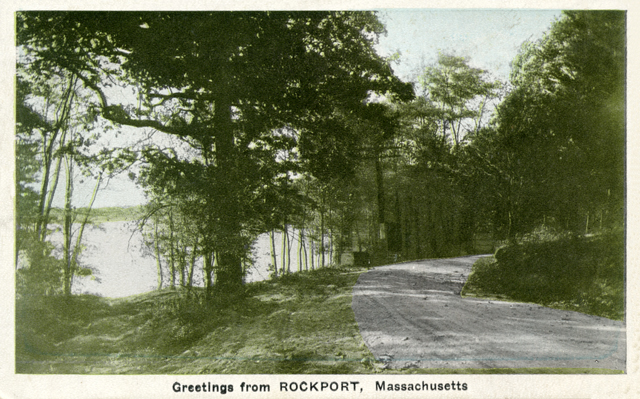
When I first saw this postcard, I wondered where it showed. The scene looked slightly familiar, but not exactly like anywhere I know in Rockport. As you can see, the card has no identifying caption, saying only, “Greetings from Rockport, Massachusetts.”

The only place I could think of that resembled this scene was on Rowe Ave., where it turns to a dirt road and passes Big Parker’s quarry pit en route to Stell Derrick Quarry. I thought the water to the left might be Big Parker’s. So I walked up there and found a very similar scene, which I captured in the photo below.
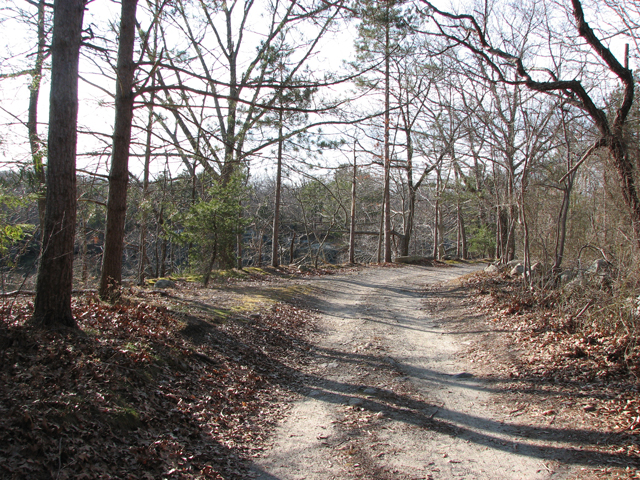
From my vantage point, you can’t see Big Parker’s to the left, but it’s right there, just on the other side of the ridge alongside the road. Granted, the scene wasn’t exactly the same, but few of these old postcard scenes look exactly the same all these years later.

Still, I wanted some further verification. I looked for clues on the reverse side of the postcard.

The wording that runs vertically on the left must be unique to a particular postcard publisher, I thought. I tried searching all of the phrase and then parts of it. After a bit of hunting, I was able to determine that this card was published by the Auburn Post Card Mfg. Company of Auburn, Ind., a company that was in business from 1913 to 1929. A little more hunting and I found an image of another postcard from this company.
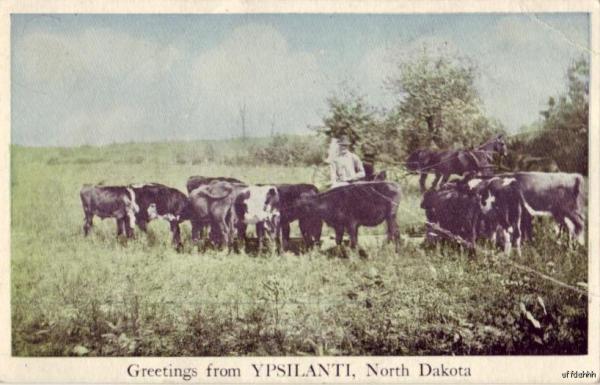
Although this one is from Ypsilanti, N.D., you can see the similarity in design and coloring, not to mention that identical “Greetings from … ” caption. And there, on the reverse, was some of the same identification, with “No. 2340” and “General Scenes” as on my card.

But there was something else on the back that I did not expect.

It appears that this was a sample used to sell the company’s postcards. And, as it says, this card is a sample of:

No. 2340. THREE-COLOR SCENES comprising 30 beautiful designs, printed with name of your town.

If I’m reading that correctly, then the scene in the postcard that got me started on this search in the first place is not even Rockport. It is a generic scene — one of 30 such scenes available from the company — printed with Rockport’s name.

So my search to identify a Rockport scene ended not in Rockport, but somewhere between Ypsilanti, N.D., and Auburn, Ind.

Posted in Uncategorized | 1 Comment

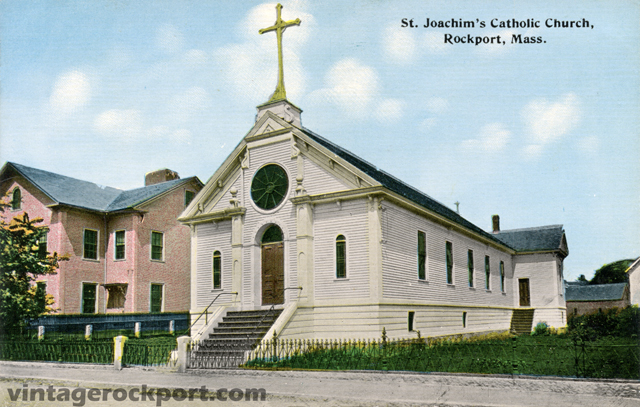
The Original St. Joachim’s Church, Rockport, Mass., c. 1915

This postcard shows the original St. Joachim’s Catholic Church on Broadway in Rockport. It was built in 1856 and stood until 1947, when it was razed to make room for construction of the larger church that now stands on the site. A 1947 newspaper article described it as the “church quarry men built,” a reference to the Irish immigrants who came to Rockport starting as early as 1830 to work in the quarries and who gave the town its first population of Catholics.

Starting in 1850, the number of the town’s Catholics had grown large enough that a priest from Salem would visit Rockport and say mass in local halls and homes. The church was built in 1856 as a one-story building level with the ground. It cost $3,000 to build. Twenty-five years later, the church was raised six feet, its roof was slanted, a new altar was installed, and new red stain glass windows were added. These improvements cost $3,600. The church remain unchanged from then until 1936, when a new heating plant was put in. In 1946, it was repainted and new lighting fixtures were installed.

When it was torn down, it was one of the oldest Catholic churches in use in the Boston diocese, second only to St. John’s Church in Quincy, built in 1853. While the new church was being built, masses were held in the auditorium of the old high school on Broadway. The current church, built at a cost of $65,000, was formally dedicated in August 1948.

The postcard was published by Tichnor Brothers Inc., a Boston publishing company. It has no date. Tichnor was in business from 1912 to 1987. By comparing the style of the front and back sides of this card to others from this publisher, this appears to be from its early years, in the 1912-1920 range.

Posted in Uncategorized | Tagged | 3 Comments

The Willow Walk, Rockport, Mass., circa 1910

This one has me stumped. The title is “The Willow Walk.” I know that Gloucester and Rockport had many fine willow groves, most notably the Annisquam Willows. But I can find no reference to anything in Rockport with the formal name, The Willow Walk. As a guess, I would say this is Pigeon Hill. If any reader has more information, please share it.

Compare this picture to this one by Charles Cleaves. Both show people strolling down a hill and have somewhat similar vantage points, except that there is no sign of Landmark Lane in this view.

As for the date, I am guess-timating about this also. The postcard does not identify a publisher or a date and there is no postmark. However, I have several cards with identical printing on the reverse, all from roughly around 1910.

Posted in Uncategorized | Tagged | 2 Comments