All Aboard for the Ballgame, Rockport, Mass., circa 1908

Rockport native Merry Seppala has graciously allowed me to scan some of her old postcards and photographs, which I’ll be posting from time to time here over the coming weeks. She has several one-of-a-kind photos, so stay tuned.

This postcard is from her collection. Although I’ve seen it published elsewhere, including in Marshall Swan’s 1980 book, Town on Sandy Bay, I love it because it is one of the rare postcards that shows the trolley that once circled Cape Ann. (Here is another.) It also illustrates the merriment that ensued whenever the warships of the North Atlantic Fleet were in town. And, of course, it underscores Rockport’s long-abiding love of all things baseball.

Swan’s book credits Dr. William D. Hoyt, a longtime collector of historic Rockport images, as the source of his image and says it is from about 1908. The trolley was on Broadway when the picture was shot and was headed to Webster’s Field on Nugent Stretch, Swan says.

A 1906 newspaper article described how every ship in the fleet had its own baseball team. The teams played each other in a full season of games, including a championship. During the fleet’s 1906 visit to Rockport, the article said, “baseball will be the feature sport of the stay here,” including the final games of the fleet championship.

As for the trolley, began offering service through Rockport on July 4, 1896. It ran from Gloucester to Rockport, then on to Pigeon Cove and Lanesville. Fare between Rockport and Gloucester was 5 cents. Those traveling on to the Cove or Lanesville had to pay 10 cents.

At first the trolley was immensely popular (except among a few Rockport merchants who complained that the trolley was taking their customers to Gloucester). But over time the townspeople started to grumble about rising fares, frequent breakdowns and excessive noise. With ridership having dropped severely and maintenance costs soaring, the trolley ran its last routes on the night of June 19, 1920.

This postcard does not identify the publisher. The only information on the reverse is that it was printed in Germany, as most postcards were prior to World War I.
Posted in Uncategorized | Tagged , | 2 Comments

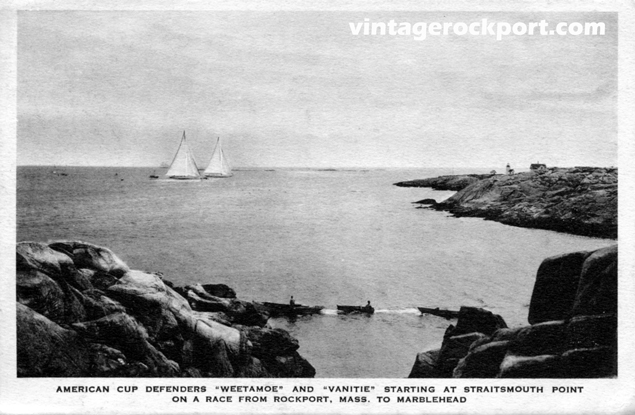
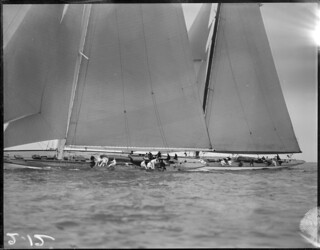
America’s Cup Defenders ‘Weetamoe’ and ‘Vanitie’ off Straitsmouth, 1932

In 1930, for the first time in America’s Cup competition, a universal rule was adopted for the design of eligible yachts, the J class. These J Class yachts had a waterline length of between 75 to 87 feet. Only 10 of these J class yachts were ever built.

In 1930, spurred by a challenge from Sir Thomas Lipton in England, racing the British yacht Shamrock V, Americans designed four J-class yachts as defenders: Enterprise, Whirlwind, Yankee and Weetamoe. Also, the Vanitie, which was built in 1914 for America’s Cup competition, was converted to J class, primarily for use as a trial horse to race other yachts.

Vanitie and Weetamoe racing close of Marblehead

Vanitie and Weetamoe racing close of Marblehead

Although some believed that Weetamoe was the fastest of the four, Enterprise was chosen to defend against Shamrock off Newport in 1930, ultimately winning the cup.

As the defending yachts prepared for the 1934 America’s Cup, Weetamoe competed against Vanitie in a series of races along the New England coast. On July 9, 1932, the last leg of the series ran from Rockport to Marblehead. Weetamoe beat Vanitie by 14 minutes to break a tie and capture the series win.

Weetamoe was designed by Clinton Crane and built  by Herreshoff Mfg. Co. It was financed by a syndicate that included magnates such as J.P. Morgan and Cornelius Vanderbilt, then was sold in 1930 to Fredrick Henry Prince, an investment banker who owned estates in Newport, R.I., and Wenham, Mass. Weetamoe was scrapped in 1937.

Vanitie was designed by William Gardner in 1914 and was a 1920 America’s Cup defender candidate. Gerard B. Lambert, part of the syndicate that financed Weetamoe, bought Vanitie in 1928 to convert her to J class and use her as a trial horse against the four new J class yachts. Vanitie was scrapped in 1938.

This postcard was published by Rockport Photo Bureau. It bears a 1933 postmark.

Posted in Uncategorized | Tagged , | Leave a comment

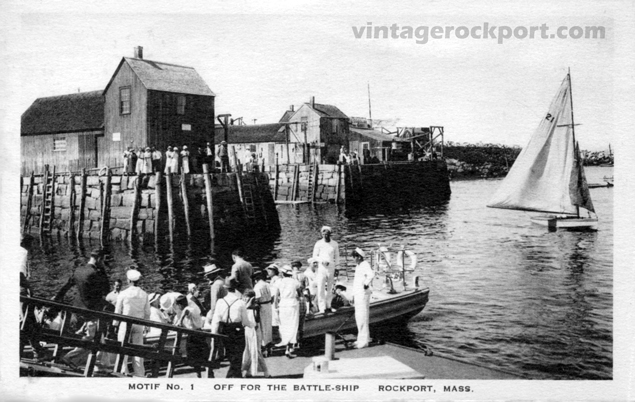
Motif No. 1, Off for the Battleship, Rockport, Mass., circa 1934

On this Memorial Day, here is a view of sailors departing from T-Wharf to return to their ship. I’ve posted other views of sailors arriving and departing — such as this from around 1907 and this also from 1907 — but this view appears to be from the 1930s.

The postcard was published by Rockport Photo Bureau. It bears a postmark from Aug. 28, 1940. Charles Cleaves, the owner of Rockport Photo Bureau, died in 1937. Although his daughter, Virginia Cleaves Little, carried on the business for another decade or so, postcards of her photos generally identified her as the photographer. Thus, this was most likely taken by Charles sometime before his death.

In the late 1800s and early 1900s, U.S. Navy warships visited Rockport virtually every summer. From what I can tell, however, the annual visits stopped sometime around 1910. Searching news reports, I can find only one reference to a battleship visit to Rockport in the 1930s, and that was in the summer of 1934. For that reason, I am estimating that to be the year this picture was taken.

Posted in Uncategorized | Tagged , , , | Leave a comment

Help Me Make Bail (and Help Send a Kid with Muscle Disease to Camp)

Believe it or not, I’m going to jail and I need your help. It’s not a real jail (I hope), but I’m raising bail to help children and adults with muscular dystrophy in my community who are supported by the vital work of the Muscular Dystrophy Association (MDA).
I’ll be participating in the Cape Ann MDA lock-up on June 6. If I raise my bail by then, I can go free and help a kid with muscle disease.

To help, please consider donating to my bail. Any amount helps and if I raise at least $800, it will pay for sending a kid to summer camp.

Donate here: Cape Ann 2012 LU: Mr. Robert Ambrogi – Muscular Dystrophy Association.

Posted in Uncategorized | Leave a comment

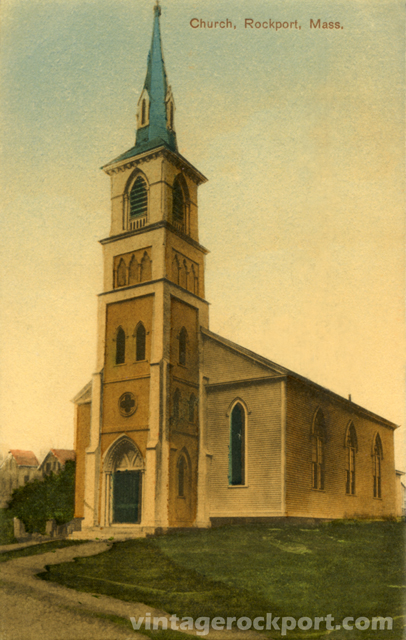
Universalist Church, Rockport, Mass., circa 1907

The loss of a lawsuit in the early days of Sandy Bay was the genesis for the construction of this church, which still stands on Cleaves St. in downtown Rockport. On Feb. 27, 1821, several prominent residents of Sandy Bay organized the Universalist Benevolent Society of Gloucester (as the village of Sandy Bay was still part of Gloucester then).

The church today.

At first, through an agreement with the Congregational Church, the Universalists held their services there. After several months, however, the Congregationalists evicted them. The Universalists brought a lawsuit against the Congregationalists. After dragging on in court for several years, the lawsuit was decided in favor of the Congregationalists.

For awhile after being denied access to the Congregational Church, the Universalists worshiped in a schoolhouse in Sandy Bay. In 1829, they completed construction of a meetinghouse of their own. The meetinghouse was dedicated in a ceremony on Oct. 8, 1829. In 1839, the society was formally incorporated as the Second Universalist Society of Gloucester. In 1845, its name was changed to the First Universalist Society of Rockport.

In 1868, a number of repairs and improvements were made to the original meetinghouse. The tower and spire were added and the interior was improved with new pulpit, pews and windows. The building was enlarged with the addition of a pastor’s study and an organ loft.

This postcard bears a postmark of Sept. 12, 1907. The postcard was published by The Robbins Bros. Co., of Boston. It was printed in Germany and distributed by the Metropolitan News Company of Boston.

Posted in Uncategorized | Tagged | 1 Comment

Vintage Rockport Featured in Film About Shalin Liu

We are proud to report that a Vintage Rockport postcard is featured in a new video about the construction of the Shalin Liu Performance Center in Rockport. The video, created by videographer Elissa Mintz for the website US Building Digest, looks at the construction of the center and the challenges of transforming a historic building into a concert hall with optimal acoustic and concert-viewing features. It features an interview with Alan Joslin of Epstein Joslin Architects, the firm that designed Shalin Liu. Our contribution was a 1911 view of Main St. showing the original building where Shalin Liu now stands.
You can watch the video here: Historic Building Meets Today’s Technology: the Shalin Liu Performance Center.

Posted in Uncategorized | Tagged | 1 Comment

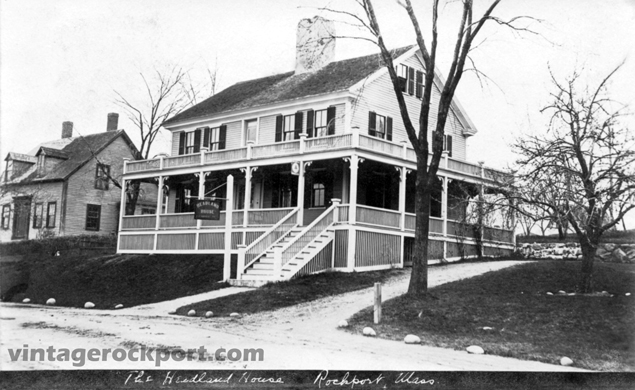
Two Views of the Headland House, Rockport, circa 1912

These views may be black and white, but this house at 10 Atlantic Ave. in Rockport has a colorful history.

As of the time of these two postcards, the Headland House was a hotel. You can see the sign hanging in front that says its name. Thanks to the classified ad to the right, we know that as of 1915, it was operated by Mrs. Henry F. Bartles. In 1913, the Headland House was listed as for sale. I do not know if that is when the Bartles bought it. The for-sale ad described it as having been a hotel for 10 years.

Mr. and Mrs. Bartles lived in the Headland House as well. Mr. Bartles was a fisherman who, as of around 1900, owned a 44-foot sloop named the Golden Eagle, which was built in 1890.

But the story of this house starts with pirates’ gold. The tale is well known around Rockport of 13-year-old Caleb Norwood’s discovery of buried pirates’ treasure at Gully Cove in 1752. Thanks to the treasure, the story goes, Caleb grew up to be a wealthy man. He and the Norwood family built several houses in the area that now extends out to the Headlands. The Inn on Cove Hill is one and the Headland House — built in 1781 — is another.

Melinna and Harrison Cady in Venice in 1931.

The house’s history took another notable turn in 1920. That year, famed artist and illustrator Harrison Cady bought it as his summer home. I previously published a postcard showing Cady’s unique round studio on Atlantic Ave. Today, that studio is attached to a house, but when Cady occupied it, it was just the studio. Cady and his wife Melinna lived in the Headland House. According to several news reports, Cady — who had a robust sense of humor — liked to brag about the fact that his home had been built with pirates’ gold.

For at least part of the time that the Cadys owned it, the Headland House continued to operate as a hotel. A 1942 business directory listed it as a hotel, naming Melinna Cady as the proprietor.

Mrs. Cady died in 1956, at age 71. Harrison Cady died in 1970. After Cady died, Thomas Grossman, a local real estate developer, purchased the Headland House and converted it into four condominiums. As you can see from the ad pictured here, the units were offered for sale at a starting price of $39,500.

As a footnote, the Cadys, when they were not in Rockport, lived in Manhattan at 27 West 67th St., on Central Park West. This was a studio building that housed many artists. The building was developed by famed impressionist artist Childe Hassam, who, as it turns out, was himself a frequent visitor to and painter of Rockport and Gloucester.

With regard to these two postcards, the top one is a real-photo postcard, meaning it was not mass produced, but created from an actual photograph. The second postcard was published by J. Sidney Poole, a Rockport pharmacist who operated out of the building at the corner of Main and Beach streets. It is interesting that the two images share virtually the identical angle, although they were clearly taken in different seasons of the year.

Posted in Uncategorized | Tagged , | 2 Comments

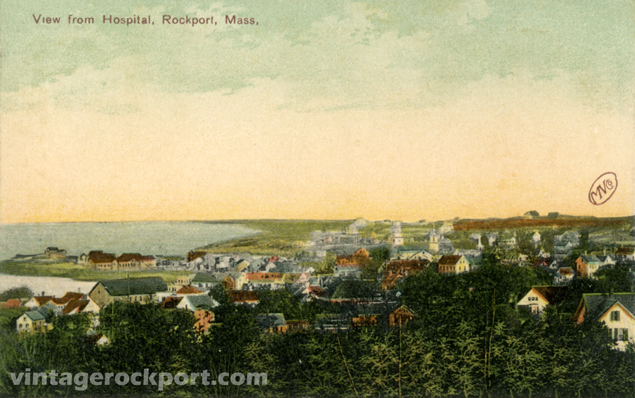
View from Hospital, Rockport, Mass., circa 1908

Here is a unique postcard showing the view out over Rockport from the Leander M. Haskins Hospital at the top of Summit Ave. (I’ve written before about the hospital and the man it was named for.)

I find myself stumped trying to figure out the brown-roofed building on the left. It appears to be on Bearskin Neck, but I am not aware of there ever being so large a building on the Neck. If you know what it might be, please let me know.

The postcard was published The Robbins Bros. Company, Boston, and printed in Germany. The company was in business only from 1907 to 1912. Robbins had many of its postcards printed and distributed through the Metropolitan News Company, a larger Boston postcard publisher, which is indicated here by the “MN Co” logo on the right side of the card.

(On Tuesday, May 8, 2012, the Sandy Bay Historical Society will present a lecture on the Haskins Hospital, featuring Debra Legg and Gwen Stephenson. The event is at 7:30 p.m. at the Rockport Public Library.)

Posted in Uncategorized | Tagged | 2 Comments

Missing Historical Marker at Benjamin Tarr House on South St.

The 1930 historical marker for the Benjamin Tarr House at 23 South St. has been torn down.

Here is how it looked before.

These markers were erected in 1930 by the Massachusetts Bay Colony Tercentenary Commission to mark “the ancient ways of the Puritan times and the structures or places relating to or associated with the early settlements within the commonwealth.” Nearly 300 of these cast-iron markers were installed around the state. Rockport had seven of them:

  • “Old First Parish Burying Ground” on Back Street.
  • “First Settler” on Main Street.
  • “John Pool” on King Street.
  • “Old Stone Fort” on Bearskin Neck.
  • “Bear Skin Neck” at Dock Square.
  • “Samuel de Champlain” on South Street.
  • “Benjamin Tarr House” on South Street.

If someone took this down as a prank, let’s hope the person returns it.

Posted in Uncategorized | 11 Comments

Congregational Church, Pigeon Cove, Mass., circa 1908

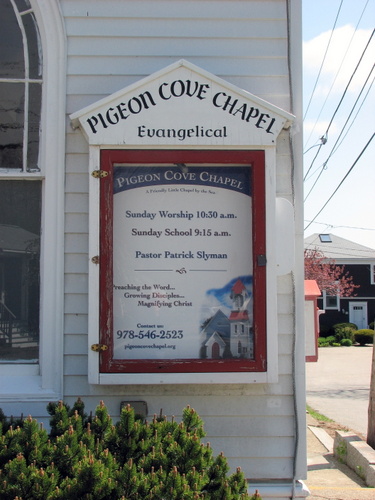
This church, formerly known as the First Church of Christ, still stands today as the Pigeon Cove Chapel, located at 155 Granite St.

The church as it looks today.

The church actually grew out of a Sunday school. In 1857, two local teachers, Ellen H. Gott and Lyman B. Stockman, decided to start a Sunday school for the children of Pigeon Cove. The school held its first class on May 31, 1857, when 43 students met in a building known as Woodbury’s Hall. Later that year, the Sunday school moved to a Pigeon Cove schoolhouse.

In 1863, the Sunday school moved to this chapel building. Apparently, the chapel was still a work in progress at that point, because its construction was not completed until 1868. The completed chapel was dedicated at a ceremony in January 1869.

Even then, work continued. In 1873, the tower was erected, a bell was purchased and a fence was built. The bell first rang on Sunday, Aug. 24, 1873 — marking the first time that villagers in Pigeon Cove were called to church by the ringing of a bell.

The next year, 1874, the church was formally organized as the First Church of Christ at Pigeon Cove, with 19 members. Later that year, it was formally recognized as a Congregational Church. According to the 1888 book, History of the Town of Rockport, a separate Swedish service was also held in this church every Sunday afternoon.

In his wonderful essay about growing up in Rockport, Where I Come From, writer Kevin Baker describes the town as “choc-a-bloc with churches,” but says this one was where you’d find him:

I was brought up mostly in the Pigeon Cove Chapel, an Evangelical church which billed itself as “A friendly little chapel by the sea.” There used to be even more places of worship, but these were Scandinavian-language churches that went out of business and were converted into private residences as their congregations learned English.

This postcard was published by Souther-Mears Co. of Boston, Mass. Because the company was in business only from 1908 to 1910, I estimate the postcard to be around 1908, although the photo could be even older.

Posted in Uncategorized | Tagged , | Leave a comment