Rockport Then and Now — Motif No. 1

Three Fishermen of Cape Ann

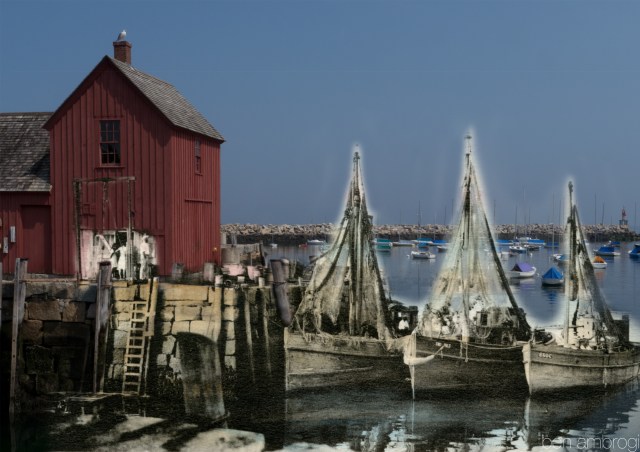
Here is another “then and now” image created by my son, Ben Ambrogi, by fusing a scene from an old postcard with the same scene as it looks today. For another “then and now” image, see Rockport Then and Now — In a Single Image.

In this one, he used a circa 1942 postcard, Three Fishermen of Cape Ann, published by Rockport Photo Bureau and probably photographed by Virginia Cleaves Little. He merged it into a photo he shot, trying to capture the perspective (and tide) as closely as possible.

As you can see from the original below, he kept the boats, parts of the wharf as it was then, and the people going into the old Motif No. 1. (The building was destroyed in the Blizzard of 1978 and a replica was built later that year.)

Three-Fishermen-of-Cape-Ann

Posted in Uncategorized | Tagged , , | 5 Comments

Rockport from the North, circa 1909

Rockport-from-the-North-pos

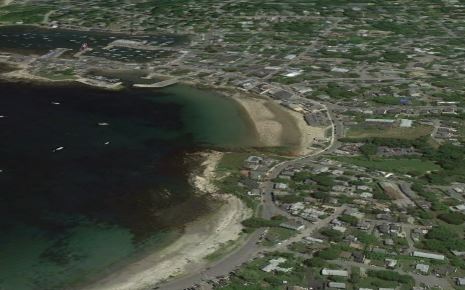
Here you see a view of Rockport from above Beach Street looking south. In the foreground is Back Beach. Towards the middle of the image is Front Beach. Farther on is the town of Rockport, where you can see the steeple of the Congregational Church at just about the center of the image and the steeple of the Unitarian Church to the right of it. Towards the left is White Wharf.

Back Beach from North

Google Maps view of the area shown in the postcard.

I tried to find the spot from where this picture was taken, but was thwarted by the fact that I would have had to go onto private property.

As best as I can tell, it was taken from the area above Granite Street, roughly in the vicinity of where Granite and Beach intersect. In the elevated area above that, there are several rocky outcroppings where the photographer might have stood. Today, there are condominiums and private homes in that area.

This postcard was published by the Rockport Photo Bureau. Based on the markings and numbering on the reverse, I estimate it to be from around 1909.

Posted in Uncategorized | Tagged , , , | 1 Comment

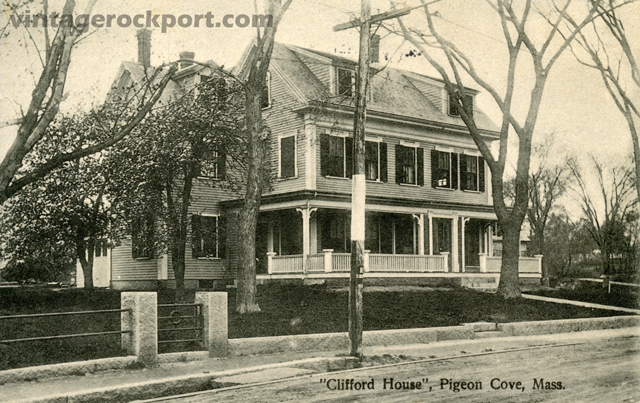
Clifford House, Pigeon Cove, Mass., c. 1912

Clifford-House-post

The longer I write this blog, the more I learn that seemingly every house in Rockport has a story to tell. The Clifford House — which still stands at 182 Granite St. in Pigeon Cove — is no exception. What makes this house so interesting is the woman who owned it — a woman so active in social, political and religious affairs that she was included in the 1914-1915 edition of Woman’s Who’s Who of America.

Clifford-House-Today

The Clifford House as it looks now.

The Clifford House was built in 1900 by Mrs. Caroline Wheeler Babson, who operated it for many years as a guest house. I do not know how long she kept it as a guest house, but I do know that she died in 1932.

Mrs. Babson, who was born on March 31, 1856, was the daughter of Addison Gilbert Wheeler and  Isabella (Gilmore) Wheeler. As best as I can tell, Mr. Wheeler was no relation to the Addison Gilbert whose 1888 bequest established the Addison Gilbert Hospital. It is possible that Mr. Wheeler was named in honor of Mr. Gilbert, who was already a prominent banker by the time Mr. Wheeler was born.

I presume but cannot confirm that Mr. Wheeler was part of the Wheeler family that was long prominent in Pigeon Cove. Wheelers were among the earliest residents of Pigeon Cove and the Wheeler Tavern was long a popular stopping-off point in the Cove.

The young Caroline Wheeler graduated from Mt. Holyoke College in 1876 and, four years later, on Feb. 10, 1880, married David Clifford Babson. Babson was a direct descendant of James Babson, who in 1662 obtained the area’s earliest grant of land for the site along Nugent Stretch that now houses the Babson Cooperage Shop. It was another Babson, Ebenezer, who supposedly had the encounter with a bear that gave Bearskin Neck its name. And a Babson also owned the farm and quarry that is now Halibut Point State Park. David Babson’s father, David Babson Jr., became one of the original Rockport selectmen when the town was incorporated in 1840. 

When Caroline and David married in 1880, it was Mr. Babson’s second marriage. Although she was just 24, he was nearly twice her age, 46. His first wife, Sarah Elizabeth Abbot, with whom he had eight children, died in 1878 at the age of 44. Well before 1880, Mr. Babson had established himself as a prominent businessman in the fishing industry. At various points over the years, he had been joint owner of several fishing schooners, including the Revenue, the Horatio Babson, the Abigail C. Woodbury (which was lost with all crew in a gale in 1869), the Urania, the Laura M. Mangam, the Flying Arrow and the Pocomtuck.

Mr. Babson died on June 17, 1897, at the age of 63. (He is buried at Locust Grove Cemetery in Lanesville.) He and Caroline had no children. Three years after his death, Mrs. Babson built the Clifford House. I have to presume she named it for her husband’s middle name. A 1910 newspaper article had this to say about the Clifford House:

The Clifford House, Pigeon Cove, Mass., is particular to give its guests every possible attention. It sets a good table and has the comforts and conveniences of a well-ordered home. Circulars and particulars regarding the house may be had by writing Mrs. C.W. Babson.

Throughout her life, Mrs. Babson was active in social, political and religious activities. In 1884, she was one of several Massachusetts residents who petitioned the state legislature to pass a law “enabling women to vote on all questions that may be submitted to the people relating to the manufacture and sale of intoxicating liquors.” In 1889, the minutes of the annual meeting of the Woman’s Universalist Missionary Society listed her as its “local agent” for the parish of Pigeon Cove.

Her Who’s Who listing (right) described her as “interested in abolition of death penalty and world’s peace movements” and as someone who “favors woman suffrage.” She was described as a Univeralist who was a member of the Massachusetts Prison Association, the Women’s Universalist Missionary Society, the American Association for Labor Legislation, the Anti-Death Penalty Society, the Prison Reform League, the Cape Ann Scientific and Literary Association, and other organizations. A 1916 publication, The Official Register of Women’s Clubs, listed her as president of the 20-member Pigeon Cove Reading Circle.

She was also an active ornithologist and was involved in various ornithology organizations. A 1914 publication of the American Ornithologists’ Union listed her as an associate member. In 1919, an Audubon Society ornithology publication listed her as having donated $1 towards building a memorial fountain in honor of Theodore Roosevelt for the inspiration he gave “to naturalists, bird-lovers, conservationists and sportsmen.”

Mrs. Babson died in 1932 at the age of 76. A news report said that, in her will, she left a sum of about $2,500 “to go towards building an annex to the town library at Rockport for children.” She also left bequests to the Women’s International League for Peace and Freedom, Addison Gilbert Hospital and Mt. Holyoke College.

This postcard does not identify its publisher. It was postmarked from Pigeon Cove on Aug. 9, 1912.

Posted in Uncategorized | Tagged , | 5 Comments

Main Street, Rockport, Mass., Looking West, c. 1912

Main-Street-Looking-West-po

Horse-drawn wagons and carriages mix with motorized automobiles in this old view of Main Street in Rockport. The photographer, Charles Cleaves, would have been standing at the corner of School and Main streets. Behind him would have been the post office and the Granite Shore Hotel. To the left in the picture is the front lawn of the Congregational Church.

On the right side of the street, a woman walks holding a parasol. There are three signs above her. One reads, “Gloucester Electric Co.” Another, just below it, says, “Post Cards, Toys, Fine Candies, Etc.” I can’t make out the third. Farther down the street, beyond the wagon, where Main Street and Beach Street meet, the large sign says “Drugs” where Poole’s Pharmacy long stood.

Along the left side of the street, you see the tracks for the trolley that ran from Gloucester through Rockport to Lanesville. It operated from 1896 to 1920.

This card was published by the Rockport Photo Bureau. It has no date. Various clues — such as the presence of wagons and the age of the cars and markings on the reverse of the card — suggest this image is from roughly 1912-1915.

Posted in Uncategorized | Tagged , | 2 Comments

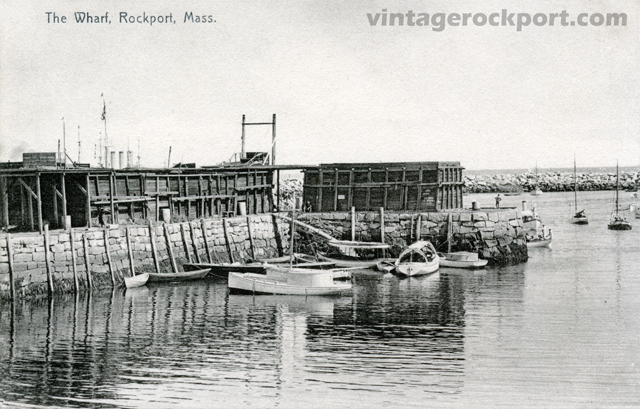
The Wharf (T-Wharf), Rockport, Mass., circa 1906

The-Wharf-Rotograph-post In this postcard, the wooden structure you see on T-Wharf is the coal pocket where coal was once stored there. Just to the right of the wharf, a shuttle boat is approaching with a uniformed sailor standing in the bow, probably carrying crew from one of the U.S. Navy warships that regularly visited Rockport in those days. On the left side of the picture, you can see the three smokestacks of one of the battleships.

This photograph appears to have been taken at the same time as the one you see in this postcard from the same publisher. You can see the same shuttle boat tied up to the pier and the same small sailboat to the right of it.

The postcard was published by The Rotograph Co. of New York City. It is undated. The company was in business only from 1904 to 1911.

Posted in Uncategorized | Tagged , , , | Leave a comment

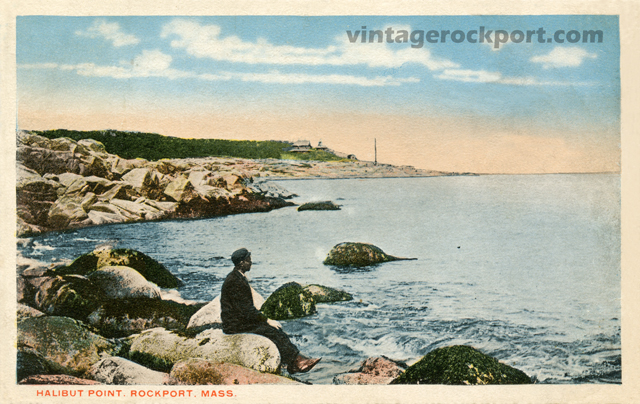
Halibut Point, Rockport, Mass., circa 1915

Halibut-Point-post

The northeast tip of Cape Ann in Rockport is known as Halibut Point. Once the Babson Farm quarry, today it is a state park. On a clear day, the view from Halibut Point extends all the way to Mount Agamenticus in Maine and the Isles of Shoals of the coast of New Hampshire.

No doubt, the man in this postcard was enjoying that very view in this scene from around 1915. The postcard does not identify a publisher or a publication date. It is postmarked Nov. 14, 1916. The note on the reverse side indicates that it snowed a bit that day and was quite cool.

I am not sure what the pole is on the far point. Possibly it is a derrick used to hoist granite blocks onto waiting schooners at either Lanes Cove or Bay View in Gloucester.

Posted in Uncategorized | Tagged | 1 Comment

A 1939 News Article About Haskell’s Camp and the Origin of the Name ‘Loblolly’

As I explained in a separate post, Cindy Haskell is a descendant of the family that operated Haskell’s Camp at Loblolly Cove in the early 1900s. She sent me the following newspaper article from 1939, which she transcribed from what she described as a poor-quality print copy. The photos are also scans from that article, which is why they are also of poor quality. 

At Loblolly Cove a Duke’s Descendant Serves You Sea Food Fit for the Minor Gods

BY FREDERIC C. SHARON, 1939

Do you like shore dinners? Of course you do if they are good. To be good, the clams must be fat and tender, the lobster must be broiled to perfection, the fish must be freshly caught and properly browned, the doughnuts must melt in your mouth.
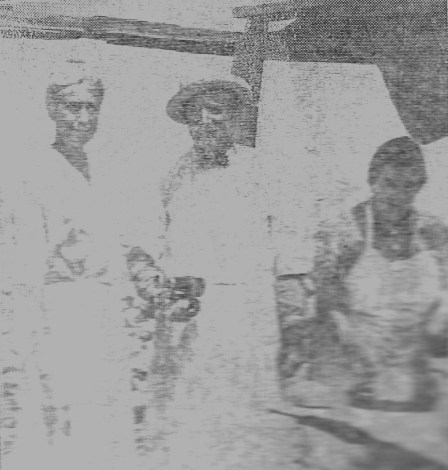
Haskells Camp 1

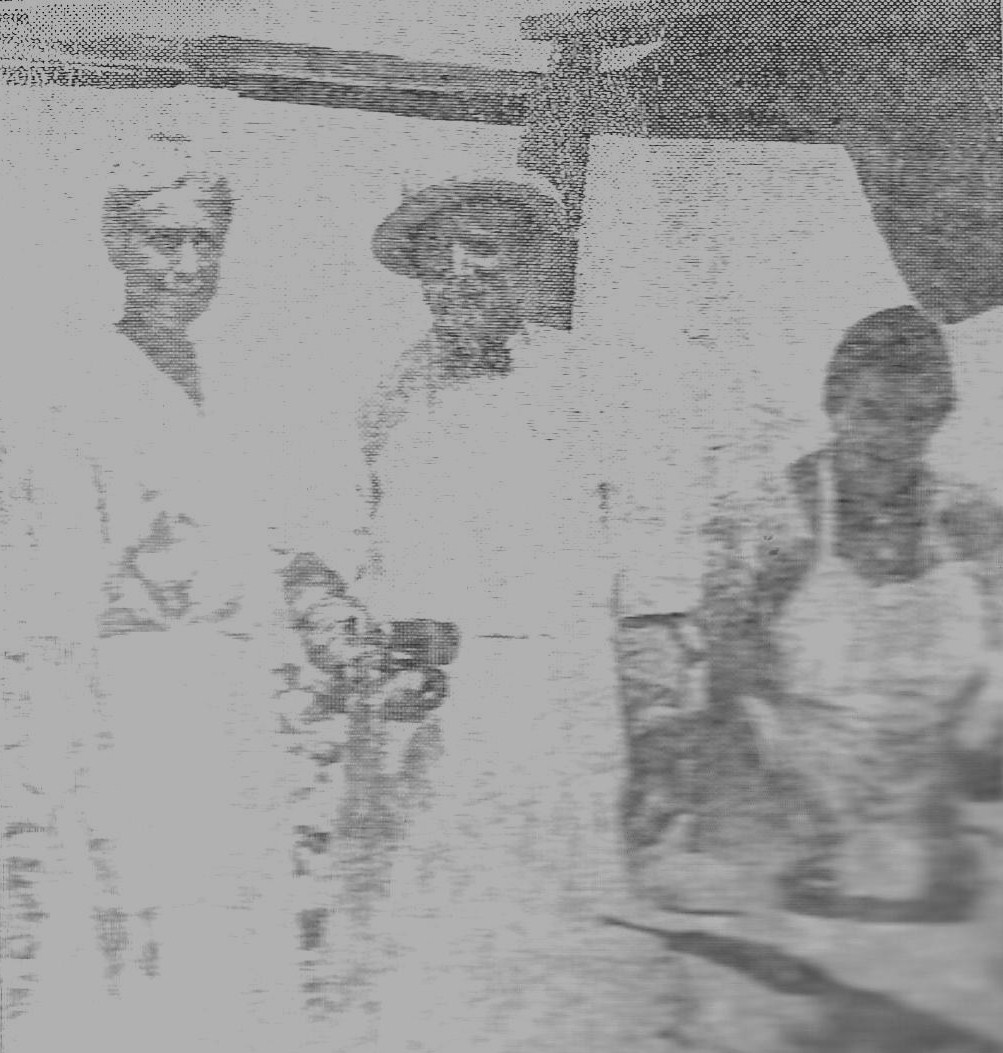
The whole “Loblolly Force,” who have made lobster eating, clam bakes and
other shore dinner deliciousness, famous the country over, among notable
and just common folks. Left to right, Mrs. Frank Haskell, Frank Haskell
and Naomi Haskell Gardner.

As I absorbed one of those delectable meals in a sheltered little cove on the north shore of Massachusetts, near Rockport, seated at a rough old table covered with oil cloth, shielded from the sun by a tattered old sailcloth, I thought of the trite saying often attributed to Emerson (but wrongly), about the man who made a better mousetrap.

I wondered how this little place so secluded one had to inquire to reach it, so primitive it was only a camp, how such a place could reach almost national fame.

Of course it was the food that brought the world to this spot but how had it originated, how had the news of such cookery gotten around, how had it been advertised?

How It All Started

So as I sipped my coffee and smoked my cigar I resolved to question mine host, who is also the chef-de-cuisine and a raconteur of rare ability.

How did this place originate and how did it become so well known? I asked.

Now you touch me in a tender spot, spoke up mine host, Frank E. Haskell, a hearty sunburned fisherman, as he stretched out in a chair opposite me.

The place was started by my father and myself back in 1896, that’s over 43 yrs. ago, he said with a far-a-way look in his eyes and this is the way it happened. Father was a pilot. He was known as Captain Emerson B. Haskell, in the days when Rockport was a flourishing port as an exporter of granite as well as a fishing port. Many schooners came into the harbor loaded with coal, but on account of shoals it was essential to have these vessels piloted safely to anchorage.

Father kept his dory in this little cove and would go up on the hill above the beach and with his glass would watch for incoming ships. When he spotted one he would hurry down, get in his dory and row out to the vessel which he would then guide into the harbor.

Real Clam Bake – Yum! Yum!

Of course there was plenty of time between boats, so the captain discovered that the cove was an ideal place for lobsters and rock cod. Accordingly he invited some of the officers of the schooners down to have a clam bake. A real clam bake consists as you probably know of clams, fillets or fish, lobster, sweet potatoes, green corn, all steamed in a heaped up mass of sea weed.

The fame of these clambakes was spread by these men and soon summer visitors heard about them. They used to come up from the resorts in tally-ho’s and barges (that was before the automobile) and then they began demanding shore dinners for smaller parties and individuals. So began the business that made Loblolly Cove famous.

“Why Loblolly Cove?” I asked. “What does Loblolly mean?”
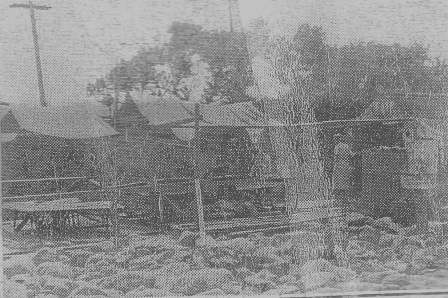
Haskells Camp 2

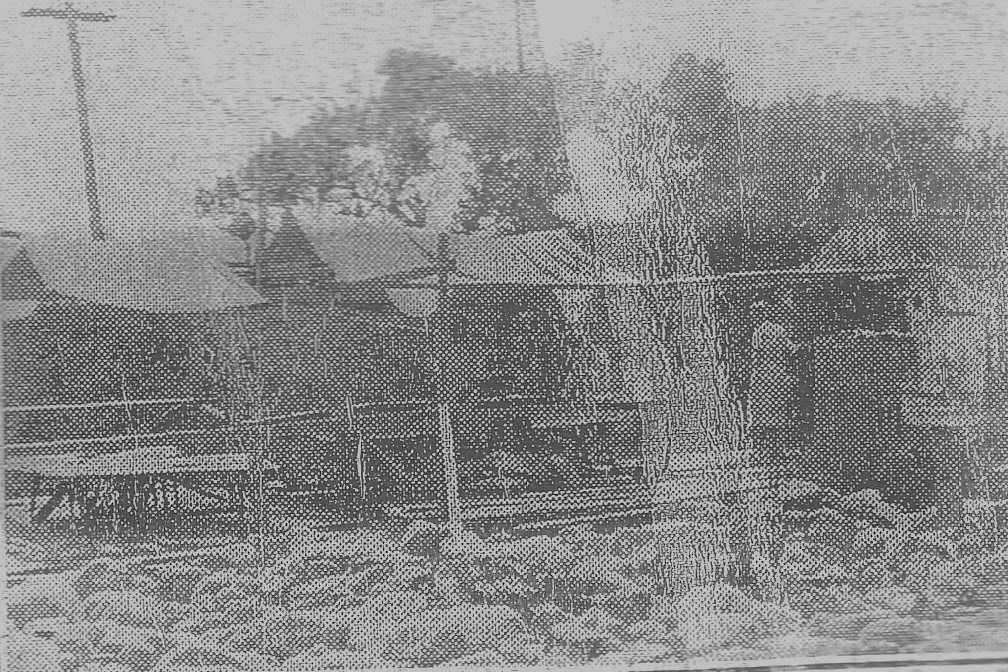
“The Camp” at Loblolly Cove, Rockport, where those wonderful
clambakes originate.

“That’s what I wanted to know, and I was a long time finding out. I found in the dictionary that ‘loblolly’ meant thick oatmeal gruel; another definition said it was a kind of tree. This didn’t suit me; I found that Peter Emmons, a Welshman, received a grant from the Commonwealth of Massachusetts about the year 1700 of this region. He named it Loblolly Cove. Now why. I wondered.

“Some years ago a Welshman had one of my shore dinners and after finishing his lobster remarked that that was as good a loblolly as he had ever eaten. I pounced on him at once. What did he mean by loblolly?”

“Why,” he replied in surprise, “don’t you know what loblolly is?”

“No,” I said eagerly. “What is it?”

Loblolly on Bread!

“Well, in my boyhood in Wales,” he replied, “we used to catch lobsters and cook them and the piece-de-resistance was the loblolly, the liver or fat of the lobster, you know that sort of greenish thing you see in a broiled lobster. Well that is the loblolly and we used to spread it on bread because we didn’t have much butter. So there you are. The loblolly is a lobster liver.”

“And then to clinch it, one day a lovely old lady from Salem was having a shore dinner and as she finished she said: ‘That was a lovely loblolly.'”

“So I tackled her and here is what she said: ‘Loblolly, why all my life I’ve known the liver or fat of the lobster as the loblolly.’

“‘But, why?’ I asked determined to find out further about this elusive word. ‘Why,’ she said, ‘when I was a girl we used to go to Nahant for our lobsters because there was a Welshman there who caught such wonderful ones, noted because of their delicious loblollies.’

“So that settled it. Peter Emmons was a Welshman, the lobsters he found in his cove had superior ‘loblollies,’ so he named his cove ‘Loblolly Cove’ and the lobsters to this day have kept alive the tradition.

“Well,” continued Haskell, “I was young and wanted to see the world, so I went to New York and entered business. After two companies I was with folded up I decided to come back here, especially as this business had grown and father needed me, so here I’ve been ever since.”

There’s a Way to Cook ‘Em

“What makes your fish or lobster so much better than the average?” I asked.

“In the first place, we get our own lobsters and fish right here in the cove; they’re absolutely fresh. Then there is an art in broiling lobsters over a charcoal fire so they keep juicy. Haven’t you had lobsters too dry or stringy? That is because they are often boiled first then put away in the ice box and afterwards broiled. That dries them out. There is a knack in broiling them fresh and just enough.”

“You’ve entertained some important people here haven’t you? I notice as I came in that your sign boasts on the fact that President Taft had dinner here in 1910.”

Haskell’s face fairly beamed.

“I’ll say we had notables! In addition to President Taft’s party we’ve had governors, ambassadors, artists, authors, university professors and so on. John Hays Hammond used to come down here frequently and he arranged the Taft dinner on Aug. 10th 1910. In addition to President and Mrs. Taft and their children there were Captain Archibald Butt, afterwards lost on the ‘Titanic,’ secret services men and the Hammond party of eighteen — altogether 32. Hammond’s yacht ‘Wayfarer’ was anchored just outside the Cove. I gave them a regular old-fashioned clam bake and how they did eat!

“Then in 1912 Governor Dix of New York and his party had a bake.

“The John Boyle O’Reilly Club used to come down every year for a clam bake and reading of O’Reilly’s poems. So many of them have passed on that they don’t have any more reunions,” he said sadly.

“The ambassador from Siam used to come down to this coast every summer and always came here three or four times each season, as did the Romanian minister.

“Professor Woods, language professor at Harvard, spent the summers in Rockport and often brought down his foreign students, Hindus and Parsis.”

A Wedding and a Clam Bake

“Two summers ago there was a big wedding in Bass Rocks of socially prominent people. Some folk from Ohio who have a summer home down here wanted to do something for the party so they invited them over here, 45 in all, for a clambake. I fixed them a swell bake down on the rocks and they afterwards came up here and had coffee and doughnuts. It was a moonlight night and the colorful summer clothes of the men and women made a regular picture.”

“Where did your family come from Mr. Haskell?”

“From England, but originally from Normandy. William Haskell, known as captain, settled in Gloucester in 1642 and Roger D., his brother, settled in Salem about the same time. The family goes back to the time of William the Conqueror. He granted a coat-of-arms to the original Roger de Haskelle which you can see is a shield surmounted with an apple tree full of apples,” and he exhibited a picture of the escutcheon.

“The apple tree bothered me for a long time till my niece, looking up the family history in Boston, discovered that Duke William, before his raid into England, was in dire straits for food and when Roger de Haskelle brought into camp a huge supply of Normandy apples the duke in his gratitude dubbed him knight and gave him the escutcheon with the apple tree! At any rate,” laughed Haskell, “that’s the story. We ought to be surrounded with apple trees and serve apples with our dinners, but,” he sighed, “these trees around the camp are wild cherry.

“There are a number of interesting relics here, taken from wrecks. For instance, look at this steering wheel,” and he exhibited an ancient wheel, mounted on a piece of an old deck. “This wheel is over 150 years old, one of the oldest in existence. It was mounted on a tiller. It is known as a traveling wheel because the tiller and wheel moved across the deck. It came off an old vessel wrecked off Cape Ann. I’ve been offered good money for it, but I won’t sell.”

And there in that little grove near the beach off this cove with an old boathouse for a kitchen, pieces of old wrecks for a dining place with an old sail cloth for a roof, you can get clams, lobster and fish that epicures say are little short of perfect and the cooking by the descendant of a Norman knight and his “missus” puts those delectable viands in the class with the ambrosia of the gods.

Posted in Uncategorized | Tagged , | 3 Comments

A Shore Dinner at Haskell’s Camp, circa 1910

Loblolly-Rockport

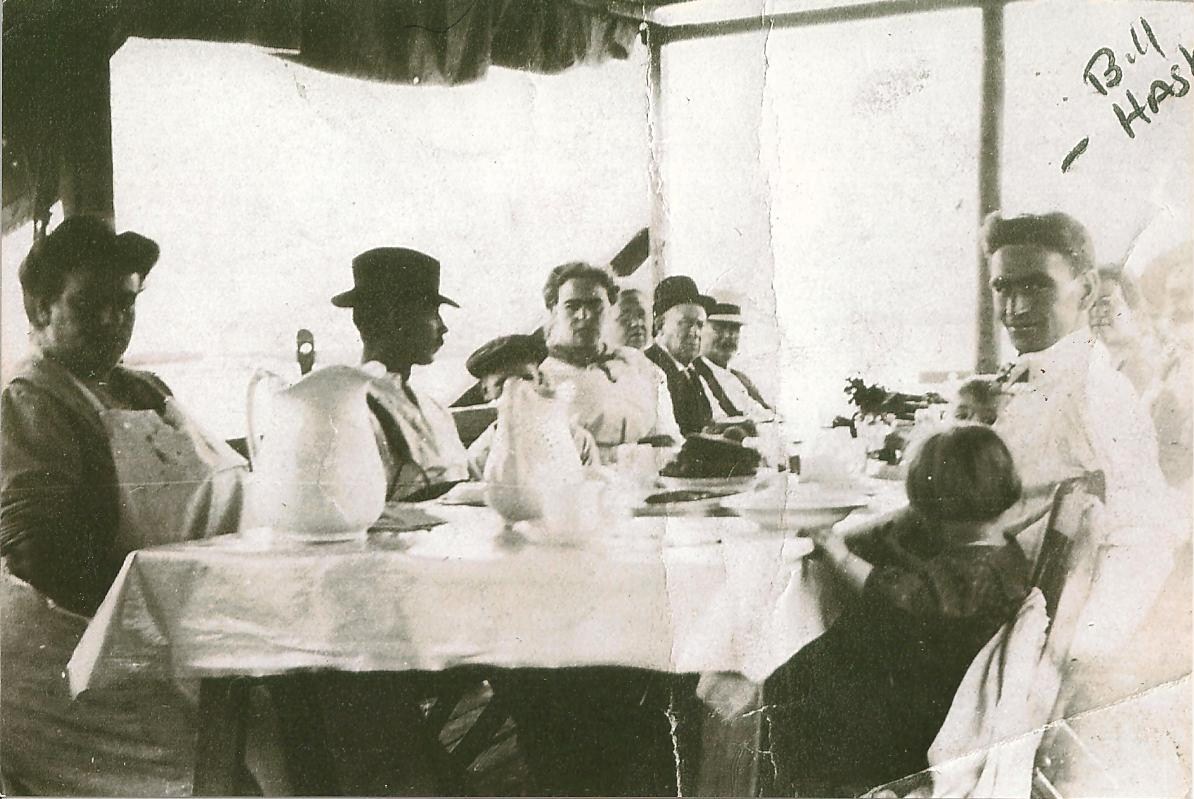
At the head of Loblolly Cove, just about where Eden Road and Penzance Road intersect, there was once a rough and rustic lobster shack known as Haskell’s Camp. It was a popular spot among tourists and once it even hosted the president of the United States, William Howard Taft.

Last year, I published a guest post about Haskell’s Camp by Kimberly Hanson, whose husband’s great-grandfather was Emerson Haskell, the founder of this popular establishment. (See also my earlier post about the camp.)

Now, I have heard from another Haskell descendant, Cindy Haskell, who sent me the photograph above of a shore dinner at Haskell’s Camp. She believes that the man looking at the camera on the right is Emerson Haskell’s son Bill Haskell and that the first woman on the left is Emerson’s wife, Naomi (Barton) Haskell.

Cindy provides this genealogy:

Emerson R. Haskell, 1851, and Naomi Barton were my Dad’s Grandparents. They had 7 kids. My Dad’s father/mother are William (Bill) E. Haskell, 1881-1975, and Lucy May Fairbanks, 1889-1948. They had 7 kids. Frank Haskell, 1875 (?), was my Dad’s Uncle (my Dad’s father’s brother). My parents were Richard (Dick) Lewis Haskell, 1929-2005, and Beverly Jean Morrill, 1930-1999. They had 7 kids.

The photograph is not dated that I know of. I am guess-timating the date based on Bill’s birthdate of 1881. He looks to be roughly 30 in this picture and perhaps that is one of his young children beside him.

In addition to this photo, Cindy sent me a fascinating 1939 newspaper article about Haskell’s Camp. I’ve published that in a separate post.

Posted in Uncategorized | Tagged , | 1 Comment

Two U.S. Navy Sailors in Rockport, 1907

Two-Sailors-post

Two-Sailors-Back-post

This is a real-photo postcard of two U.S. Navy sailors visiting Rockport in 1907. The card is signed by Arthur F. Duggan, who identifies himself as the sailor on the right. He indicates that he is from the battleship U.S.S. Kentucky. The card is postmarked from Norfolk, Va., on Nov. 19, 1907. The location appears to be somewhere near Old Garden Beach or the Headlands.

The U.S.S. Kentucky was part of the North Atlantic Fleet that was formed in 1906 and that regularly visited Rockport for several years to conduct maneuvers off the coast. The Kentucky was part of the fleet’s second squadron. That squadron visited Rockport in late August and early September of 1907, just two months before this postcard was mailed. This photograph was likely taken during that visit.

A month after this postcard was mailed, in December 1907, the fleet — which became known as the Great White Fleet under the command of Rear Admiral Robley D. Evans — departed from Virginia on a round-the-world cruise that lasted until 1909. The cruise was both a goodwill tour and intended as a show of the United States’ naval strength.

I have not been able to find any more information about Mr. Duggan. His postcard was addressed a Miss Viola Quick of New Carlisle, Ohio. I was able to find that a Viola Schaffer Quick was born in New Carlisle in 1890 and died there in 1971. She would have been 17 when Mr. Duggan sent her this card. Was he courting her? Here’s what’s written on the card:

I am on the right of this picture. It was taken at Rockport, Mass. Would be pleased to hear more from you. And also your photo. Received your postal, pleased to hear from you. Many thanks. It is very cold here now. How is it at your home?

Arthur F. Duggan, U.S.S. Kentucky

From what I can tell, Ms. Quick never married. Had she held on to this card throughout her life? We can only wonder.

Posted in Uncategorized | Tagged , , | 1 Comment

Rockport Then and Now — In a Single Image

white wharf_img123_BA copy

One of my favorite postcards of Rockport is The Town Turned Upside Down, an early 1940s postcard by Virginia Cleaves Little. (That link takes you to my original post of it.) Now, my img123_posttalented son Ben Ambrogi has worked some Photoshop magic to fuse parts of that 70-year-old image with the same scene today.

Above, you see the fruits of his labors. Click on it to bring up a much larger version. Note that the reflections in the water show the buildings as they were then, letting you compare them with what is there today.

Posted in Uncategorized | 1 Comment