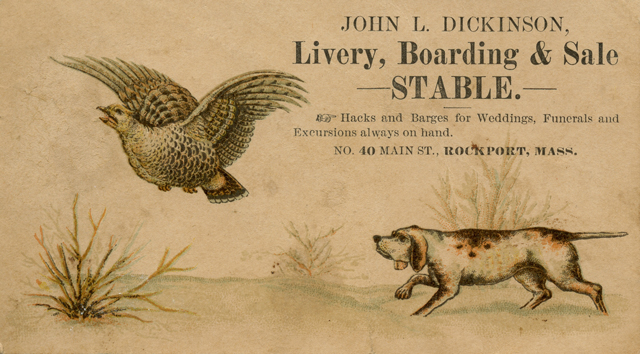
Livery, Boarding & Sale Stable, Rockport, Mass., circa 1885

Before they became popular as souvenirs, postcards were used for advertising. This beautifully illustrated card advertises John L. Dickinson’s stable at 40 Main Street, Rockport. The address is right across from where Main St. and Beach St. intersect. A house is there now.

I am constantly amazed at the information I can find online. Such is the case here. I wondered whether I could find anything about John Dickinson or his stable. Sure enough, I found information about both, described in a 1908 book, Genealogical and Personal Memoirs Relating to the Families of Boston and Eastern Massachusetts, Volume I, and found via Google Books.

As it turns out, Dickinson had his stable in Rockport for a brief time in the late 1800s. He was married in Rockport in 1880 but left Rockport to return to his native Ipswich sometime in the 1880s when his father died. In 1890, he sold his property in Ipswich and moved to Salem, where he opened another stable. “He was one of the best known and most popular men in his line of business in Essex county,” the book says.

Here is an excerpt:

John Lewis Dickinson, son of Lewis Dickinson, was born at Ipswich, July 24, 1855. He was educated in the public schools of his native town, graduating from the high school, and was a student under Issachar Lefavour. He began early in life to work on his father’s farm. He was fond of horses and, after leaving school, engaged in buying, selling and trading horses. He understood the horse thoroughly and loved the animals. He kept a livery and sale stable in Rockport for a time. After the death of his father he removed to Ipswich, but soon afterward sold the homestead and moved to Salem, in 1890, and again became the proprietor of a livery stable. He continued in the stable and horse dealing business there the remainder of his days. He died at Salem, August 11, 1905. He was one of the best known and most popular men in his line of business in Essex county. He met many people and made many friends. He was kindly in his disposition, enjoying the fun and humor of life and always a cheerful influence among his associates. … He married, February 11, 1880, in Rockport, Josie A. Saunders, born April 8, 1856, daughter of Captain Edward Howard and Mary J. (Wilkins) Saunders, of Gloucester.

Read more here.
Posted in Uncategorized | Tagged , | 1 Comment

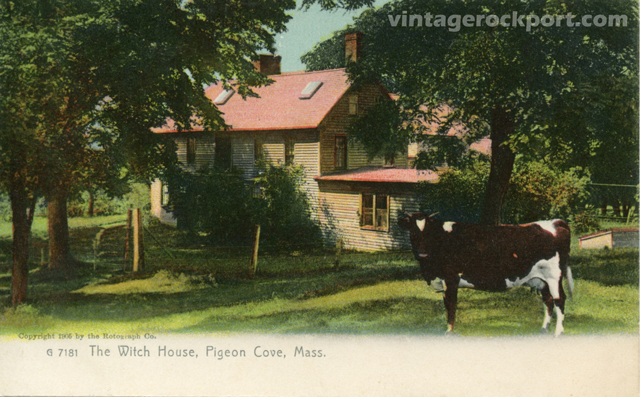
The Witch House, Pigeon Cove, Mass., 1906

Lots of postcards feature the old Witch House, but only one includes the cow. The story goes that the house was built in 1692 by two brothers from Salem to protect their mother, who was suspected of being a witch.

The house still stands in the Pigeon Cove section of Rockport. In fact, it played minor roles in a recent book and a recent movie. David Lovelace talks about the witch house, where he stayed for a time in the early 1980s, in his book, Scattershot: A Memoir of My Bipolar Family. More recently, the film A Walk Into the Sea tells the story of Danny Williams, who grew up in the Witch House and then went on to become a fixture at Andy Warhol’s Factory and possibly Warhol’s lover before returning to his childhood home one Thanksgiving and committing suicide.

This postcard is from The Rotograph Co.

Posted in Uncategorized | Tagged , | 5 Comments

The Straitsmouth Inn, Rockport, Mass., 1908

In a post yesterday, I mentioned the Straitsmouth Inn, which stood on Gap Head from 1906 until it burned to the ground on New Year’s Eve in 1958. Built and operated by Ella S. Wilkinson, the inn could accommodate 100 guests.

Postmarked Aug. 7, 1908, this postcard provides a dramatic view of the inn and the rocky coast. It was published by E.C. McIntire, Gloucester, Mass., and printed in Germany.

For an account of the fire’s aftermath, see After the Straitsmouth Inn Fire.

Posted in Uncategorized | Tagged , , , | 2 Comments

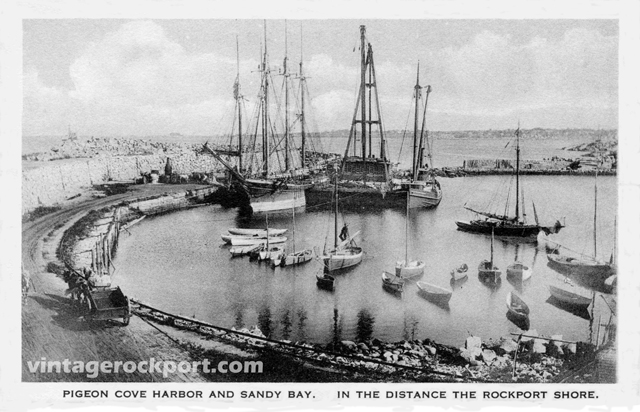
Pigeon Cove Harbor and Sandy Bay, circa 1912

This postcard of Pigeon Cove is not dated. The derrick scow in the center of the photo appears to be the same one shown in an earlier post here putting granite blocks on the Sandy Bay breakwater. That earlier postcard was postmarked 1912, so I am assuming this is from the same time period.

Some details to note include the horse-drawn cart in the lower left and the four-masted schooner in the center, possibly used to transport granite. A bump on the horizon, just to the left of the schooner’s forward mast, might be the Straitsmouth Inn, which stood on Gap Head near the life-saving station from 1906 until it burned to the ground on New Year’s Eve, Dec. 31, 1958.

This postcard was published by the Rockport Photo Bureau.

Posted in Uncategorized | Tagged , , , | 1 Comment

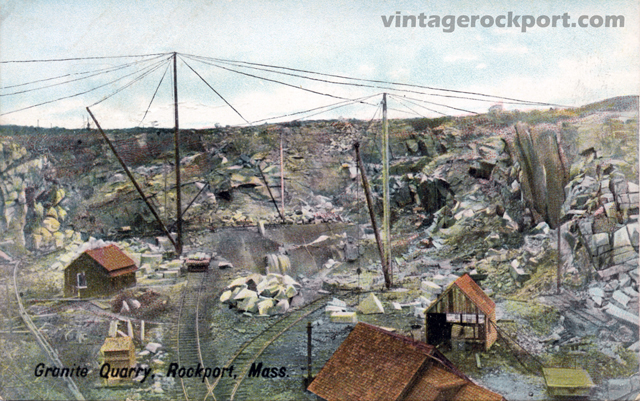
Granite Quarry, Rockport, Mass., circa 1910

As I noted in an earlier post, granite quarrying was long a major activity in Rockport, with granite first commercially excavated here in 1823. The most prominent of the quarry companies, the Rockport Granite Company, was in business from 1865 to 1933. The quarry pictured here is not identified. It could be Flat Ledge Quarry.

Rockport granite was shipped all over the world. It can be found in New York in the bases of the Statue of Liberty and the Brooklyn Bridge and in six Central Park Monuments, in Boston in the Custom House Tower and Longfellow Bridge, and in the Charlestown, Mass., and Portsmouth, N.H., navy yards, to name but a few places.

This postcard has no date or postmark. It was published by The Metropolitan News Company of Boston, which was in business from 1905 to 1916.

Posted in Uncategorized | Tagged , , | 2 Comments

Harbor Looking East, Rockport, Mass., 1907


This postcard shows the eastern side of Rockport harbor, looking out towards the Headlands, with Atlantic Avenue to the right. Note the fishermen’s shacks and the paucity of homes along Atlantic Avenue.

The card was published by The Rotograph Co. and printed in Germany. It bears a postmark dated Oct. 23, 1907.

Posted in Uncategorized | Tagged , , | Leave a comment

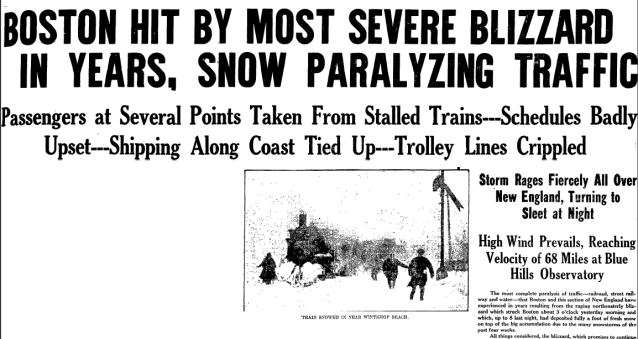
Rockport Commuter Rail Crippled by Snow, 91 Years Ago

Off topic a bit, but while doing some research I came across this timely article from the Feb. 6, 1920, Boston Daily Globe: Boston Hit By Most Severe Blizzard in Years, Snow Paralyzing Traffic. In a parallel we can well sympathize with these 91 years later, it wasn’t the quantity of the latest snowfall that was crippling, but the addition of yet more snow to a four-week stretch of repeated storms. As the Globe explained:

The most complete paralysis of traffic — railroad, street railway and water — that Boston and this section of New England have experienced in years resulting from the raging northeasterly blizzard which struck Boston about 3 o’clock yesterday morning and which, up to 8 last night, had deposited fully a foot of fresh snow on top of the big accumulation due to the many snowstorms of the past four weeks.

Regular riders of the Rockport commuter rail might appreciate this passage:

The first night train from Beverly arrived at 8 pulled by two locomotives. The train left Rockport at noon and the cars were nearly derailed when a mountain of snow was encountered near the Magnolia station. Trainmen reported that two Rockport-bound trains, between which a snowplow was sandwiched, were stalled in huge drifts at Magnolia.

A reminder that, when it comes to winter weather, what goes around comes around.

Source: Boston Globe Archive.

Posted in Uncategorized | Tagged | Leave a comment

Town Hall, Rockport, Mass., circa 1910

This impressive-looking building, with its enormous, church-like windows, no longer stands. (If you know when it was torn down, please let me know.) As quiet as it looks in this postcard, it was sometimes the scene of major social events.

I’ve written before here about the regular summer visits to Rockport of the U.S. Navy’s North Atlantic Squadron and of the celebrations the town would throw to welcome them. On Aug. 14, 1906, the Town Hall was the scene of perhaps the largest such event ever — and perhaps the largest since, with the Boston Daily Globe reporting, “Several thousand persons attended, in fact about all the townspeople able to get out and many of the summer residents.”

The draw that evening was the presence of the squadron’s commander, Rear Admiral Robley D. Evans. The Globe paints a picture of the scene:

Tonight is the greatest night ashore for the citizens since the squadron first came here. The people of this truly representative New England town, their wives and daughters had an opportunity to shake the hand of Rear Admiral Robley D. Evans and his officers.

Never was the town hall decorated so profusely and tastefully. The women of Rockport outdid themselves in collecting flowers and foliage. The entire front of the stage was banked in hydrangeas, while the arch was of evergreen and white flowers. In the center was the word “Welcome.” To the left of the stage was a smaller arch of evergreen under which Admiral Evans and the receiving party stood. The keystone of this arch was a floral blue flag on which was two stars, the flag of the commander-in-chief. …

In the full dress uniform of his rank and flanked by Judge Sumner D. York, the admiral established the handshaking record of his career. From 8 to 9:15 an incessant stream of people passed him. More than 2000 tickets of admission had been issued, and many of them were used twice. Judge York made good his claim to knowing personally every man, woman and child in Rockport, and he never hesitated for the right name as face after face appeared for an introduction to the admiral.

The next night, the Town Hall was again packed, according to the Boston Daily Globe, as the visiting sailors put on a minstrel show. “On the program was a lightweight boxing bout between Katzenberger, champion of the navy, and Hennessy of the Maine, the first exhibition of this kind ever permitted in Rockport.”

In the 1920s and 1930s, the Town Hall was the venue for the annual Artists’ Ball, an affair so “spirited,” the Boston Globe recently recounted, “that in 1932 local officials called in the state troopers to keep the party in check.”

“Dancing Until 5 This Morning, When Breakfast Was Served,” was the headline of an Aug. 24, 1926, Boston Daily Globe report on the ball. The report began:

Rockport Town Hall was packed last night by people from along the North Shore for the annual artists’ ball given by artists of this locality.

The walls were paneled with representations of fishermen, Indians and other similar decorations designed by Maurice Compris, chairman, and Aldro T. Hibbard, who collaborated with him. The color motifs were purple, green, black and gold.

The orchestra appeared in blackface, from Dixieland, the music being interspersed with short skits.

The news report goes on to list many of the artists who attended and describe their costumes. “The ball ended at 2,” the report says, “but 75 couples continued dancing at Aldro T. Hibbard’s studio until 5 this morning, when breakfast was served.”

And we can thank the intrepid Globe reporter for sticking with it to the bitter end.

This postcard identifies no date or publisher. I am guessing at its date based on similar photos.

Posted in Uncategorized | Tagged | 5 Comments

Memorial Hall, Rockport, Mass., 1911

I have seen this building referred to as the Grand Army of the Republic Memorial Hall and then later as Veterans Memorial Hall. From what I can gather, it was in active use as a veterans’ hall from at least the 1880s through the 1920s. The building still stands on Main Street.

Note the Sandy Bay Cafe to the right of the hall.

The card is postmarked 1911. No publisher is identified on the reverse side.

Posted in Uncategorized | Tagged , | 3 Comments

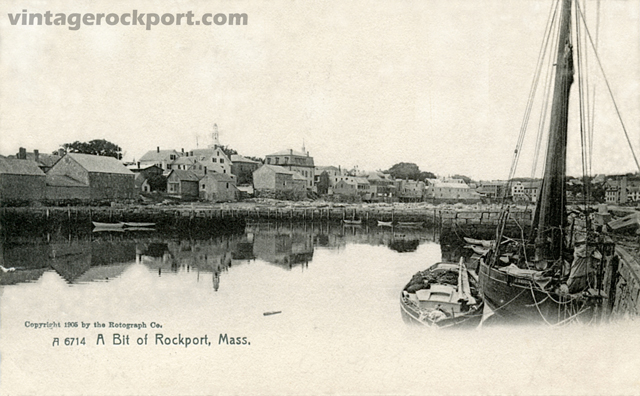
A Bit of Rockport, Mass., 1905

This view of Rockport, taken from White Wharf and looking out over Old Harbor, is copyright 1905 and postmarked 1906. It was published by The Rotograph Co. of New York City.

It is interesting to compare this photo on the town of Rockport website taken from a similar vantage point in contemporary times. Other than the boats, not a lot has changed. Note the steeple of the Congregational Church in both photos.

Posted in Uncategorized | Tagged , | Leave a comment