Two Old Views Looking Down Bearskin Neck

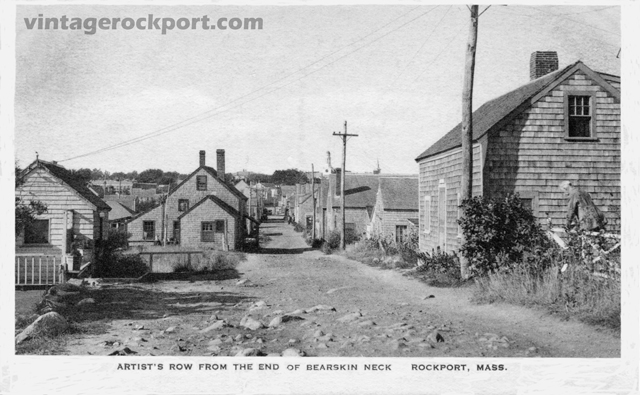
Here are two postcards with virtually identical perspectives looking down Bearskin Neck towards town. Both have the exact same caption, both are published by Rockport Photo Bureau and printed by The Albertype Co., Brooklyn, N.Y. Neither provides a date.

Despite the similarities between the two, there are subtle differences that suggest the top card is the older. For example, note that the rough, rocky road in the top picture is now smooth in the bottom picture. In the top picture, there is not an automobile in sight; in the bottom picture, there are several. In the top picture, the light pole in front of the house appears rough hewn and slightly crooked; the pole in the bottom picture is straight and smooth. In the top picture, there is only a small bush by the corner of the house and another, smaller bush by the front door. In the bottom picture, the side of the house appears much more overgrown. In the top picture, there is a man standing by a fence next to the house. In the bottom picture, there is no sign of the fence (or of the man).

As I’ve noted before, the Rockport Photo Bureau started publishing photos in 1907 and continuing under that name until the mid-1930s. The cars in the bottom photo look to be from around 1930, so I think it’s fair to say that postcard is from around then. That would put the top card at some point earlier — how much earlier, I don’t know.
Posted in Uncategorized | Tagged , | 1 Comment

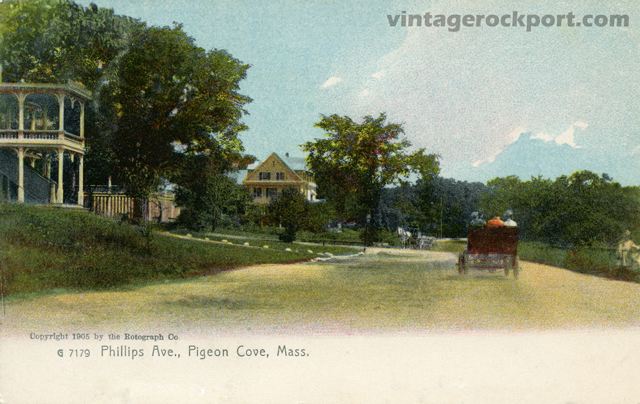
Phillips Ave., Pigeon Cove, Mass., 1905

The past meets the future in this 1905 view of Phillips Avenue, as a horseless carriage approaches a horse-drawn one. By 1905, Phillips Avenue had been home to a schoolhouse, two hotels and a number of summer cottages. But just 50 years earlier, the land it occupies was still mostly pastures and woods. The 1888 book, History of the Town of Rockport, tells how Phillips Avenue came to be:

About the year 1855, Mr. Eben B. Phillips purchased at Pigeon Cove, of John W. Wheeler and others, a large tract of pasture and wood-land, and soon commenced to lay out and construct avenues over the same. He also added to his first purchase until it included Andrews and Halibut Point. There are now over this territory miles of good smooth road, by the line of which are many pleasant and attractive summer cottages. These avenues taken in connection with that over Sunset Hill, and others over the Babson Farm constructed during these later years by the Misses Babson and Gaffield, constitute as pleasant a drive as can be found anywhere within our good old county of Essex. On one side in the near distance is the broad Atlantic in full view; on the other, trees and shrubbery in great variety. In fact we think it would be hard to find a more pleasant drive than that from the Gloucester line at Folly Cove, over the main street to Sunset Hill, then over Phillips’ Avenue to Granite street, through Pigeon Cove to Beach street, to Main through Sandy Bay, then over Mt. Pleasant and South streets, to the Long Beach.

Even today, it would be hard to find a more pleasant drive. Here is another telling of the origins of Phillips Avenue, this one from the 1873 book Pigeon Cove and Vicinity:

Since the purchase of Andrews’ Pasture and the extensive adjacent grounds, by Eben B. Phillips and George Babson, these proprietors have improved their tract by laying it out with broad avenues and winding walks. These avenues and walks are nicely graded and gravelled. From the hotels into the principal avenue, — that is, Phillips Avenue, — it is but a step. The mile’s walk of this wide and smooth road is circuitous, partly through groves of oaks and pines, and partly over open grounds, fragrant with sweet ferns, bayberry shrubs, and wild roses, and affording fine views of the sea from Thatcher’s Island to Agamenticus, and a view of the long coast to this mountain in Maine, from Ipswich Beach and Plum Island.

As noted above, Phillips Avenue was once home to a schoolhouse, a two-story building constructed in 1857. Although not the first school in Rockport, it was the first school to be built by the town in its corporate capacity.

This 1905 postcard was published by The Rotograph Co. of New York and printed in Germany.

Posted in Uncategorized | Tagged , | Leave a comment

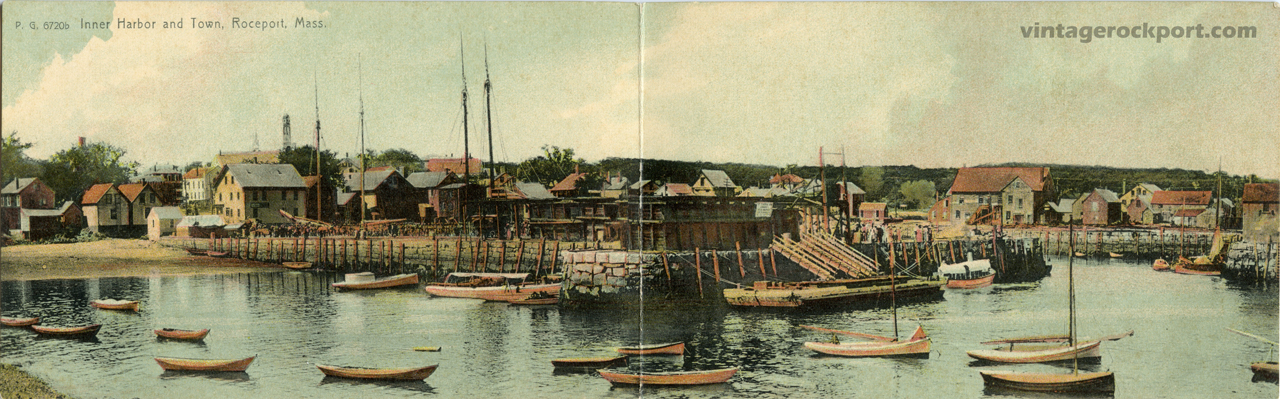
Panorama of Inner Harbor and Town, Rockport, Mass., circa 1905


This is a folded, double-wide postcard with a panoramic view of the town and harbor of Rockport. It was published no later than 1905 by The Rotograph Co. of New York. The company also sold just the left side of this picture as a single-width postcard.

If you click on the image, it should open a full-width version of this picture, so you can better see the detail.

Posted in Uncategorized | Tagged , | Leave a comment

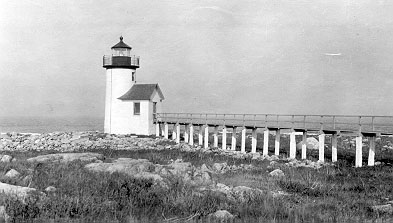
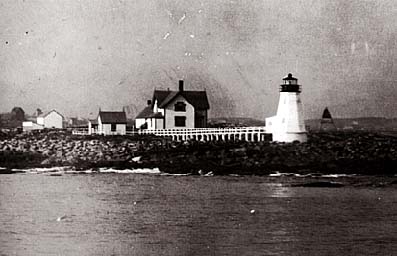
Straitsmouth Light, Rockport, Mass., circa 1895

This postcard comes with a bit of mystery. It appears to have been published around 1910 (and is postmarked 1915) and purports to show the Straitsmouth Light. The reverse side of the card describes the light as situated “on the northeasterly point of Straitsmouth Island, Mass., northeasterly side of Cape Ann, and southerly side of the entrance to Rockport Harbor.”

U.S. Coast Guard photo of the 1851 lighthouse.

The mystery about that is that it actually shows an older lighthouse, one that was replaced in 1896 by the lighthouse that remains on Straitsmouth to this day. Was the postcard’s publisher simply unaware that the light shown on this card had been replaced? We’ll never know.

In fact, the lighthouse that stands on Straitsmouth today is the third to have been built there. The first Straitsmouth light was built in 1834, spurred on by the increasing number of ships sailing to Pigeon Cove for cargoes of granite from Rockport’s burgeoning granite industry. The first lighthouse was poorly constructed, leaky and with lamps out of plumb. Not only that, but it was situated too far away from the point of the island it was intended to warn against.

The 1896 lighthouse, the one that still stands today.

In 1851, construction began on a new lighthouse, a 24-foot tall octagonal stone tower, at a location 87 yards closer to the island’s point. This is the lighthouse depicted in the postcard, as you can see from its unique octagonal shape.

By 1896, the light again needed rebuilding, and the current lighthouse was built. The 37-foot cylindrical tower was erected on the foundation of the 1851 lighthouse. This 1896 lighthouse is the one that still stands on Straitsmouth today.

This photo from the 1890s is almost identical to the postcard.

Last year, the U.S. Coast Guard turned over ownership of the lighthouse to the town of Rockport.

As for the mystery, my guess is that the publisher created the postcard based on the photograph shown to the left, which shows the lighthouse in the 1890s. If you compare the postcard with the photo, they are virtually identical.

This postcard was published by The Hugh C. Leighton Co., Portland, Maine, and printed in Germany.

For more information on the history of the Straitsmouth lighthouses, see LighthouseFriends.com and New England Lighthouses: A Virtual Guide (where I found the 1890s photo).

Posted in Uncategorized | Tagged , | 2 Comments

Motif No. 1 and Harbor, Rockport, Mass., 1905

Here, once again, is a picture of Rockport’s famous Motif No. 1 well before anyone ever gave it that name. This card is dated 1905, was published by the Rotograph Co., New York City, and was printed in Germany.

Posted in Uncategorized | Tagged , , | 1 Comment

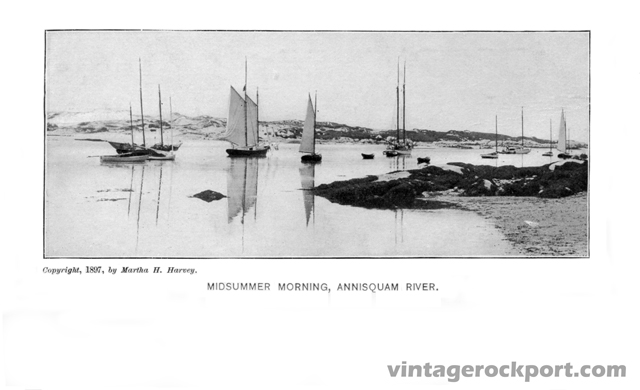
Midsummer Morning, Annisquam River, 1897

I’m sure the calls will be pouring in to the Vintage Rockport complaint department to point out that this picture is of Gloucester, not Rockport. Even so, given that it is such a beautiful photograph and is one of the oldest postcards I have, I had to share it. (For readers unfamiliar with the area, Annisquam is a village within the city of Gloucester.)

The 1897 photograph is by Martha H. Harvey. What little I could find about her online suggests that she was a photographer active in the 1890s. I believe she lived in Annisquam and was married to George W. Harvey, a painter. I have seen a couple of recent references to sales of her photographs through art galleries (such as this one). I also found references to her photographs used as book illustrations (such as here).

Here are two of George Harvey’s Gloucester paintings from the same period. Here are several more.

If anyone has more information about either Martha or George Harvey, please share it below.

Posted in Uncategorized | Tagged , | 5 Comments

Rockport, Mass., Thatcher’s Island, 1906

Like many old postcards of Thacher Island, this one misspells the name as “Thatcher’s.” This card is postmarked Sept. 3, 1906. It was published by the Hugh C. Leighton Co., Portland, Maine, and printed in Frankfort, Germany.

For more about the island, see my earlier post and also the website of the Thacher Island Association.

Posted in Uncategorized | Tagged | Leave a comment

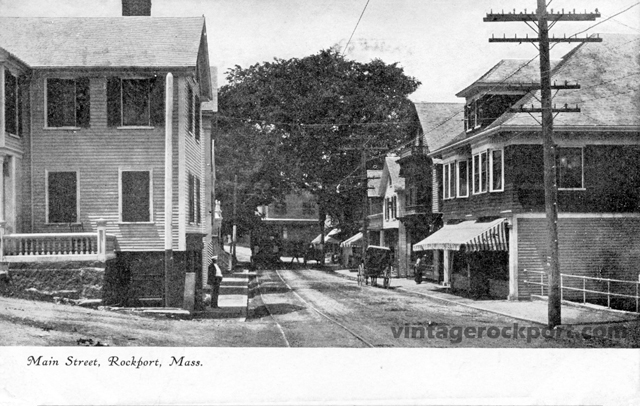
Main Street, Rockport, Mass., circa 1906

The quality of this picture is poor but the view of Main Street around 1906 is interesting. It’s too dark to be positive but I am pretty sure there is a trolley on the track, in the center of the photo under the tree, and a man crossing the street towards it, as if to get on board. Closer to the foreground, note the rotund man with the odd hat looking bemusedly toward the photographer.

The postcard has a 1907 postmark but was probably printed at least a year earlier. It has an undivided back, which was true of all U.S. postcards until 1907, when postal regulations changed to allow divided backs.

Posted in Uncategorized | Tagged | 2 Comments

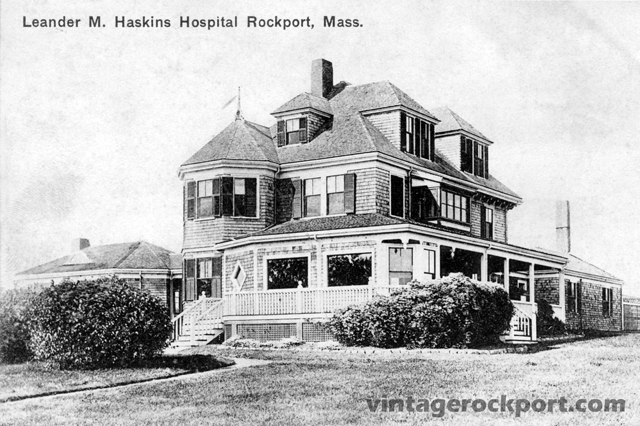
Leander M. Haskins Hospital, Rockport, Mass., 1907

[See also my update to this post.]

Yes, there once actually was a hospital atop Hospital Hill. The Leander M. Haskins Hospital opened for patients in 1906. It had 10 beds and, according to one report I found, treated 90 patients in a year. By comparison, the larger Addison Gilbert Hospital in neighboring Gloucester had 30 beds at the time. Those who live in Rockport today know that Hospital Hill is now bare, but I can find no reference to when the hospital stopped operating or what became of it. If anyone knows, please add a comment below.

As for Leander Haskins, the man for whom the hospital was named, he was, at least for a time, in the business of manufacturing isinglass, a substance made from the air bladders of fish and used in making glue, refining wines and liquors, and other purposes.

He was also someone who was active in town affairs. When the Sandy Bay Yacht Club was organized in 1885, he was its first commodore. When the town in 1903 needed a new library, he was the person who negotiated with Andrew Carnegie for the funding to build it.

A native of Rockport, Haskins graduated from Dartmouth College in 1862. A book about his class at Dartmouth, published in 1884, said this about him:

Leander Miller Haskins, son of Moses and Betsey D. Haskins, was born at Eockport, Mass., June 20, 1842. His father was a mariner. He fitted at Andover, Mass., entered the Scientific School in the spring term of 1860, and continued through the course.

After graduating he continued the study of engineering and surveying in Boston ; taught in the winter of 1862-3; went to New Orleans in May, 1863, and joined the 19th Army Corps, as Commissary Chief Clerk, stationed at Port Hudson and Carrol ton ; discharged by reason of sickness in September, 1863 ; appointed clerk in the Navy Department in December, 1863; resigned in April, 1866; continued the study of engineering in Boston until October, 1866, when he was reappointed a clerk in the Navy Department; resigned in October, 1868, and entered into a partnership with his brother Moses W. Haskins, in the wholesale fish and oil business ; in November, 1879 he engaged in the manufacture of isinglass, and so continues.

This postcard is postmarked 1907. No publisher is identified.

Posted in Uncategorized | Tagged | 12 Comments

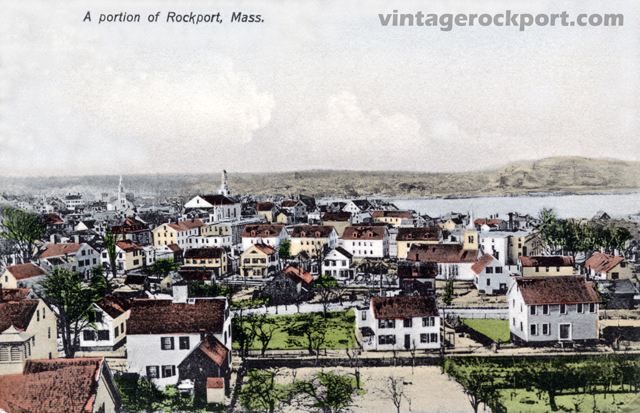
An Elevated View of Rockport, Mass., circa 1910

Here is an interesting view of Rockport. The perspective appears to be from Pleasant Street or thereabouts. Postmarked July 19, 1910, the card was published by E.C. McIntire, Gloucester, and printed in Germany.

The card has a rather sad note written on the back. It says:

Dear, dear Emma,

I feel ashamed for not having written you a long letter but I have been feeling mean. Hope to feel better when I get to Gt. Chebeague, Me. Will call on you when we return. I don’t know what ails me but when I think of you & Edie and what you girls did I can’t keep the tears back.

Love, Clara

Posted in Uncategorized | Tagged | 2 Comments