Mr. and Mrs. Elis Stenman Inside Their Paper House, circa 1932

In 1922, Elis F. Stenman, a mechanical engineer living in Cambridge, and his wife Esther bought land in the Pigeon Cove section of Rockport to build a summer house. They had been fascinated by a trend to use newspaper for insulation and even for construction and decided to try it themselves. In 1924, they had a carpenter erect a frame and lay a wooden floor. Then Stenman went to work, wrapping sheets of newspaper around a piece of thin wire and rolling them into tight, stiff rods. He used those to fill out the frame and then made walls out of 215 sheets of paper glued together. He finished the house with shingles constructed of paper and thick layers of varnish to protect it from the weather.

The Paper House today

Then came the furniture. There is a piano made from newspaper reports of Admiral Byrd’s South and North Pole expeditions. There is a writing desk made entirely of newspapers reporting on Lindbergh’s historic flight across the Atlantic. There is a radio cabinet made entirely of reports of Herbert Hoover’s 1928 presidential campaign and election. There is a grandfather clock made of newspapers from the capital cities of each state in the U.S. There is a fireplace made from the rotogravure sections of the Boston Sunday Herald and the New York Herald Tribune. And there are a table, chairs, lamps, settee and desk made from the Christian Science Monitor.

All tolled, some 100,000 newspapers went into the construction of the house and furniture.

The house quickly became such a popular tourist attraction that the Stenmans moved to a second house down the street and operated the Paper House as a museum. It remains one today. Mr. Stenman told a newspaper reporter in 1932 that he had received thousands of offers to sell his furniture, but that he never would. The furniture represented his life’s work, he explained, and meant far more to him than mere money.

Stenman died in 1942 at the age of 68. In 1956, the Boston Globe featured a story about Esther Stenman, who was then 80. The article talked about the seeming indestructibility of the house, which has withstood fierce winters and strong hurricanes. Mrs. Stenman said that they never even worried about fire during the four years they occupied the house. “We always used our fireplace in the winter to heat the rooms.”

This postcard shows the Stenmans inside the house, with Mrs. Stenman sitting at the desk made from the Christian Science Monitor. The postcard has no date. I estimate it is from around 1932-1934.
Posted in Uncategorized | Tagged | 1 Comment

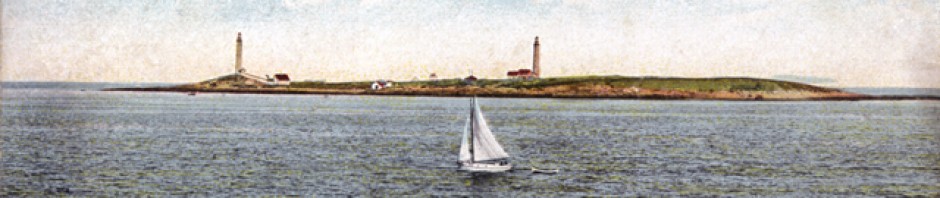
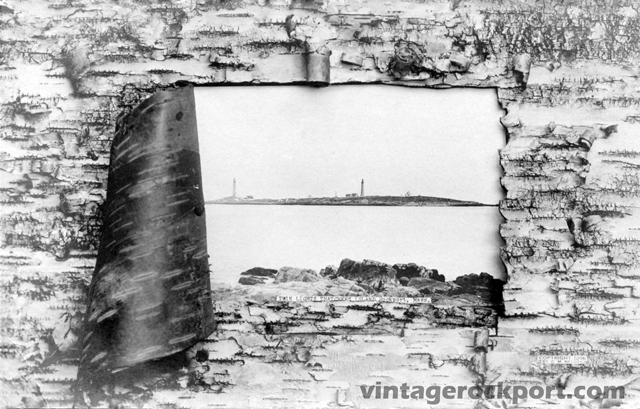
Birch Bark Framed View of Twin Lights, 1906


At the Gloucester block party tonight, I stopped in Bodin Historic Photo, where Fred Bodin asked me whether I’d seen any postcards where the image appears to be framed in birch bark. He just acquired several such cards with images of Gloucester, he said.

Not only have I seen them, but I have one. The postcard above is from 1906 and shows the Twin Lights of Thacher Island. Looking at this scan, it almost looks as if it is a real birch-bark frame, but the apparent bark is actually a photograph itself and part of the postcard.

This is the work of C.M. Nelson, a photographer who produced postcards of New England and New York from 1906 to 1910. Most, if not all, of his postcards featured these birch-bark borders, which were themselves photographs. Each postcard image had a unique border. Most of his cards were distributed by the R.C. Co., Boston. One reference indicated that Nelson was in Boston, but I found several turn-of-the-century references to a photographer named C.M. Nelson who was located in Plymouth, N.H.

Posted in Uncategorized | Tagged , | Leave a comment

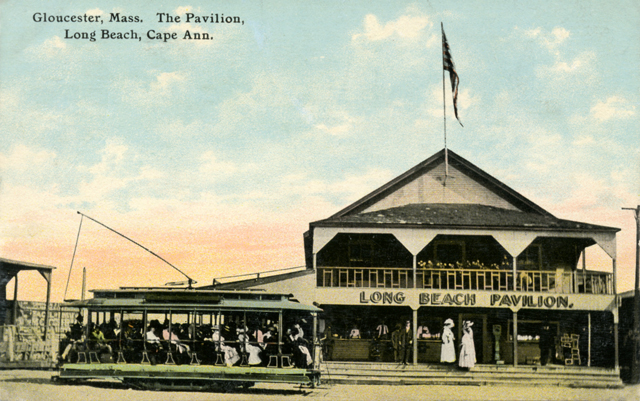
The Pavilion, Long Beach, Gloucester, circa 1910


Long Beach starts in Gloucester and ends in Rockport, and the Long Beach Pavilion was once a popular stop for tourists traveling from one town to the other — provided they were traveling by foot, because Thatcher Road had not yet been constructed. The electric trolley from Gloucester to Long Beach was built in the late 1800s and the trolley company constructed this pavilion in 1895. Within it were a restaurant, dance hall, bowling alley and vaudeville theater.

I have found references to this pavilion through 1915 but cannot find any record of what came of it. It suffered a bad fire in 1909, according to a news report, but apparently was salvaged and continued to operate. If anyone knows the fate of this lovely building, please let me know.

This postcard was postmarked in August 1911. It was published by Edwin C. McIntire, Gloucester.

Posted in Uncategorized | Tagged | 16 Comments

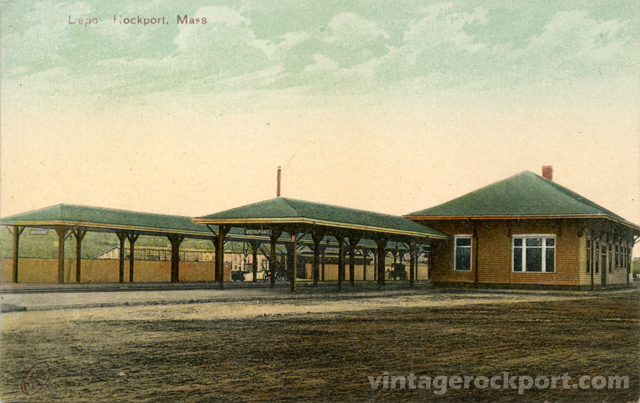
Train Depot, Rockport, Mass., circa 1910

If not for the enterprise of the people of Rockport, there might never have been a train coming here. In 1847, the Eastern Railroad Corporation open a railroad line for travel to Gloucester. The people of Rockport implored the company to extend the line here, but without success. In response, a group of Rockport citizens incorporated the Rockport Railroad Company. In 1855, the Rockport Railroad issued a proposal to Eastern Railroad by which it would construct the track to Rockport and all necessary facilities and assume all ancillary operating costs for five years if Eastern would run its trains here.

Eastern was interested but the Rockport company was unable to raise sufficient capital to carry out the plan. Five years later, in 1860, the company received authorization from the state legislature to issue $50,000 in stock. At a special town meeting, Rockport citizens voted 326-31 to purchase the stock and issued bonds to finance the purchase. Money in hand, the Eastern and Rockport rail companies completed their agreement and the work of building the railroad commenced on Aug. 23, 1860.

The rail line to Rockport opened for travel on Nov. 4, 1861. On that day, free rides were given to anyone who wanted to try the new line. Throughout the day, the cars were crowded to full capacity. In the afternoon, there was a celebratory dinner for invited guests and dignitaries at the Rockport Hotel. After dinner came a series of speeches by railroad executives and town leaders.

By one account, the most rousing speech of the day was delivered by Moses Kimball, who was raised in Rockport and went on to become a prominent Bostonian and associate of circus founder P.T. Barnum. In his speech, Kimball recounted how the spirit of enterprise of the people of Rockport had propelled it to grow from a little cluster of hamlets to a town that could soon outstrip Gloucester in importance. He concluded with these words:

Glory, Glory, Hallelujah,
Rockport is marching on.

This view of the railroad depot has no date or postmark. It was published by The Robbins Bros. Co. and distributed through the Metropolitan News Company. As I noted in another post here recently, Robbins was in business only from 1907 to 1912. Thus, the date of this scene would be within that range — I’ll call it 1910.

Posted in Uncategorized | Tagged | 2 Comments

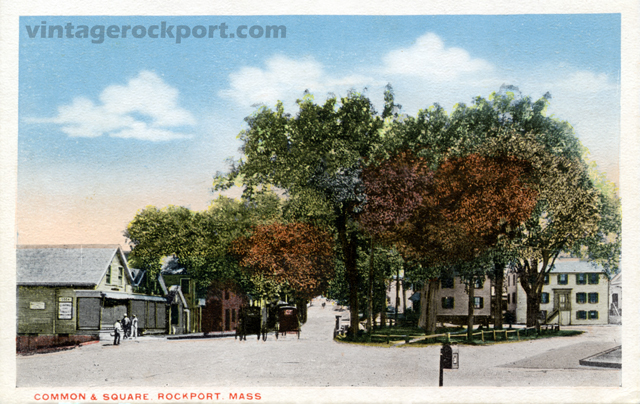
Common and Square, Rockport, Mass., circa 1912

The view here is from Broadway looking south. Mt. Pleasant St. is to the left and High St. comes into it from the right. The diagonal cross street to the right of the common is no longer there. To the far right, out of view of this picture, would be the Baptist church.

This postcard has no date and identifies no publisher. I have another card, postmarked 1919, that is identical in style and in its markings on the reverse side. However, the presence of horse-drawn carriages and the absence of automobiles makes me think this view must be from earlier than 1919. Thus, I am pegging it at 1912 — admittedly a guess, but in the ballpark.

Posted in Uncategorized | Tagged | Leave a comment

Henry’s Pond, Rockport, Mass., circa 1910


The caption on this postcard says, “Fresh Water Pond near Bathing Beach — Turks Head Inn — Rockport Mass.” Although it’s not labeled as such, this appears to me to be Henry’s Pond, just across the street from Pebble Beach. Google Maps calls this Camborne Pond, but I’ve never heard that name before.

A Purple Gallinule

In 1875, Henry’s Pond gained widespread notoriety among birdwatchers and naturalists when a man named Robert Wendel shot a Purple Gallinule there. The bird is found in Florida, the Caribbean and South America, but rarely this far north. The shooting was reported in a number of journals and books. To this day, Henry’s Pond is a popular location for birdwatchers — and most Rockporters know the swans that live there.

The Turk’s Head Inn, mentioned in this postcard, was farther up South Street, at the location where the Cape Hedge Inn now stands.

Posted in Uncategorized | Tagged | 4 Comments

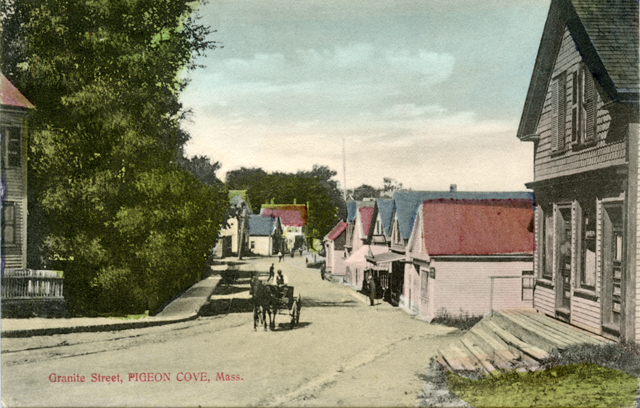
Rush Hour, Granite St., Pigeon Cove, 1909

I was thinking how sleepy Rockport’s Pigeon Cove section looked in this 1909 postcard, until it occurred to me that it’s not much busier today. Here you can see a horse-drawn wagon, various pedestrians, and the trolley tracks along the left side of the road.

The postcard was postmarked at Pigeon Cove station on July 9, 1909. The note on the back says, “The last three days have been hotter than h___ here.”

The card was published by Souther-Mears Co., Boston, and printed in Germany. The company was in business only from 1908 to 1910.  See here for another Pigeon Cove postcard from this company.

Posted in Uncategorized | Tagged | 4 Comments

Geo. J. Tarr School, Rockport, Mass., 1907

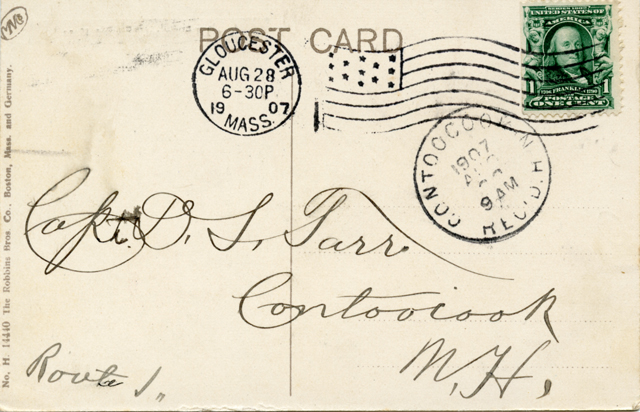
Here is a postcard that is as interesting for its reverse side as for its front.

The front shows the George J. Tarr School on School St. in Rockport. As I wrote in a previous post, this building, constructed in 1864, was once part of the Annisquam Cotton Mill that occupied the site between School St. and the waterfront. When fire destroyed the mill in 1882, this was the only building spared. In 1904, when the mill ruins were finally removed, the then-owner of the property, George J. Tarr, deeded it to the town to become a school. Today, the building houses the Rockport Public Libary.

Conversion of the building from machine shop to school was completed in 1907, as best I can tell. That is the year of the postmark on the card, so the card must have published shortly after the school opened.

All that is interesting enough, but it is the reverse side that caught my attention when I first saw this card. Note the name of the addressee — Capt. D.S. Tarr, Contoocook, N.H.

I cannot help but wonder whether D.S. Tarr is a relative of the Rockport Tarrs, who date back to the town’s first settlers. And if so, could this card have been sent by one proud Tarr family member to another to let him see the new school that bore his family’s name? For that matter, could it have been George Tarr himself who sent it?

I have found no record of a Capt. D.S. Tarr. There was a prominent Bostonian in the 1800s, active in the temperance movement, named David S. Tarr, but he died in the 1890s. There was also a David S. Tarr listed as serving on one of the organizing committees for Gloucester’s 250th anniversary celebration in 1892.

The postcard was published The Robbins Bros. Company, Boston, and printed in Germany. The company was in business only from 1907 to 1912. Robbins had many of its postcards printed and distributed through the Metropolitan News Company, a larger Boston postcard publisher. You can see the “MN Co.” logo on both sides of the card.

Posted in Uncategorized | Tagged | 4 Comments

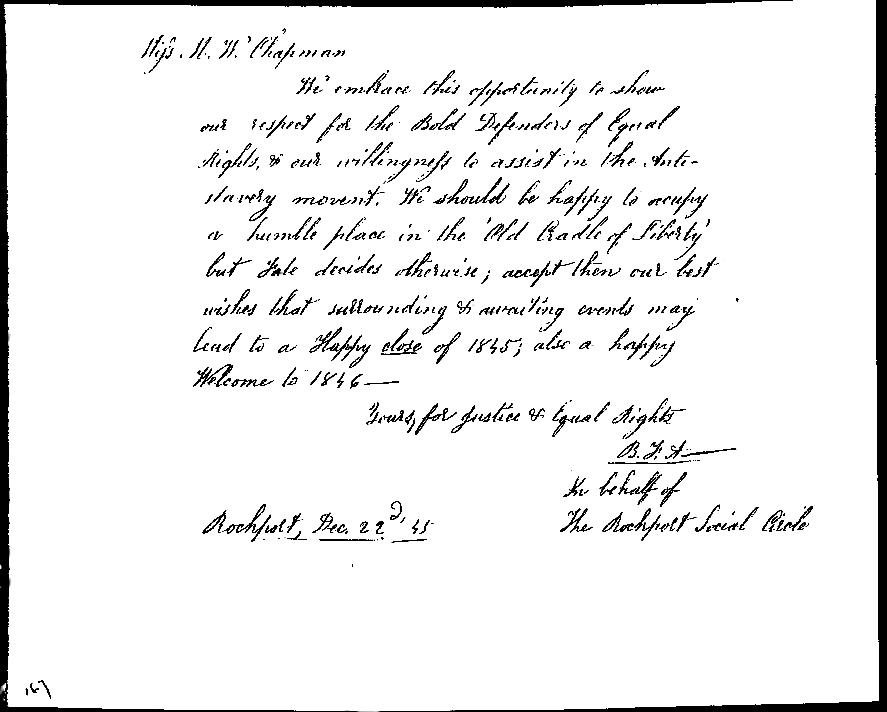
Rockport Shows its Support for Equal Rights, 1845

Needless to say, this is not a postcard. Rather, it is a scan of a Dec. 22, 1845, letter signed, “B.F.A. on behalf of The Rockport Social Circle.” The letter was delivered at Faneuil Hall, Boston, to Maria W. Chapman, a prominent American abolitionist who served on the executive committee of the American Anti-Slavery Society from 1839 to 1842 and who was editor of the anti-slavery journal, Non-Resistant.

The letter says:

We embrace this opportunity to show our respect for the Bold Defenders of Equal Rights, and our willingness to assist in the Anti-slavery movement. We should be happy to occupy a humble place in the ‘Old Cradle of Liberty’ but fate decides otherwise; accept then our best wishes that surrounding and awaiting events may lead to a Happy close of 1845; also a happy Welcome to 1846.

Yours, for Justice and Equal Rights
B.F.A.
On behalf of
The Rockport Social Circle

The line that begins, We should be happy …” makes it sound as if the writer is expressing regret for the group’s inability to attend an event. Chapman was known for organizing an annual Massachusetts Anti-Slavery Fair to raise money for abolitionist efforts, so perhaps the letter is in reference to one of these.

Posted in Uncategorized | Leave a comment

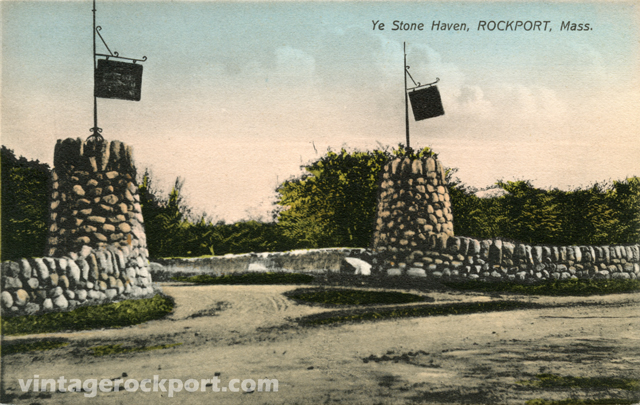
Ye Stone Haven, Rockport, Mass., circa 1912

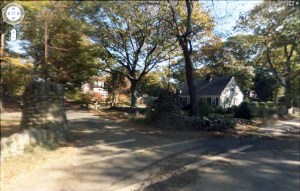
These twin stone towers still mark the entrance to Straitsmouth Way in Rockport. In the image below, you can see the Google Street View perspective of this same scene as it looks today.

“Stone Haven” was the name given to this part of Rockport, stretching from the South Street entrance to Straitsmouth Way and continuing through to Gap Cove and Gap Head Road. There is still a Stone Haven Lane off of Straitsmouth Way.

Until I started researching this postcard, I’d never heard the name Stone Haven used to describe this section of town. All the references I’ve found to it date from the early 1900s. For example, the 1908 book, Who’s Who Along the North Shore, includes this description of Rockport:

Rockport is a town of 4500 population, has a post office, and a railroad station on the Gloucester Branch of the Boston and Maine railroad. Electric railway to Gloucester, Pigeon Cove and Lanesville. Localities, in the town: Pigeon Cove, Ocean View, Stonehaven, Lands End.

Similarly, the 1907 Massachusetts Year Book and City and Town Register describes Rockport as consisting of five villages: Rockport, Pigeon Cove, Ocean View, Stonehaven and Lands End. And the 1919 Alphabetical List of Unincorporated Villages and Sections of Cities and Towns published by the Massachusetts Bureau of Statistics lists Stonehaven as a section of the town. Also, The North Shore Blue Book for 1912 lists the address of the Straitsmouth Inn as “Stone Haven, Rockport,” and lists the address of a summer resident by the name of Oril Arnes as Stone Haven Cottage on Stone Haven Rd.

The earliest reference I could find was in an 1896 magazine advertisement for product called Eureka packing. It featured a testimonial from one H.A. Twichell, whose address is listed as “The Stone Haven, Rockport, Mass.”

This postcard was published by E.C. McIntire of Gloucester and printed in Germany. It has no date, but is definitely from before 1917. Judging by how its markings compare to other postcards from this same publisher, it is probably from somewhere between 1910 and 1915.

[Note: Since first posting this, I found another copy of the same postcard with a January 1911 postmark. That means this is from at least 1910 or maybe earlier.]

Posted in Uncategorized | Tagged | 1 Comment