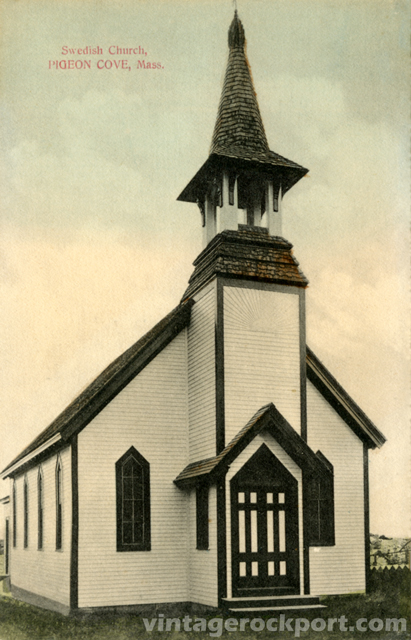
Swedish Church, Pigeon Cove, Mass., circa 1908

The church as it looks today.

Swedish immigrants began arriving on Cape Ann in the late 1800s to work in the quarries. The first man to come from Sweden to Pigeon Cove was Peter Magnus Lilja in 1879, according to Barbara Erkkila’s history of the granite industry, Hammers on Stone. Soon, many more Swedes arrived, settling in Pigeon Cove.

The Swedes built three different churches in Pigeon Cove. The church pictured here, now a private residence at 145 Granite St., was built in 1891 by Swedish Methodists.

The other Swedish churches — both also now private residences — were the Swedish Evangelical Church at 111 Granite St. and the Swedish Lutheran Church, originally built on Pigeon Hill St. and moved in 1949 to 20 Stockholm Ave.

This postcard was published by Souther-Mears Co., Boston, Mass. The company was in business only from 1908 to 1910. The picture could be from those years or even earlier.

Posted in Uncategorized | Tagged | 5 Comments

Special Guest Post: Granite Shore Hotel, Rockport, circa 1915

[Note: After I last posted about the Granite Shore Hotel, I heard from Lawrence Neal, whose grandparents, Ernest and Martha Neal, bought the hotel in 1940 and operated it until 1960. He sent along the following information about his grandparents and their time with the hotel. I reprint it with his permission.]

By Lawrence Neal

In the 1920s, Ernest Neal of Newfields, N.H., bought a grocery store located in Rockport’s Dock Square. After moving to town he met Martha Bray, who was from an old Rockport family. She was then working as the local switchboard operator for the telephone company, which was located upstairs in a Main St. building. The two married, having four children with descendents still living in Rockport.

Mr. and Mrs. Neal bought the Granite Shore Inn in 1940. Shortly after that purchase, they moved the grocery store into the hotel building. The store was located at the far end of the School Street wing. The Rockport Post Office was then located in the front part of that wing which forms the corner of Main and School Streets. After the post office moved to its current site on Broadway, Oscar Spaatz rented that hotel building space and used it as his General Store. The General Store became the Madras Shop which he eventually moved across Main Street in the early 1960s.

The Neals closed their School St. grocery store in the mid-1940s, continuing to run the hotel each summer season until 1960. Because of family illness, the Neals sold the Granite Shore Inn in 1961. It was bought by Leon Rosenblum and Bea McNulty. Mr. Rosenblum had been part owner of the Baltimore Colts professional football team. They stopped operating the building as the Granite Shore Inn, instead converting it to apartments and shops. During the conversion, the outside of the building stayed much as it had always been, except they did change its color from the light gray it had always been to the dark red it is today.

Mrs. Neal always enjoyed visiting faraway places. In the early 1960s, she traveled with old Rockport friends that included Daisy and Judge Jodrey to the Holy Lands. It became one of her most unforgettable trips. In that era, overseas travel was extremely slow and difficult with distances seeming much greater than they do today. After several days of travel, to what seemed like a place completely disconnected from her Rockport home, she walked into the lobby of a Beirut, Lebanon, hotel, looked at the large oil painting hanging on the wall behind the front desk, and found it to be of the Rockport Granite Shore Inn. The painting had been bought from a traveling artist. The Lebanon hotel owner thought it portrayed one of most idealist beautiful places that he had ever seen and found it hard to believe it was of a real place.

[Postscript: The postcard above I estimate to be from 1915 — long before the Neals owned the building. It was published by the Frank W. Swallow Post Card Co. of Exeter, N.H., which also published this 1907 view. You can also see the building and the Post Office at the corner in this 1920 postcard.]

Posted in Uncategorized | Tagged , | Leave a comment

My First-Ever Correction: I Had the Wrong Breakwater!

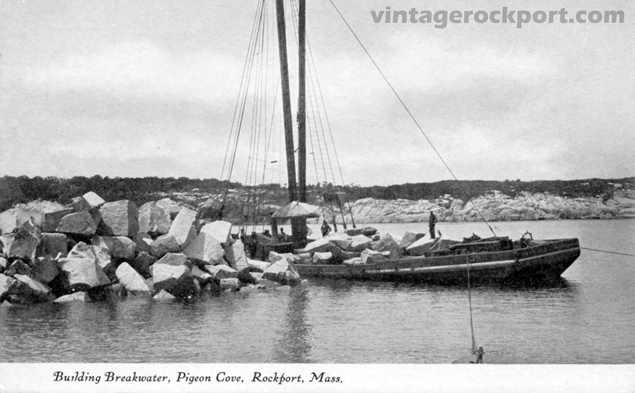
Two days ago, I posted a postcard, Building Breakwater, Pigeon Cove, Rockport, Mass., circa 1905, that I described as depicting the building of the Sandy Bay breakwater. An astute reader pointed out that the land in the background of the picture looked like Folly Point.

Building Breakwater, Pigeon Cove, Rockport, Mass., circa 1905Of course, there is a breakwater at Folly Cove, as anyone who has visited the Lobster Pool restaurant would have seen. Not able to find anything about when the Folly Cove breakwater was constructed, I put the question to the Cape Ann Online discussion board.

Sure enough, I was pointed to the Annual Report of the Massachusetts Board of Harbor and Land Commissioners for 1906. It showed approval of two separate petitions for licenses to build wharves and breakwaters at Folly Cove. The first (Number 3038) said:

Petition of the Rockport Granite Company of Massachusetts for license to build a stone pier and breakwater in extension of its wharf in Massachusetts Bay near Folly Cove, in Rockport. Granted April 2, 1906.

The second (Number 3127) said:

Petition of Charles P. Babson, guardian, for license to build a wharf in Folly Cove, in Rockport. Granted Nov. 16, 1906.

With the benefit of this information, it seems certain that the breakwater being built in this picture was at Folly Cove. Further, because the postcard was produced prior to 1907, it would be the breakwater approved for the Rockport Granite Company. That petition was approved in April 1906, early enough for construction to begin and this picture to be taken within that year — probably that summer.

Posted in Uncategorized | Tagged | 1 Comment

Building Breakwater, Pigeon Cove, Rockport, Mass., circa 1905

Building Breakwater, Pigeon Cove, Rockport, Mass., circa 1905

[Important update and correction: I got this wrong. This does not show construction of the Sandy Bay breakwater. Rather, it is the breakwater at Folly Cove. At least I was close in the year — this picture was most likely taken in 1906. See my explanation: My First-Ever Correction: I Had the Wrong Breakwater!]

Given how quaint and quiet a town Rockport is, it is ironic to look back at the building of the Sandy Bay breakwater, which many townspeople believed would make Rockport a major East Coast center for transatlantic travel and commerce.

As I’ve written before about the breakwater, Congress in 1882 approved plans to dump tons of granite in Sandy Bay and build a breakwater that would form a 1,600-acre harbor. It would be the biggest harbor in North America and the second largest in the world. But in  1916, with two-thirds of it built, construction was abandoned. Today, the breakwater remains as a curiosity and nautical hazard.

The hopes many held for this project were captured in a May 30, 1907, article in the Boston Daily Globe headlined, “Expects Big Things: Rockport Sees Itself as Terminal for Liners.” It started:

That something big is doing, in the way of the development of Rockport as a terminal for transatlantic liners and transcontinental railroads, the majority of the citizens of this town firmly believe.

Ever since the construction of the breakwater was begun 15 years ago the citizens have been firm in their belief tha the town was destined for big things.

The breakwater, when completed, will make Rockport one of the largest artificial harbors in the world. It will enclose nearly 1500 acres of water of an average depth of 40 feet, into which the largest shipping afloat and whose construction is contemplated can steam directly from Europe almost to the very wharves of the town without encountering any obstacle. It would be unnecessary to slacken way or to wait for favoring high tide until the ship reached the pier.

The Rockporters confidently believe that these advantages will be availed of making the journey from Europe to this country one day shorter than if the voyage is continued to New York. Here passengers and freight could be transshipped to the railroads and whisked across the country to their homes and destination, saving time and money.

Another article, from the June 23, 1909, Boston Daily Globe, quotes Rockport Postmaster William Parsons, who everyone called “Uncle Billy,” the article said.

Yes, siree. I’m one of those chaps who think that Rockport is going to be the greatest port on the north Atlantic coast for European traffic. Why shouldn’t it be? Haven’t we got right down at our wharves from 30 to 80 feet of water at low tide? Can’t the biggest liner ever built come right in here under her own steam, tie up to her dock, back out, swing around and go to sea without the aid of a tug? Sure she can. Now that means a whole lot to steamship people, don’t it? Course it does. It saves expense. Ain’t that what business men are looking for all the time?

This postcard was published sometime before 1907. No publisher is identified and the card has no postmark or writing on the reverse.

Posted in Uncategorized | Tagged , | 1 Comment

The Congregational Church, Rockport, Mass., circa 1911

The Congregational Church, Rockport, Mass., circa 1911

The First Congregational Church, also known as “The Old Sloop,” has stood in the center of Rockport since 1805. It has had a colorful history, as I’ve written about before and as is described in more detail on the church’s website. Also see my post about the Odd Fellows Hall, which was originally built as the Second Congregational Church to handle the overflow from the first.

This postcard has a Boston postmark dated Oct. 6, 1911. No publisher is identified on the reverse.

Posted in Uncategorized | Leave a comment

Straitsmouth Island and Lighthouse, Rockport, Mass., 1905

Straitsmouth Island and Lighthouse

Note the misspelling of Straitsmouth as “Straithmouth” on this 1905 postcard from the Rotograph Co. of New York City. That aside, this is a beautiful and serene view of the island and lighthouse.

Compare this view of the lighthouse with this 1895 view and this 1909 view. There is also this 1925 view of a sloop passing between the island and the mainland.

As I’ve noted before, there have actually been three different lighthouses on Straitsmouth. The first was built in 1834. It was replaced in 1851 by 24-foot tall octagonal stone tower. In 1896, the lighthouse that still stands today was constructed.

Posted in Uncategorized | Tagged , | 1 Comment

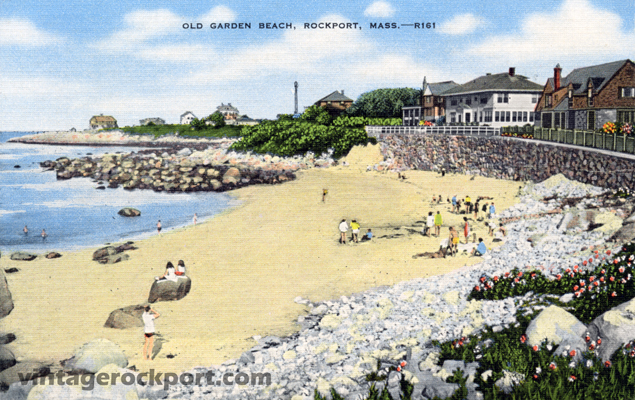
Old Garden Beach, Rockport, Mass., circa 1945

Old Garden Beach, Rockport, Mass.

This view of Old Garden Beach was published by Virginia Cleaves Little. She took over the Rockport Photo Bureau after her father, Charles Cleaves, died in 1937. She was active publishing her own images until at least 1946.

This linen postcard is not dated or postmarked. I am estimating the date to be around 1945.

Note the tower in the background. My guess is that the tower was the life saving station at Gap Cove, but it seems taller than any tower I’ve seen there.

Posted in Uncategorized | Tagged , | 4 Comments

Granite Delivery and Wharf, Rockport, Mass., circa 1908

Granite Delivery and Wharf, Rockport, Mass.

Here is a view of two three-masted schooners being loaded with granite. The scene is what we now know as Granite Pier and which was then the pier of the Rockport Granite Co. Compare this postcard with this other one (also shown below) from the same publisher. It appears that both of these pictures were taken the same day, from different vantage points. The same two schooners are visible in both pictures and you can see the same buildings on the pier in both.

The above postcard and the one I posted earlier were both published by Souther-Mears Co., a Boston company that was in business only from 1908 to 1910. The card was distributed by A.M. Simon, a New York City post card publisher. The card was printed in Germany using a process known as collotype, which was used because of the accuracy of the reproductions it produced.

This postcard is postmarked Aug. 20, 1913. Given that Souther-Mears was out of business by then, and that it appears to be from the same day as the earlier card, I estimate it is from 1908. Of course, even though the card was probably produced in 1908, the image could be from even earlier.

Posted in Uncategorized | Tagged , | 2 Comments

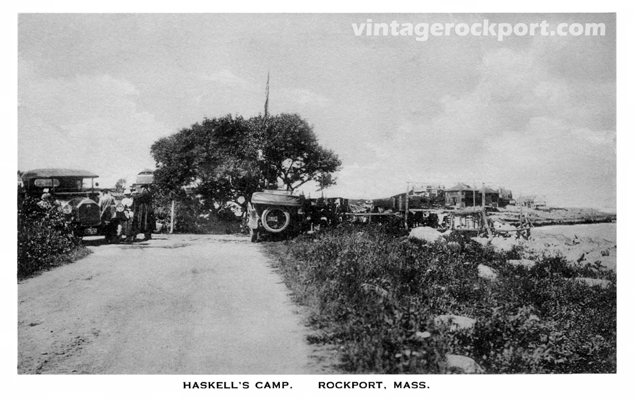
Haskell’s Camp, c. 1920 — And A Special Guest Post!

Haskell's Camp, Rockport, Mass.

[Note: What follows is a guest post written by Kimberly Hanson. Haskell’s Camp at Loblolly Cove was run by her husband’s great grandfather. After I first posted a view of Haskell’s Camp, Kimberly posted a comment about her family’s ties. After corresponding with her further, I learned that she has done extensive research into her husband’s family and uncovered some fascinating facts. Read on to learn more about the fascinating story behind Haskell’s Camp. Note that her article dates President Taft’s visit as 1912 but that another article says it was 1910.]

By Kimberly Hanson

Loblolly Cove of Lands End holds some uncommonly known and interesting bits of Rockport history. Rockport used to be a flourishing port and the spot called Loblolly Cove was the last bit of land that tourists saw on their way to Europe as their ships steamed out into the open wide ocean. On that spot stood a picturesque little wharf with an antique cabin close by the shade of beautiful trees. This place used to be a favorite haunt of tourists and locals and hosted many famous visitors.

The place was called Loblolly Camp and on the wharf, famous fish dinners were served by my husband’s great grandfather Emerson Haskell and his family for almost 50 years. In 1896, Captain Emerson used to invite officers of schooners that were in the port to Loblolly Cove for shore dinners. He served them lobsters and clams caught right in the cove. People passing by would get a whiff of the clams steaming on the rocks, and the lobsters broiling over a charcoal fire, and began begging for dinners too.

The camp was built piece by piece out of driftwood. Rough wooden tables and chairs sat upon the wharf and a canopy of sail cloth covered the tables to protect diners from the sun. A century old boathouse served as the kitchen.

President Taft visited in 1912.

It was in this spot at Loblolly Camp that President William Howard Taft was an honored guest. The president and a party of 32, including Mrs. Taft and their children, were brought over by John Hays Hammond Sr. who lived in Gloucester and was a friend of the president. This event was held in August of 1912. They partook of a lobster dinner, followed by a clambake, prepared in the real old fashioned way with plenty of green corn, sweet potatoes, lobster, fish fillets and juicy clams all steamed in a pile of seaweed out on the rocks.

Though Captain Emerson Haskell and his son, Captain Frank Haskell, tried to keep the president’s visit a secret, somehow word got out and hundreds of people filled the roads and surrounding hills and even stood by in dorries and sailboats to watch the presidential feast. Fortunately, president Taft was a jolly man and did not mind the spectators. He ate with his usual hearty appetite and canceled an afternoon drive to spend a few extra hours at Loblolly Camp, leaning out of his car and shaking hands with everyone before leaving.

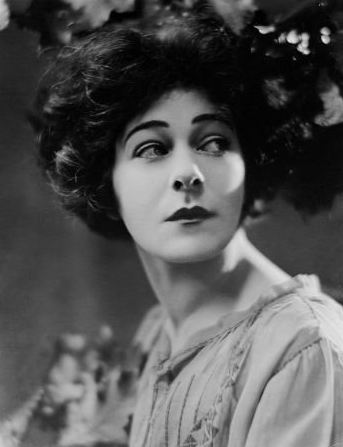
Alla Nazimova

Actress Alla Nazimova visited while filming.

Loblolly camp was a popular place and attracted other noteworthy visitors such as H. C Frick, the steel tycoon, and Tom Walsh, the Colorado mining tycoon, who brought his daughter Evelyn (Mrs. Edward Mclean), who was the owner of the Hope Diamond. The ambassadors for Belgium, Brazil, Siam and Romania were hosted. Other visitors included Hollywood actress Fay Bainte and the flamboyant Russian actress and silent film star Alla Nazimova, whom Natalie Hammond brought over as her house guest when the film Out of the Fog was being made at Straitsmouth Island. Groups of college girls would have an outing there every spring. The Appalachian Club of Boston held an annual clambake there. The John Boyle O’Reilly club came annually for clams and poetry reading.

Captain Frank Haskell and his wife, the former Miss Annie Goodridge of Melrose, whom the captain met right at Loblolly Cove, where she was a guest of her parents, ran the camp before and after his father Emerson’s death in 1929, up until at least World War II, when gas rationing and blackouts curtailed the activities at Loblolly for a bit. Captain Haskell took a night job in Boston working as an armed guard and special policeman at a war plant until his son Francis Haskell and his niece Dorothy Hanson came home from serving overseas in the great war. Most afternoons, however, he continued spinning his yarns, which were almost as famous as his fare with natives, summer folk and the occasional shore patrol or coastguardsman who might wander into his camp.

[Footnote: The postcard above was published by Rockport Photo Bureau. It is undated, but based on the markings on the reverse side, it is clear it was published at the same time as the other Haskell’s Camp postcard I posted. Although I had estimated the date of that earlier card to be around 1925, I now believe, based on the similarity of the reverse to other cards I have, that it was closer to 1920.]

Posted in Uncategorized | Tagged , , | 10 Comments

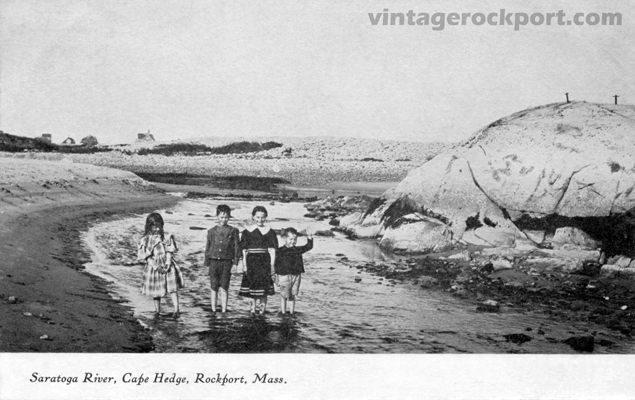
Saratoga River, Cape Hedge, Rockport, Mass., circa 1906

Saratoga River, Cape Hedge, Rockport, Mass.

In the some-things-never-change category, here, more than a century ago, are four young children playing in the Saratoga Creek, between Cape Hedge Beach and Long Beach, just as children do today.

The postcard has an Aug. 24, 1908, postmark. The reverse side of the card is an undivided back, which indicates it was printed prior to 1907, when divided-back cards were first allowed by postal regulations.

Posted in Uncategorized | Tagged , | Leave a comment