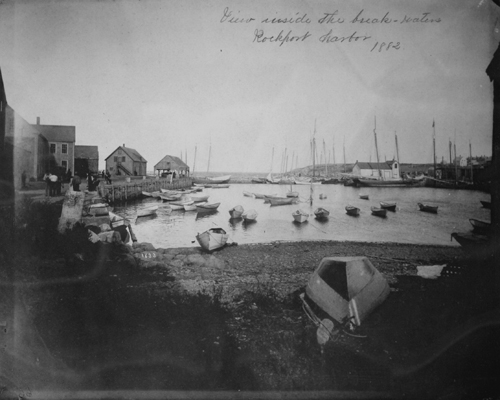
Found on the Web: View of Rockport Harbor, 1882

I have so far generally restricted this blog to postcards from my own collection. However, in the course of surfing the Web for research, I often come across historical images of Rockport posted elsewhere. Rather than keep these finds to myself, it makes sense to share them here.

This picture is one of the oldest I’ve come across online. It is captioned, “View inside the break-waters, Rockport harbor, 1882.” It comes from the image collection of the National Marine Sanctuaries division of the National Oceanic & Atmospheric Administration.

Posted in Uncategorized | Tagged | Leave a comment

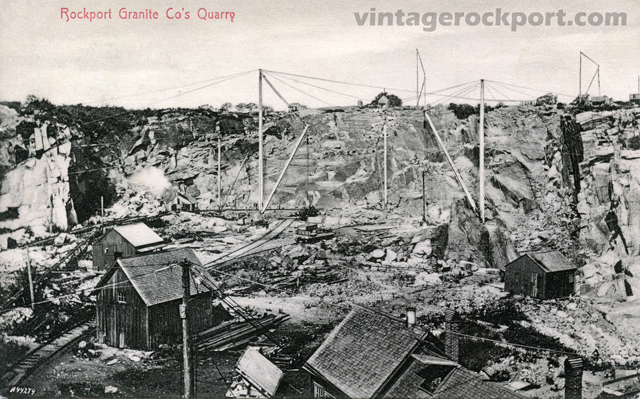
Rockport Granite Co’s Quarry (Flat Ledge), circa 1908

This postcard shows the Rockport Granite Company’s quarry, now known as Flat Ledge Quarry, around 1908. Compare this picture with this one of the same quarry. For other posts about the Rockport Granite Company and its quarries, see here.

This postcard is postmarked July 10, 1908. No publisher is identified.

Posted in Uncategorized | Tagged , | Leave a comment

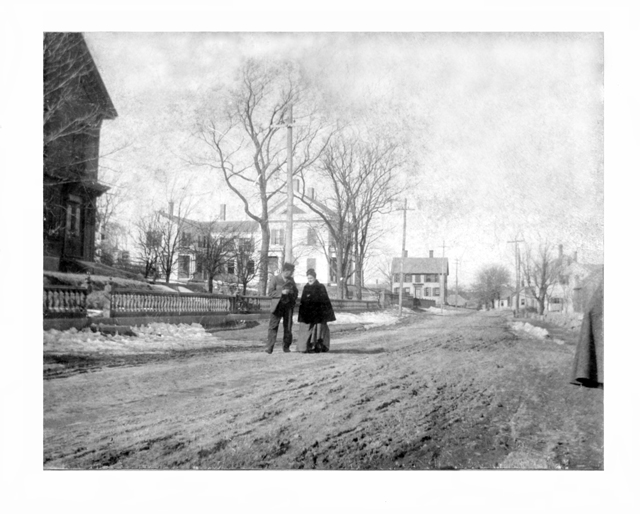
Swedish Lutheran Church, Pigeon Hill St., Pigeon Cove, Mass., circa 1900

This is an old photograph from the collection of Merry Seppala of Pigeon Cove. It shows the Swedish Lutheran Church that once stood on Pigeon Hill Street, where Pigeon Hill Court begins. In 1949, the church was moved to Stockholm Avenue and converted to a private residence.

As I noted in a previous post, this was one of three churches built in the Pigeon Cove area of Rockport by Swedish immigrants who came here to work in the quarries. The other churches were the Swedish Methodist Church at 145 Granite Street and the Swedish Evangelical Church at 111 Granite Street.

I do not know the date of this photograph. Merry has several others in her collection from around the turn of the century. This appears to be from about that time.

Posted in Uncategorized | Tagged , , | Leave a comment

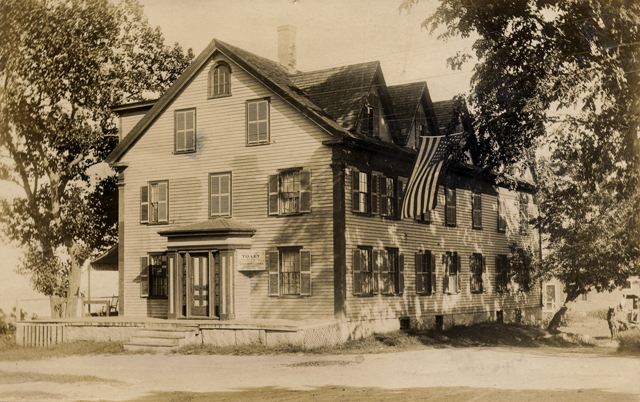
The Original Pigeon Cove House, Before it Became the Emerson, 1911

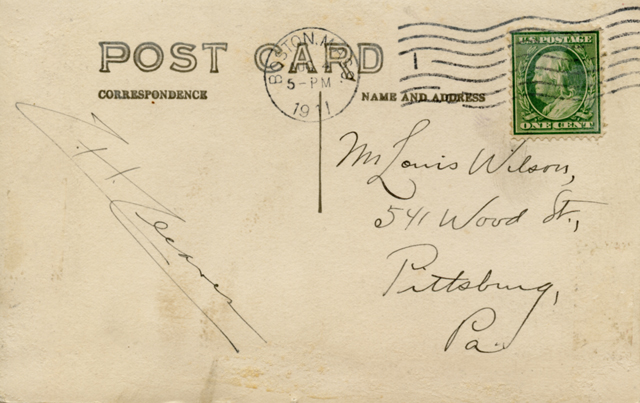
This real-photo postcard is remarkable for a couple reasons. For one, it shows a rare view of a historic Pigeon Cove building. For another, it appears to be signed on the reverse by Charles H. Cleaves, the Rockport lawyer and photographer who founded the Rockport Photo Bureau.
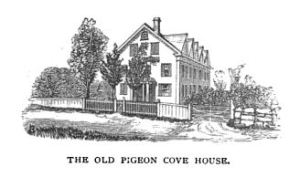
Illustration from 1873 book, Pigeon Cove and Vicinity.

In 1805, at approximately the location of the current Pigeon Cove Post Office, Capt. Daniel Wheeler opened a tavern. In 1838, Mr. and Mrs. William Norwood took it over, operating it as a tavern and boardinghouse. The business was popular with tourists and attracted notable visitors, including Richard Henry Dana, William Cullen Bryant, and Richard Henry Dana Jr., who honeymooned there in 1840, the year he published his memoir, Two Years Before the Mast.

With their business thriving, the Norwoods decided to build a larger boardinghouse about 600 years farther up Granite St. In 1846, they build the building you see pictured here, which they operated as the original Pigeon Cove House. Over the years, they continued to enlarge and add-on to the house, to accommodate their growing business. After Mr. Norwood’s death, Mrs. Norwood continued to operate the business until 1866, when she sold it to Mrs. E.S. Robinson.

In 1871, to make way for construction of a new and larger Pigeon Cove House, Mrs. Robinson moved the building to the corner of Philips Avenue and Green St. This is where the picture above was taken and where the building still stands — although you would not recognize it. The building was used there as a rooming house until 1911, when it was purchased by a new owner, extensively renovated, and reopened as the Hotel Edward. In 1964, the Wemyss family bought the hotel and reopened it as the Ralph Waldo Emerson Inn.
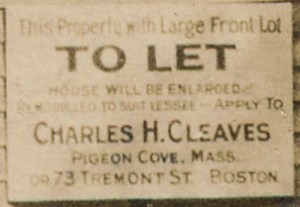
To the right you see an enlargement of the sign on the building in this picture. It indicates that the entire property, including a “large front lot,” is available, and that the “house will be enlarged” to suit the lessee. It indicates that inquiries should be sent to Charles H. Cleaves, who we may presume was handling it in his capacity as an attorney.

It seems safe to assume that Cleaves also took this picture. He was an avid photographer and produced many postcards through his Rockport Photo Bureau. This was not a commercial postcard, however, but a real photo postcard, meaning that it was an actual photograph mounted on postcard stock for mailing. The reverse (see below) is addressed to someone in Pittsburgh, Penn., and postmarked Aug. 4, 1911. It has no note, but bears what appears to be Cleaves’ signature. My guess is that he was sending this to someone who was interested in the property.
Posted in Uncategorized | Tagged , | Leave a comment

Vista of the Town Through the Back Beach Willows, Rockport, Mass., c. 1934

Today, the 4th of July, Back Beach in Rockport will be the scene of an enormous bonfire watched by hundreds. But Back Beach once looked much different than it does today. Where the road along the beach now offers an unobstructed view of the ocean beyond, the road was once lined with willow and oak trees, as this postcard shows.

Ready for today’s bonfire at Back Beach.

I cannot determine when the willows were lost or what happened to them. Were they wiped out by a storm? A disease? Surely some reader remembers and can help with this mystery.

As for this postcard, it was published by the Rockport Photo Bureau. It has no date, but based on the style of the printing and markings on the reverse, compared to other cards from this same publisher, I estimate it to be the mid-1930s. Another clue is in the right center, where there appears to be a 1930s-style, two-seat roadster parked.

With regard to the bonfire, this is another tradition whose origins are not clear. In a previous post, I noted an 1899 New York Times article about the annual summer visit to Rockport of the U.S. Navy’s North Atlantic Squadron. The article described the festivities the town staged to greet the sailors, including a dance and a banquet. “Bonfires and fireworks also lighted up the shores,” the article said, “although the display was greatly interfered with by the heavy fog.”

Posted in Uncategorized | Tagged | 2 Comments

Granite Street and the Bulfinch House, Pigeon Cove, Mass., circa 1900

This is not a postcard, but a photograph from the collection of Pigeon Cove native Merry Seppala. As I’ve mentioned before, Merry has graciously allowed me to scan some of her old photographs and postcards.

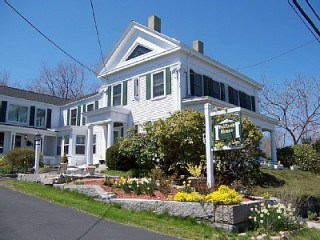
A contemporary view of the Bulfinch House.

The elegant Greek Revival home at the center of this picture, which still stands at 96 Granite St. in Pigeon Cove, is full of history. Known today as the Bulfinch House, the house was built in 1840 and supposedly was designed by Charles Bulfinch, one of the leading architects of his time. Among his many accomplishments, Bulfinch designed the original dome and portico of the U.S. Capitol, the Massachusetts State House, and Boston Common. Born in 1763, Bulfinch died in Boston in 1844. If he did, in fact, design this house, it would have been near the end of his life.

Equally as interesting is the man who commissioned the house, Ezra Eames. Eames was just 39 years old when he built this house. He had grown wealthy by buying up granite ledges in Pigeon Cove just as the area’s granite industry was beginning to grow. He also purchased the then-open fields at the top of Pigeon Hill. Eames went on to form the quarrying company Eames, Stimson & Co., in partnership with John Stimson and Beniah Colburn, which later become the Rockport Granite Co., and he was later a founder of the Cape Ann Granite Co. Eames also helped form the original Rockport Railroad Company in 1847 and was the first president of the Rockport National Bank in 1851.

If I have my lineage straight, Eames was the maternal grandfather of Charles Cleaves Jr., the Rockport lawyer and photographer who founded the Rockport Photo Bureau and who photographed so many of the images you see on this blog. Cleaves’ mother Emma was one of the seven children of Ezra and his wife, Miriam Colburn Eames.

The photo is not dated, so I’m guessing at the date. I’ve also cleaned up some stains and scratches that were on the original.

Posted in Uncategorized | Tagged | Leave a comment

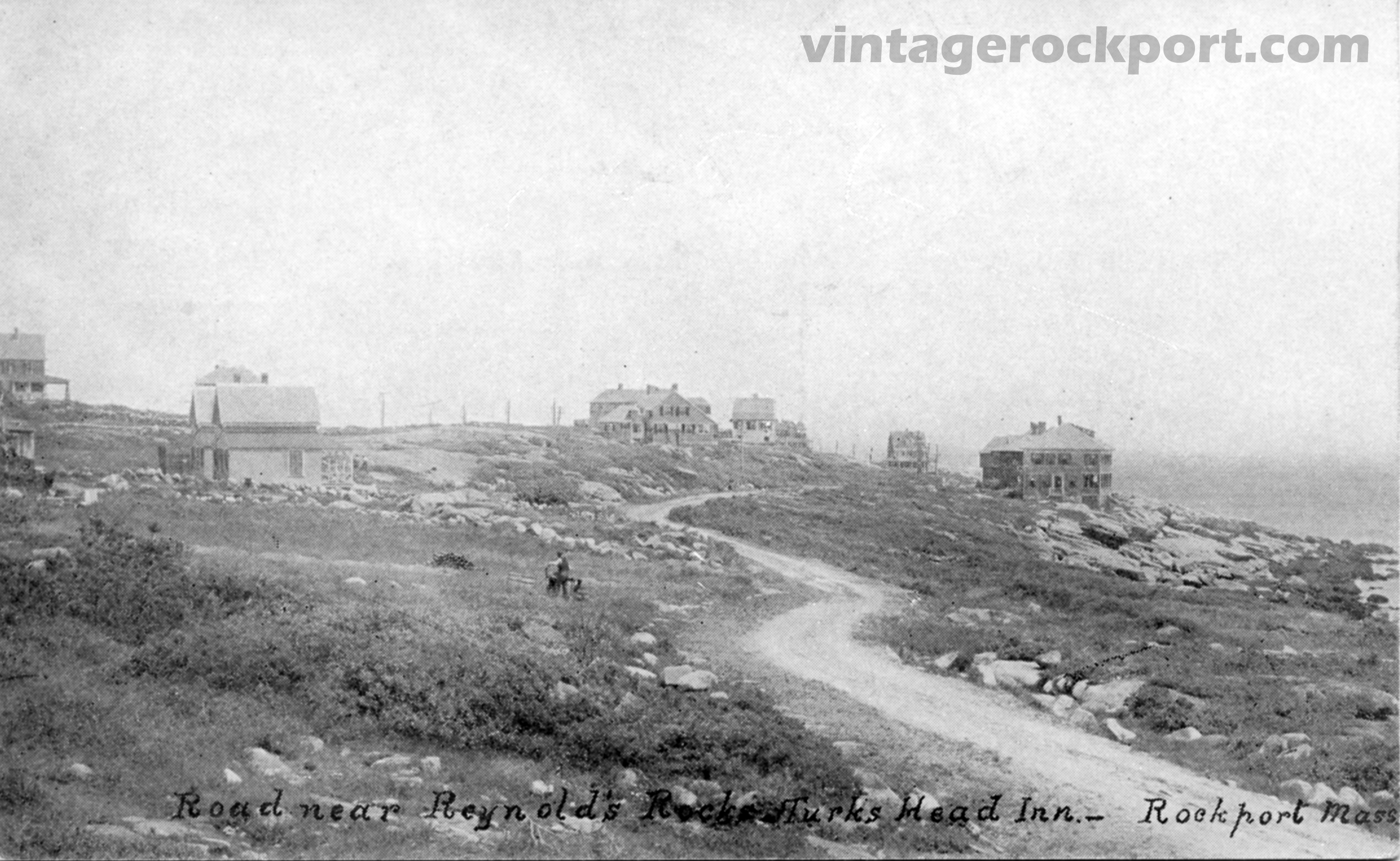
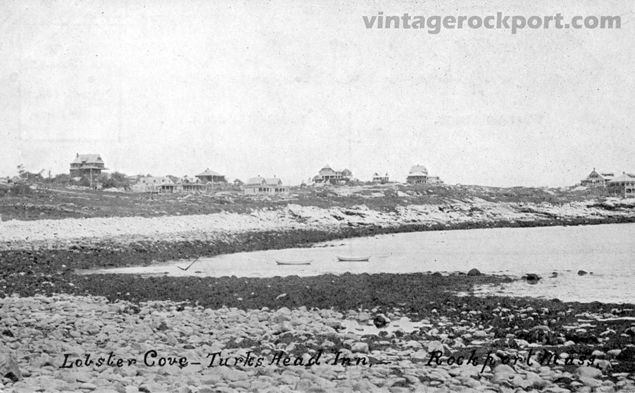
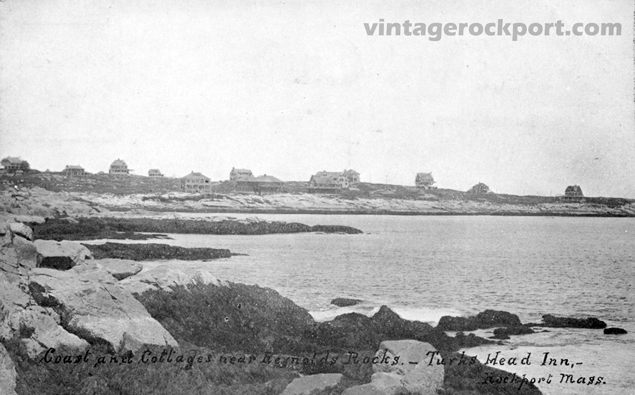
Three Views of Eden Road and Loblolly Cove, Rockport, Mass., circa 1910

Here are three views of Eden Road and Loblolly Cove. The three came to me as a set. No publisher or date is identified, but the markings on the front and rear, not to mention the views, make clear that they all came from the same publisher. Unfortunately, the printing quality was poor to begin with and the pictures have faded over time.

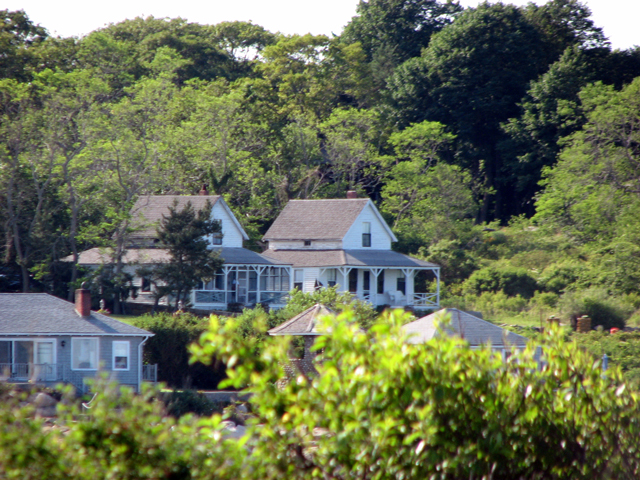
The top one is interesting for its view of Eden Road. There is a man in the foreground, who appears to be working at something. To his left you can make out the twin cottages that still stand there. (See image right.) The first house on the right and the house barely visible just past it also still stand. The first house is 50 Eden Road (see image below) and the next one, at 48 Eden Road, is now the Eden Pines Inn. According to Zillow, the house at 50 Eden Road was built in 1906.

Two of the three postcards describe their locale as “near Reynold’s Rocks” and the Turks Head Inn. I have never heard the name Reynold’s Rocks and have been able to find no reference to the name in any other source or on any map. If any reader can provide more information about Reynold’s Rocks, please post a comment below or send me an email.

The second card looks towards Eden Road from across Loblolly Cove. Here you can see those same twin cottages on the left side of the picture and the 50 Eden Road house at the extreme right.

The final picture looks towards Eden Road from Loblolly Point. Now, the two houses at 48 and 50 Eden Road are just to the left of center and just one of the twin cottages is visible along the left edge of the image.

Posted in Uncategorized | Tagged , , | 8 Comments

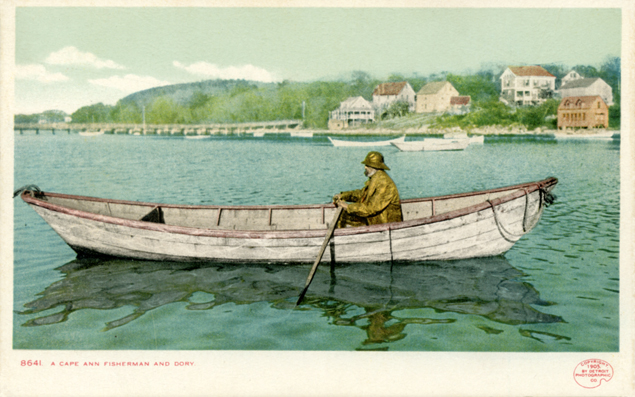
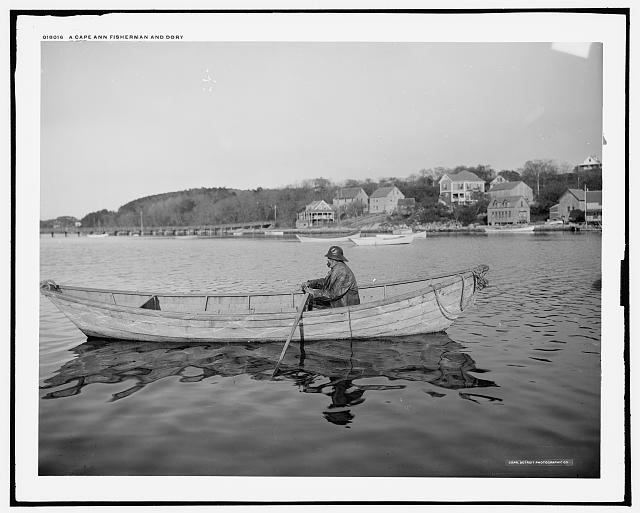
A Cape Ann Fisherman and Dory, 1905

Here is another view of what looks to be the same fisherman pictured in this postcard from the same publisher. Both postcards are from the Detroit Publishing Company and are dated 1905. (See other Detroit Publishing postcards here and here.)

Below is the original photograph that was the source for this postcard.

Posted in Uncategorized | Tagged | Leave a comment

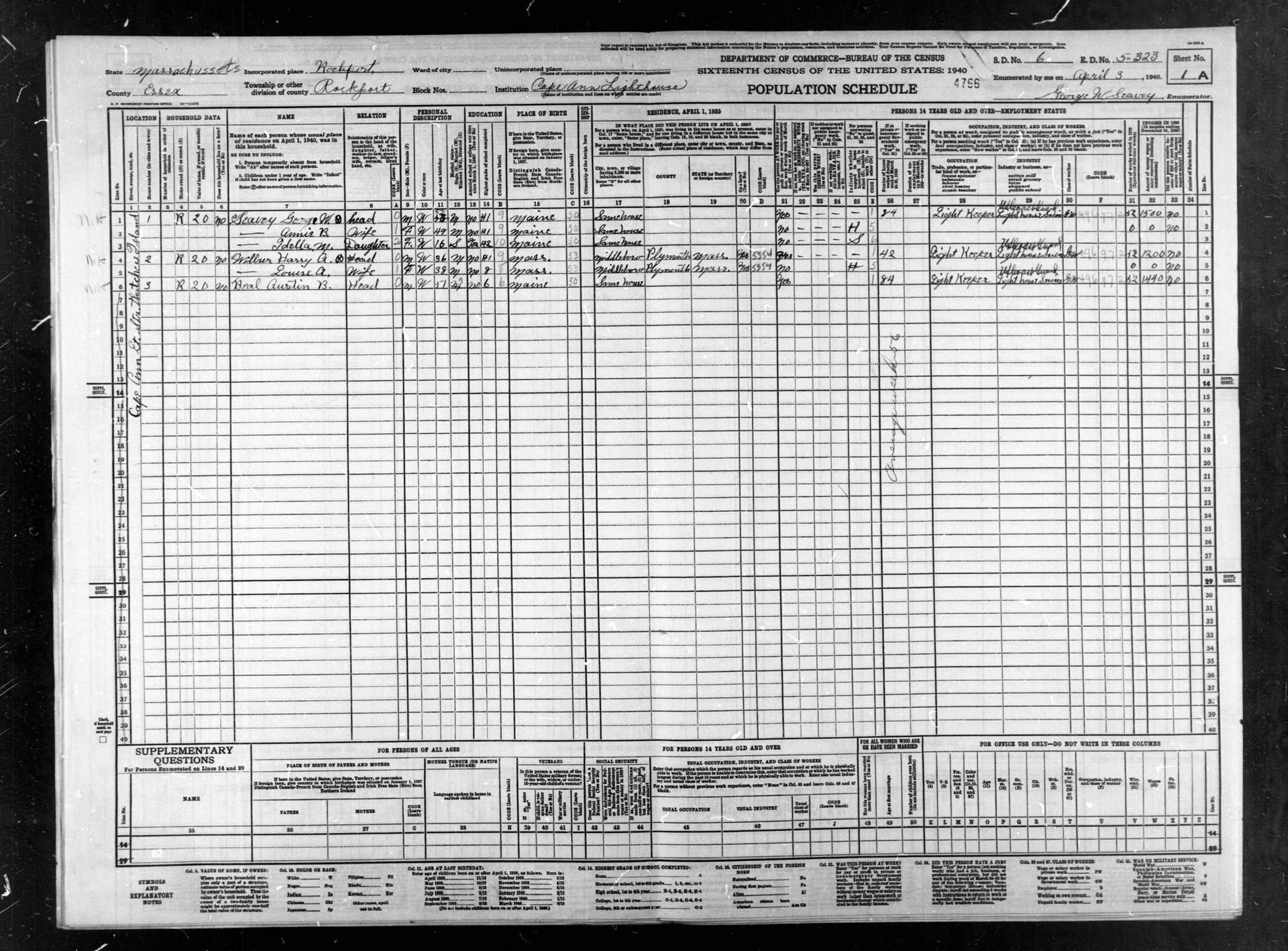
1940 Census Records Show Residents of Thacher Island

In April, the U.S. National Archives published online the full set of records from the 1940 United States census. The records are published as images and have not been indexed, so they are a bit difficult to search. However, you can easily find the records for a particular location and examine the images for that location to search for names and addresses.

Above is the record for Thacher Island. If you click on it, you should be able to open it in a larger size for easier viewing.

It lists six residents of the island:

  • George W. Seavey, light keeper, age 53, together with his wife Annie, age 49, and daughter Idella, age 16.
  • Harry A. Wilbur, light keeper, age 36, together with his wife Louise, age 38.
  • Austin B. Beal, light keeper, age 51.

The document also tells how much each man earned for his work as light keeper. Geary was paid $1,500 a year, Wilbur $1,200 a year and Beal $1,440.

Seavey was the principal light keeper from 1935 to 1945, according to Paul St. Germain’s book, Twin Lights of Thacher Island, Cape Ann. Beal succeeded him as principal keeper in 1945 and served through 1948.

Posted in Uncategorized | Tagged , | Leave a comment

Speedwell Engine No. 2, Pigeon Cove, Mass., circa 1915

Here is another postcard from the collection of Rockport’s Merry Seppala. The caption on it says, “Auto combination hose and chemical wagon built by members of the Speedwell Engine Company, Pigeon Cove, Mass.” The card was published by Rockport Photo Bureau. It has no date, but the reverse side says that it was printed in Germany, which indicates that it was printed prior to 1917 and the advent of World War I.

In the Nov. 1, 1913, issue of a magazine called The Power Wagon, in a section entitled “Motor Fire Apparatus Notes,” I found a one-line reference that said, “Pigeon Cove has a new motor chemical.” I do not know whether that is the same vehicle pictured here, but, if so, that would tell us the date of the engine.

I searched photographs of antique fire engines from that era looking for others that matched the appearance of this one. I found several that looked similar, from various manufacturers, but none that looked identical. If the caption is correct — that the members of the Speedwell Company built this themselves — that was quite an accomplishment.

Posted in Uncategorized | Tagged , , | Leave a comment