The Old Stone Bridge between Rockport and Pigeon Cove

Several old postcards show the granite bridge that still connects Rockport and Pigeon Cove. But this is the only one I’ve seen that includes the locomotive that hauled granite between Flat Ledge Quarry and Granite Pier.

The Rockport Granite Company, which operated from 1865 to 1933, owned this quarrying operation. It built this 65-foot arched bridge in 1872. It took just 11 weeks to build and, at the time, was one of the largest bridges in the state, according to the Gloucester Times,

In the picture, the locomotive is heading away from the pier, towards the quarry. In the background, through the bridge, you can see the masts of a schooner and the derricks used to load the granite onto the boats.

The picture is by the Rockport Photo Bureau. The postcard is not dated. Because it is an early, divided back postcard, printed in Germany, it is probably from about 1910.
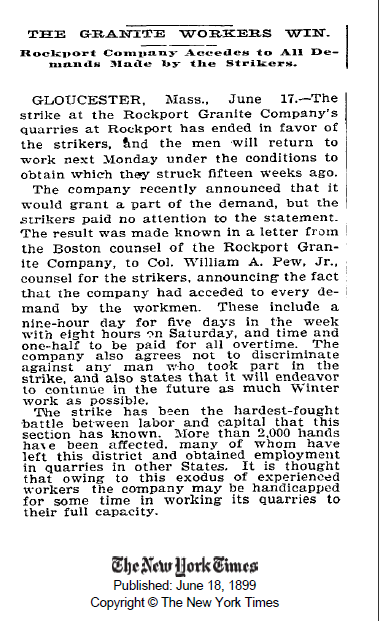
An an interesting aside, I came across this clip from the June 18, 1899, New York Times, reporting on the end of a 15-week strike by workers at the Rockport Granite Company. As you can see from the clip, the workers won, with the company giving in to all their demands. But few workers these days would consider it a victory. They still had to work six days a week, nine hours a day weekdays and eight hours on Saturdays, with time-and-a-half pay for overtime.
Posted in Uncategorized | Tagged , , , | 3 Comments

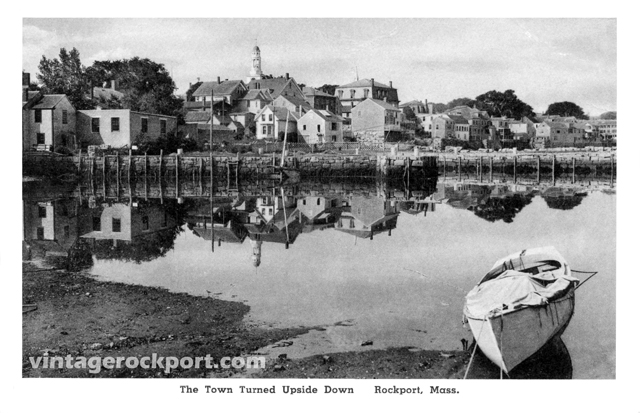
The Town Turned Upside Town, Rockport, Mass., circa 1945

This is one of my favorite images of Rockport. The photograph is by Virginia Cleaves Little. Although the postcard is not dated, I am guessing it was shot between 1940 and 1945, based on other photographs by her.

Worth noting is that Little was the second generation in her family to produce Rockport postcards. Her father, Charles Cleaves, was a photographer who produced many postcards in the early 1900s under the imprint Rockport Photo Bureau.

According to Paul St. Germain in his wonderful book, Twin Lights of Thacher Island, Cape Ann, Cleaves established the Rockport Photo Bureau in 1906 and produced thousands of postcards. His glass plate negatives are held by the Sandy Bay Historical Society.

Posted in Uncategorized | Tagged | 4 Comments

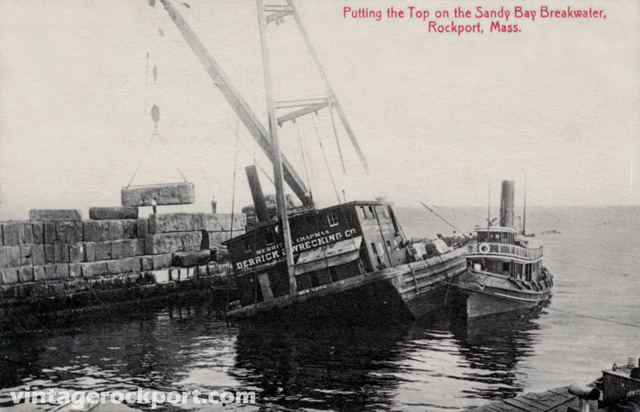
Putting the Top on the Sandy Bay Breakwater, circa 1912

It might have been the Big Dig of its day. In 1882, the U.S. Congress authorized a survey of Sandy Bay “with a view to the construction of a breakwater for a harbor of refuge.” The goal was to create a massive safe harbor where ships en route between Boston and Portland could duck into in bad weather. By 1886, when scows began dumping the granite rubble that would form the breakwater’s base, the plans and the budget remained works in progress. The original estimated cost of $4 million had risen to $5 million and engineers disagreed on the best method of construction.

In 1892, after some 500,000 tons of stone had been dumped to form the breakwater’s substructure, a final plan was approved for construction of the superstructure. By 1898, crews had completed construction of 600 feet of the superstructure — built of granite stones each weighing an average of six tons — only to have it partially knocked down by a severe storm.

That sent engineers back to the drawing board once again. They decided to replace the six-ton stones with a layer of 10-ton stones capped by a layer of 20-ton stones. By this time, the budget for the project had risen to roughly $7 million. Congress authorized more funds, but only after ordering a study to determine whether continuation of the project was feasible and advisable. A study board concluded yes on both points.

In 1916, 34 years after Congress gave it the go-ahead and with two-thirds of it completed, the construction of the Sandy Bay breakwater was abandoned. By that time, steam power was replacing sail power and the need for a harbor of refuge had diminished. Of the 9,100 foot long breakwater called for in the plans, 6,100 feet were completed.

The breakwater remains standing today, a popular spot among divers and perhaps a granite testament to boondoggles then and now.

This postcard, showing a derrick putting one of those 20-ton top stones in place, bears a postmark of Sept. 9, 1912.

Posted in Uncategorized | Tagged | 2 Comments

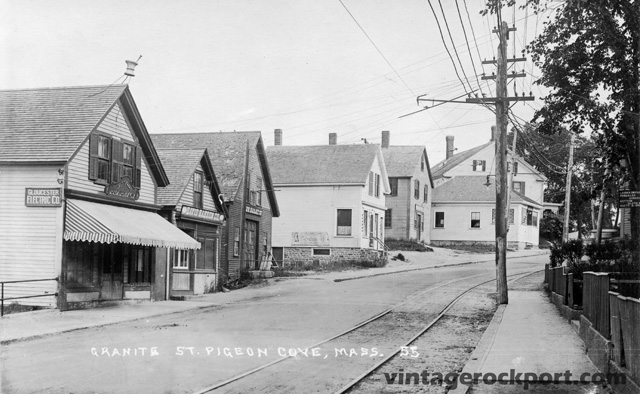
Granite St., Pigeon Cove, Mass., circa 1905

This postcard of Pigeon Cove is not dated. The back side is undivided, which indicates it was produced sometime between 1901 and 1907.

The first building (the one that says Gloucester Electric on the side) has a sign on the front identifying it as Mason’s Pharmacy. Out of curiosity, I Googled the name and came up with the clip you see here from the Feb. 4, 1904, issue of The Pharmaceutical Era. “For the fourth time within six months,” it reports, “the drug store of Andrew J. Mason, Pigeon Cove, was entered by burglars.” (Click the excerpt to see the full page.)

The next building up bears the sign, “David Babson Co.” I can’t make out the type of business. Next from there, the sign says, “Edw. Bailey.” The white building has markings on the front that look like those of a barber’s pole. The building after that says, I believe, “Linen Store.”

Posted in Uncategorized | Tagged | 3 Comments

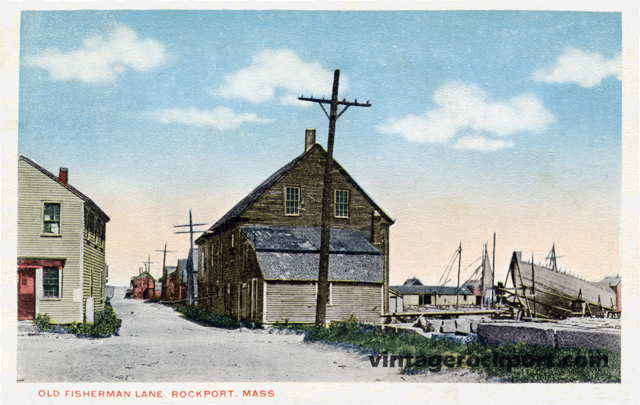
Old Fisherman Lane, Rockport, Mass., 1919

The postmark on this card is dated 1919. The card shows what is now known as Bearskin Neck. To the right is a boat being built.

Posted in Uncategorized | Tagged | 3 Comments

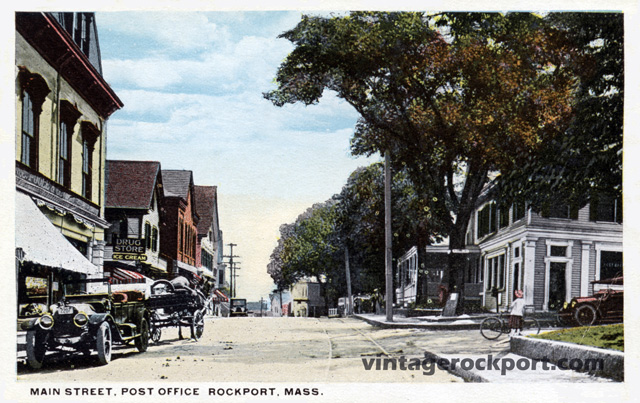
Main Street, Post Office, Rockport, Mass., circa 1920

The postcard is undated. Judging from the cars, it appears to be around 1920. Poole’s Pharmacy is to the left and the Post Office to the right. Trolley tracks run down the right side of the street.

Posted in Uncategorized | Tagged | 7 Comments